Culture Ark · D-1628 · Holidays and traditions · Browse the gallery · The full 2,000-pick list
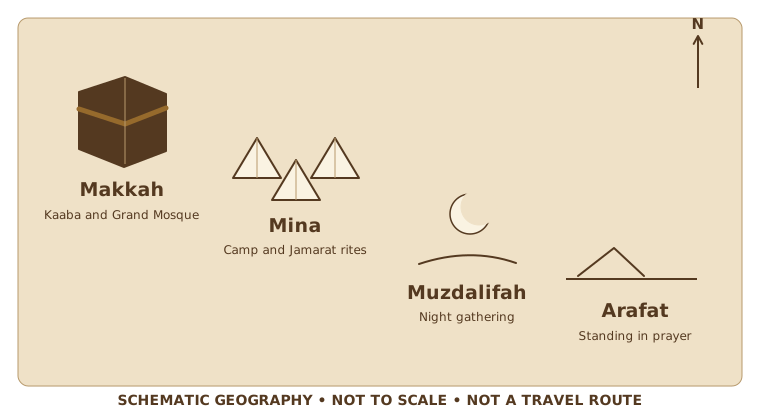
Original educational diagram, not a photograph. The sketch identifies relationships between places. It omits roads, boundaries and access arrangements and must not be used to navigate.
Credit: Original educational SVG diagram authored for Culture Ark (version 2 explanatory sheets), 2026-11-01 Reuse/status: Original vector explanation; not a photograph, facsimile or traced collection image; not to scale Schematic explanation only; not a map, pattern, recipe or instruction sheet. Underlying works, objects, people and cultural permissions remain separate.
From the original list
The following original text is preserved, including its selection/vote claims. Preservation is not independent verification of every assertion.
Why: Millions in white circle the Kaaba in the oldest mass pilgrimage still running.
What to preserve: rituals, pilgrim numbers by year
Year and origin: 632 · Saudi Arabia
Vote: 8/9 (historian 3 · future kid 2 · curator 3)
Learn more: Hajj on Wikipedia
Explanatory sheets
2 original explanatory sheets prepared for this pick, each with its own diagram. Codes in square brackets such as [J1] point to the numbered sources at the end of the page.
A pilgrimage connects distinct sacred places
More than the Kaaba. Hajj is the annual Muslim pilgrimage associated with Makkah and the surrounding holy sites, in Dhu al-Hijjah, the twelfth Islamic lunar month. It is one of Islam’s five pillars. Ihram is a sacred state involving intention and observance, not merely a name for white clothing. [J1, J2]
Different places carry different rites. Mina is associated with the camp and Jamarat rites. Arafat is central to standing in prayer and supplication. Muzdalifah is a gathering place after Arafat, between Arafat and Mina. Tawaf takes place around the Kaaba in Makkah. These relationships explain the pilgrimage’s geography without reducing Hajj to one crowd scene. [J1, J2]
Educational overview only, not a current itinerary, legal ruling or health guide. Details vary by form of Hajj and religious interpretation.
Two movement patterns with different meanings
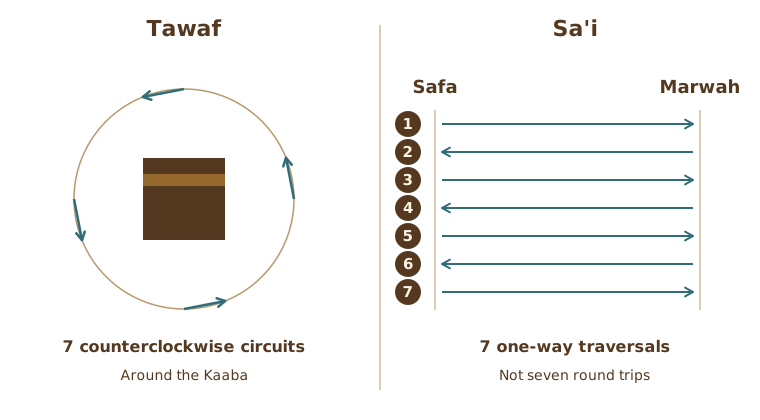
The Kaaba square is a plan symbol, not an architectural drawing. Sa’i paths are separated vertically only for counting; the diagram is not a floor plan.
Tawaf is circular. Tawaf circles the Kaaba seven times counterclockwise. In Muslim practice it expresses devotion to God; the Kaaba is the focus of the movement, not a separate deity. The shared circular form makes a collective act visible while each pilgrim participates in worship. [J1]
Sa’i is back and forth. Sa’i consists of seven one-way traversals between Safa and Marwah, beginning at Safa and ending at Marwah. It recalls Hajar’s search for water for her son Ismail in Islamic tradition. The two patterns are distinct: a circuit returns to its start, while a traversal reaches the opposite end. [J1, J2]
This schematic explains counting and meaning, not the full requirements or ordering of Hajj rites.
Where to learn more
- https://apiarybee.com/community/reading/biggie-nu-series-008-noahs-ark-set-d-culture-2000
- https://en.wikipedia.org/wiki/Hajj
Sources and rights
- J1 · Balady Atlas Saudi Arabia — Mapping Hajj — Site relationships, Tawaf direction, Sa’i meaning and lunar-month context; no current travel data reused.
- J2 · Nusuk Hajj — The Journey — Official account of the named sites and seven Sa’i traversals; used for cultural explanation only.
Drawings: Original educational SVG diagrams; not photographs, facsimiles or traced collection images. Sources consulted 2026-11-01. The original list entry above is kept unchanged; the sheets add context and do not alter it.
Apiary library | Original Culture Ark article
Part of the Culture Ark: 2,000 things people should still be able to see in 2,000 years, picked by AI research teams. This page keeps the original list entry for D-1628 word for word and adds context. Browse the gallery. The Culture Ark is an Artificial Mind Hive (AMH) project. AMH is owned by Austin Little.

Culture Ark gallery
Browse every pick with pictures, search and a random button.
Open the gallery →