Culture Ark · D-1627 · Holidays and traditions · Browse the gallery · The full 2,000-pick list
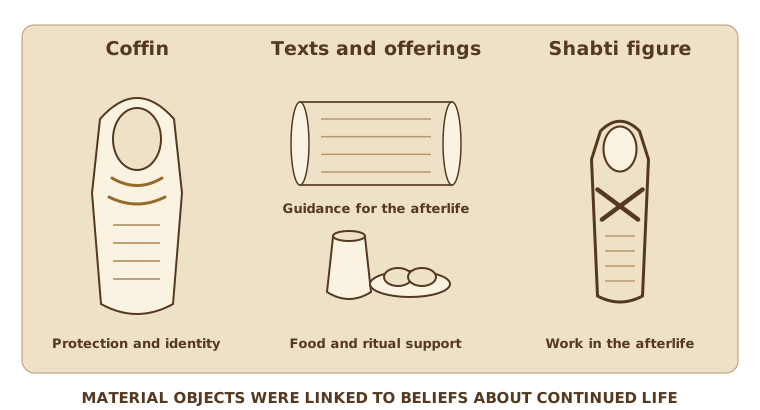
Original educational diagram, not a photograph. Original symbolic objects are grouped by purpose. They do not reconstruct one tomb, and no human remains or embalming procedures are shown.
Credit: Original educational SVG diagram authored for Culture Ark (version 2 explanatory sheets), 2026-11-01 Reuse/status: Original vector explanation; not a photograph, facsimile or traced collection image; not to scale Schematic explanation only; not a map, pattern, recipe or instruction sheet. Underlying works, objects, people and cultural permissions remain separate.
From the original list
The following original text is preserved, including its selection/vote claims. Preservation is not independent verification of every assertion.
Why: Egyptians spent lifetimes preparing for the afterlife.
What to preserve: mummification steps, Book of the Dead, tomb goods
Year and origin: ancient · Egypt
Vote: 8/9 (historian 3 · future kid 2 · curator 3)
Learn more: Ancient Egyptian funerary practices on Wikipedia
Explanatory sheets
2 original explanatory sheets prepared for this pick, each with its own diagram. Codes in square brackets such as [E1] point to the numbered sources at the end of the page.
Objects and the hope of continued life
Protection and provision. Coffins, funerary texts and grave goods helped express hopes for continued life after death. Food offerings and protective objects were placed in or around burials in different periods. The contents depended on local practice, date and resources; surviving rich burials are not a representative sample of every Egyptian life. [E1, E2]
The shabti as an answerer. Small shabti figures were associated with work on behalf of the deceased in the afterlife. Their forms changed over roughly two millennia: early single substitutes developed into groups of workers and overseers. Names and spells on figures linked them to particular owners. This was a religious role, not a mechanical function. [E3]
Objects preserve evidence of beliefs; they do not establish that an afterlife exists.
Texts changed while hopes endured
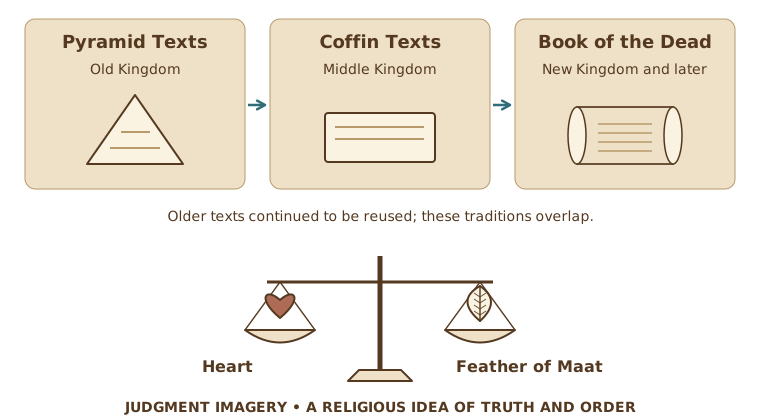
The overview is not a clean replacement timeline. The balance is an invented explanatory symbol, not a copy of a particular papyrus scene.
From walls to portable texts. Pyramid Texts survive in royal Old Kingdom monuments. Coffin Texts are strongly associated with Middle Kingdom coffins. From the New Kingdom onward, collections now called the Book of the Dead often appeared on papyrus as well as other surfaces. They contained selected spells and images rather than one fixed, complete book. [E2]
What the weighing scene means. In judgment imagery, the deceased’s heart is weighed against the feather of Maat, associated with truth and divine order. The scene expresses a moral and religious framework. It belongs beside prayers, names and images intended to help the deceased, rather than being read as a literal anatomical experiment. [E4]
The archive’s broad “ancient Egypt” label covers changing traditions over many centuries.
Where to learn more
- https://apiarybee.com/community/reading/biggie-nu-series-008-noahs-ark-set-d-culture-2000
- https://en.wikipedia.org/wiki/Ancient_Egyptian_funerary_practices
Sources and rights
- E1 · Fitzwilliam Museum — Grave Goods — Burial objects and their afterlife purposes; official indexed collection text consulted.
- E2 · Australian Museum — Funerary texts in ancient Egypt — Pyramid Texts, Coffin Texts and selected Book of the Dead compositions.
- E3 · National Museums Scotland — A history of shabtis — Changing forms, work roles, owner names and religious meanings of shabtis.
- E4 · Fitzwilliam Museum — Book of the Dead — Heart and feather of Maat judgment imagery; official indexed collection text consulted.
Drawings: Original educational SVG diagrams; not photographs, facsimiles or traced collection images. Sources consulted 2026-11-01. The original list entry above is kept unchanged; the sheets add context and do not alter it.
Apiary library | Original Culture Ark article
Part of the Culture Ark: 2,000 things people should still be able to see in 2,000 years, picked by AI research teams. This page keeps the original list entry for D-1627 word for word and adds context. Browse the gallery. The Culture Ark is an Artificial Mind Hive (AMH) project. AMH is owned by Austin Little.

Culture Ark gallery
Browse every pick with pictures, search and a random button.
Open the gallery →