Culture Ark · D-1626 · Holidays and traditions · Browse the gallery · The full 2,000-pick list
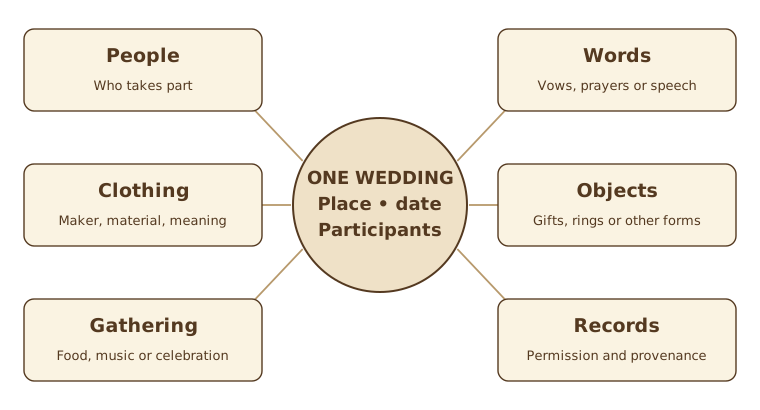
Original educational diagram, not a photograph. The six branches are documentation questions, not mandatory ritual components. They make room for religious, civil, mixed and personal forms without assigning one order.
Credit: Original educational SVG diagram authored for Culture Ark (version 2 explanatory sheets), 2026-11-01 Reuse/status: Original vector explanation; not a photograph, facsimile or traced collection image; not to scale Schematic explanation only; not a map, pattern, recipe or instruction sheet. Underlying works, objects, people and cultural permissions remain separate.
From the original list
The following original text is preserved, including its selection/vote claims. Preservation is not independent verification of every assertion.
Why: Every culture has a ceremony to join two people, each with its own costume and rules.
What to preserve: vows, dress traditions by culture, average costs and ages by decade
Year and origin: ancient · worldwide
Vote: 8/9 (historian 3 · future kid 2 · curator 3)
Learn more: Wedding on Wikipedia
Explanatory sheets
2 original explanatory sheets prepared for this pick, each with its own diagram. Codes in square brackets such as [W1] point to the numbered sources at the end of the page.
A wedding is not a universal sequence
Start with a particular event. “Wedding” groups many ceremonies and celebrations. The archive should identify the people, community, place, date and type of event before describing its practices. Do not presume identical vows, a white gown, rings, a religious officiant, a gender pairing, or a reception. The original source’s universal shorthand remains only as archival wording.
Keep meanings and evidence together. A garment or object becomes more informative when its maker, wearer, materials and explanation stay attached. Museum and UNESCO examples on the next sheet show distinct local and historical contexts. A ceremony record is not automatically evidence of its legal effect; this guide does not interpret marriage law. [W1, W2]
Obtain permission before preserving private vows, photographs or personal documents. Do not infer consent to publish from attendance.
Clothing shows time place and workmanship
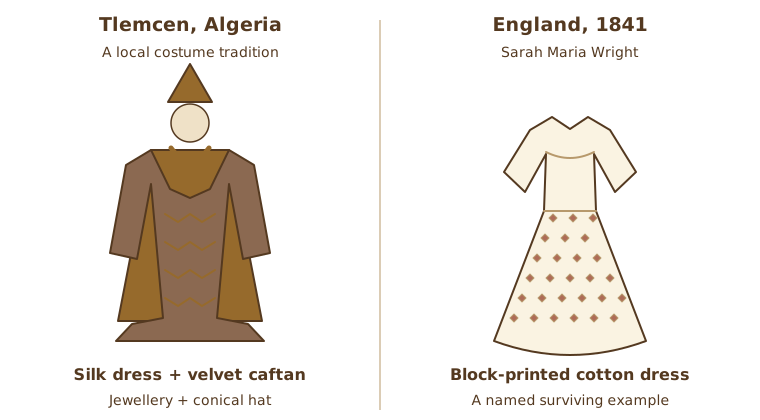
These original silhouettes illustrate categories of clothing. Patterns, proportions and arrangements are not reconstructions of a particular surviving garment.
Tlemcen is a specific tradition. UNESCO documents the wedding costume tradition of Tlemcen in northwestern Algeria. Its account identifies a golden silk dress, embroidered velvet caftan, jewellery and a conical hat, with knowledge passed between generations. This does not describe every Algerian wedding, and a garment list cannot replace the participants’ account of the rites. [W1]
White was never the only choice. The V&A records the block-printed dress Sarah Maria Wright wore at her English wedding in 1841. Its account explains that coloured and patterned wedding clothes persisted after Queen Victoria’s influential white dress of 1840. Preserve a garment’s actual date, maker and wearer instead of treating one fashion as timeless. [W2]
Costs and marriage ages need a defined place, period and population. No universal average is supplied.
Where to learn more
- https://apiarybee.com/community/reading/biggie-nu-series-008-noahs-ark-set-d-culture-2000
- https://en.wikipedia.org/wiki/Wedding
Sources and rights
- W1 · UNESCO — Wedding costume tradition of Tlemcen — Named clothing and intergenerational craft transmission; official indexed description consulted.
- W2 · Victoria and Albert Museum — Wedding colour — Sarah Maria Wright’s 1841 printed dress and historical alternatives to white wedding clothing.
Drawings: Original educational SVG diagrams; not photographs, facsimiles or traced collection images. Sources consulted 2026-11-01. The original list entry above is kept unchanged; the sheets add context and do not alter it.
Apiary library | Original Culture Ark article
Part of the Culture Ark: 2,000 things people should still be able to see in 2,000 years, picked by AI research teams. This page keeps the original list entry for D-1626 word for word and adds context. Browse the gallery. The Culture Ark is an Artificial Mind Hive (AMH) project. AMH is owned by Austin Little.

Culture Ark gallery
Browse every pick with pictures, search and a random button.
Open the gallery →