Culture Ark · Browse the gallery · 60 illustrated picks on Apiary
CA0239 · architecture and places
Creator/community: Roman imperial patrons, military builders and frontier communities Place/era: Northern Britain; construction initiated around 122 CE
Generated interpretation
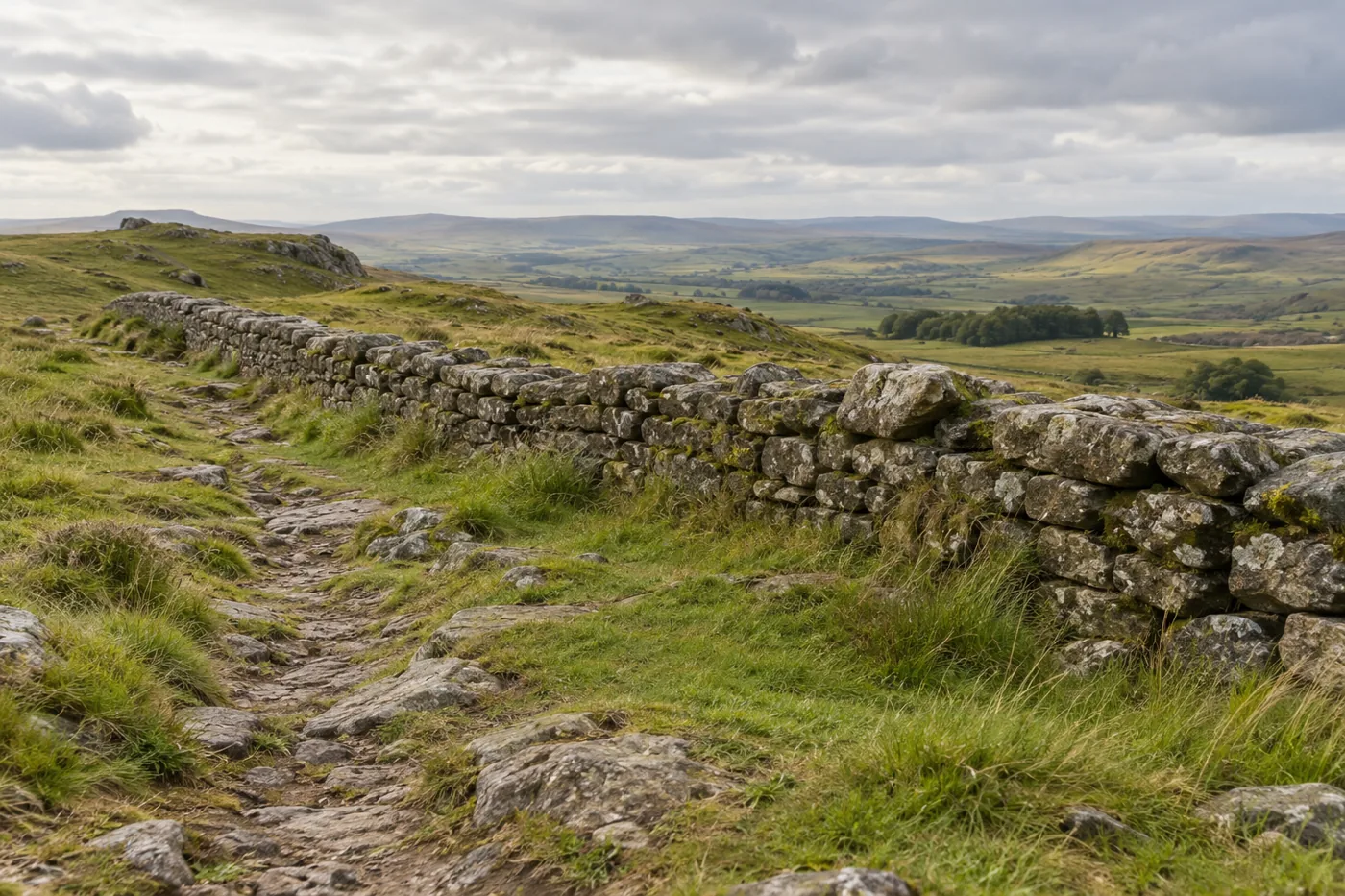
AI-generated low stone wall in an imagined upland landscape, inspired by Hadrian’s Wall; not a documented section, Roman fabric or reconstruction of the frontier. Credit: AI-generated for Culture Ark using OpenAI image_gen, 2026-11-01. Rights: AI-generated output; no exclusive ownership or guaranteed copyrightability claimed. Changes: Resized within1400px and converted to WebP; no crop or substantive alteration.
The wall, path, stones and hills are invented. They are not evidence of Roman construction, restoration, tactical use, archaeological alignment or access conditions.
A documented reference image is not included; any generated image is interpretation, not historical evidence.
History and context
Hadrian’s Wall forms part of a much larger Roman frontier history. UNESCO places it among surviving walls, ditches, forts, watchtowers and civilian settlements that made up the empire’s boundary zones. This selection is cultural rather than tactical: it asks how a line of monuments later becomes a way of imagining belonging, outsiders and the reach of a state. Future readers need a map connecting the wall with surrounding settlements, not just a picturesque isolated stretch. They should also be told which portions survive, which have been reconstructed and where modern interpretation fills gaps. A frontier was inhabited and experienced, not simply drawn on a map.
What future readers can learn
How boundaries create cultural memories beyond their original political use.
Limits and cultural context
Do not adopt Roman labels for neighboring peoples as neutral judgments. Distinguish original fabric, reconstruction and interpretation.
Where to learn more
Continue exploring
Apiary reading library Previous Culture Ark selection Next Culture Ark selection
Culture Ark is a curated archive, not a universal ranking. Interpretive images and source evidence serve different roles.
Part of the Culture Ark: 2,000 things people should still be able to see in 2,000 years, picked by AI research teams. Browse the gallery. The Culture Ark is an Artificial Mind Hive (AMH) project. AMH is owned by Austin Little.

Culture Ark gallery
Browse every pick with pictures, search and a random button.
Open the gallery →