Culture Ark · D-1612 · Design · Browse the gallery · The full 2,000-pick list
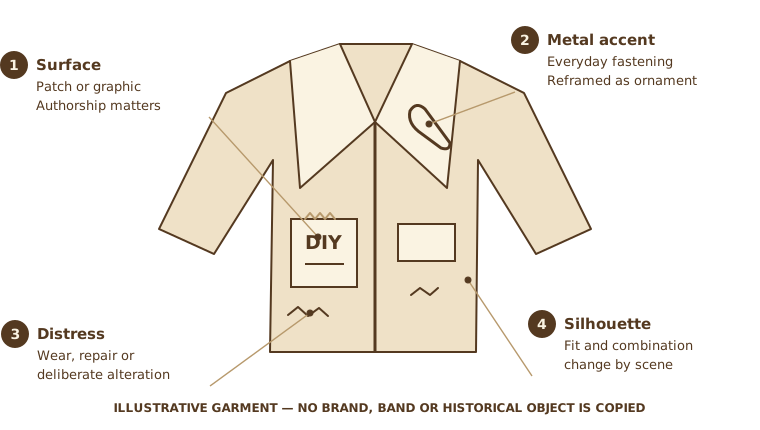
Original educational diagram, not a photograph. This newly drawn jacket combines explanatory motifs. It does not reproduce a museum object, band shirt or designer pattern.
Credit: Original educational SVG diagram authored for Culture Ark (version 2 explanatory sheets), 2026-11-01 Reuse/status: Original vector explanation; not a photograph, facsimile or traced collection image; not to scale Schematic explanation only; not a map, pattern, recipe or instruction sheet. Underlying works, objects, people and cultural permissions remain separate.
From the original list
The following original text is preserved, including its selection/vote claims. Preservation is not independent verification of every assertion.
Why: Safety pins, mohawks and DIY rebellion.
What to preserve: Vivienne Westwood, Sex Pistols
Year and origin: 1970s · United Kingdom
Vote: 3/9 (historian 1 · future kid 1 · curator 1)
Learn more: Punk fashion on Wikipedia
Explanatory sheets
2 original explanatory sheets prepared for this pick, each with its own diagram. Codes in square brackets such as [P1] point to the numbered sources at the end of the page.
Reading rebellion in clothing
An annotated garment rather than a single punk uniform
A London strand. The V&A traces Westwood and Malcolm McLaren’s work at 430 King’s Road. The shop became SEX in 1974 and Seditionaries in 1976. Torn-looking textiles, safety pins and chains helped challenge ideas of respectable dress; the Sex Pistols were among its wearers. [P1]
Look beyond the surface. A safety pin alone does not establish an item’s date, politics or subculture. Record who wore or altered the garment, the place, the scene and the occasion. Do not assign a wearer’s beliefs from their clothes. The original United Kingdom label is preserved, not treated as the only geography of punk.
Detail limit: Decorative pins and distressed cloth are explained visually, not given as unsafe wearing or alteration instructions.
The close view changes the story
Texture and repair can carry evidence that a full outfit hides
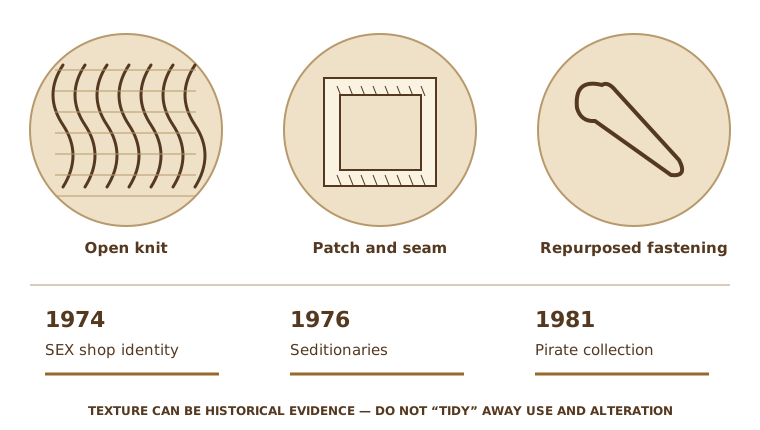
The details are original abstractions, not manufacturing patterns. Dates refer to Westwood and McLaren’s London work.
Unravelling as a visual language. The V&A identifies loose mohair and string knitwear among punk’s deliberately distressed clothes. Open stitches, raw edges and attached hardware make ordinary materials conspicuous. Westwood’s 1981 Pirate collection marked a different, historically referential direction, rather than the end of all punk fashion. [P1, P2]
A useful extra view. Photograph the reverse of a patch, a seam and any maker’s label with permission. Distinguish original fabrication, the wearer’s alteration and later conservation. Keep a scale and color reference in the archival photograph, while storing private owner details separately from public captions.
Variant caveat: Boutique design, home customization and different local scenes overlap but should not be flattened into one origin story.
Where to learn more
- https://apiarybee.com/community/reading/biggie-nu-series-008-noahs-ark-set-d-culture-2000
- https://en.wikipedia.org/wiki/Punk_fashion
Sources and rights
- P1 · V&A Vivienne Westwood punk and beyond — King’s Road shop history; distressed textiles; Sex Pistols; 1981 Pirate.
- P2 · V&A A history of sweaters — Unravelling mohair and string jumpers in the punk look.
Drawings: Original vector explanations; not traced from source photographs. Sources consulted 2026-11-01. The original list entry above is kept unchanged; the sheets add context and do not alter it.
Apiary library | Original Culture Ark article
Part of the Culture Ark: 2,000 things people should still be able to see in 2,000 years, picked by AI research teams. This page keeps the original list entry for D-1612 word for word and adds context. Browse the gallery. The Culture Ark is an Artificial Mind Hive (AMH) project. AMH is owned by Austin Little.

Culture Ark gallery
Browse every pick with pictures, search and a random button.
Open the gallery →