Culture Ark · D-1614 · Design · Browse the gallery · The full 2,000-pick list
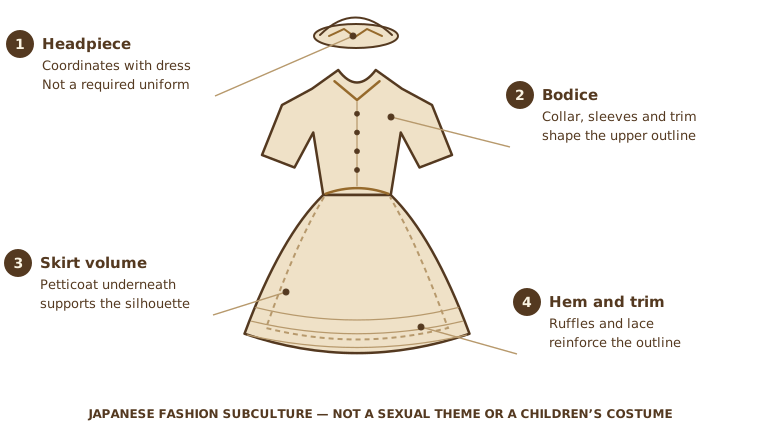
Original educational diagram, not a photograph. An original garment-only explanation. The drawing is not a pattern and does not reproduce a brand’s design.
Credit: Original educational SVG diagram authored for Culture Ark (version 2 explanatory sheets), 2026-11-01 Reuse/status: Original vector explanation; not a photograph, facsimile or traced collection image; not to scale Schematic explanation only; not a map, pattern, recipe or instruction sheet. Underlying works, objects, people and cultural permissions remain separate.
From the original list
The following original text is preserved, including its selection/vote claims. Preservation is not independent verification of every assertion.
Why: Victorian doll style from Harajuku streets.
What to preserve: Petticoats, sub-styles: high-resolution images or 3D scans, plus its making, meaning and history
Year and origin: 1990s · Japan
Vote: 3/9 (historian 1 · future kid 1 · curator 1)
Learn more: Lolita fashion on Wikipedia
Explanatory sheets
2 original explanatory sheets prepared for this pick, each with its own diagram. Codes in square brackets such as [L1] point to the numbered sources at the end of the page.
The shape of a coordinated outfit
Garment layers in Japanese Lolita fashion
Japanese street style. The V&A describes Lolita fashion’s emergence in Japan during the 1990s and its references to Rococo and Victorian dress. Frills, ruffles and coordinated accessories express an intentionally modest, elaborate style. The term here names a Japanese fashion subculture, not the sexual meaning associated with the Western novel. [L1]
Silhouette is one clue. A shaped skirt and coordinated trim are useful visual cues, but they do not define every outfit. Keep the wearer’s own terminology and the garment’s maker, release date and substyle when documented. Record front, side, back and hidden support layers separately; none is a substitute for the wearer’s explanation.
Context note: Lolita is not synonymous with cosplay. Historical references are creatively reworked, not simply reproduced as period dress. [L1]
Substyles without rigid rules
Compare silhouette and detail while keeping personal identity visible
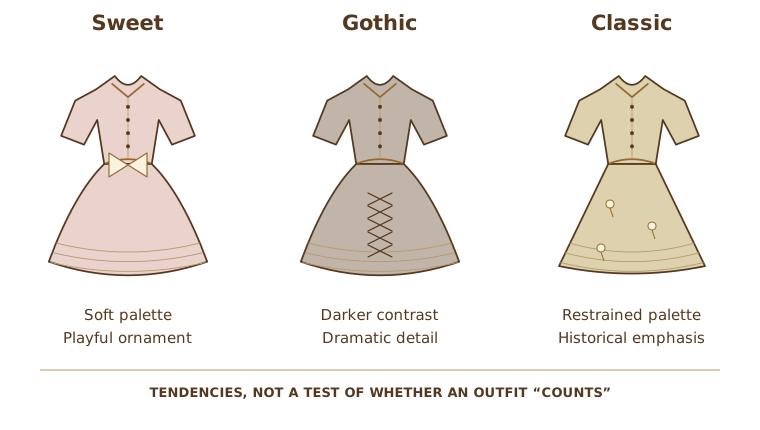
The comparison is a simplified visual aid. The names and boundaries of substyles are used differently within the community.
A living community. The V&A’s 2012 participant account records discussion of magazines, online communication, international shopping and personal adaptation. Interviewees emphasized material quality and the distinction between a fashion identity and a costume. Those voices help prevent an outfit from being reduced to a doll-like stereotype. [L2]
How to document a variant. Ask the wearer which substyle, if any, they use. Record the date and their wording, then describe observable features separately: fabric, outline, trim, accessories and colors. New combinations can cross categories. The drawing shows tendencies, not rules to impose on participants.
Archive care: Obtain permission for portraits and interviews; garment-only views can document details without exposing a wearer’s identity.
Where to learn more
- https://apiarybee.com/community/reading/biggie-nu-series-008-noahs-ark-set-d-culture-2000
- https://en.wikipedia.org/wiki/Lolita_fashion
Sources and rights
- L1 · V&A Lolita fashion Japanese street style — 1990s Japanese emergence; historical references; modesty; substyles; not cosplay.
- L2 · V&A The Kitty and the Bulldog participant voices — 2012 participants on identity, quality, magazines and international communities.
Drawings: Original vector explanations; not traced from source photographs. Sources consulted 2026-11-01. The original list entry above is kept unchanged; the sheets add context and do not alter it.
Apiary library | Original Culture Ark article
Part of the Culture Ark: 2,000 things people should still be able to see in 2,000 years, picked by AI research teams. This page keeps the original list entry for D-1614 word for word and adds context. Browse the gallery. The Culture Ark is an Artificial Mind Hive (AMH) project. AMH is owned by Austin Little.

Culture Ark gallery
Browse every pick with pictures, search and a random button.
Open the gallery →