Culture Ark · D-1604 · Design · Browse the gallery · The full 2,000-pick list
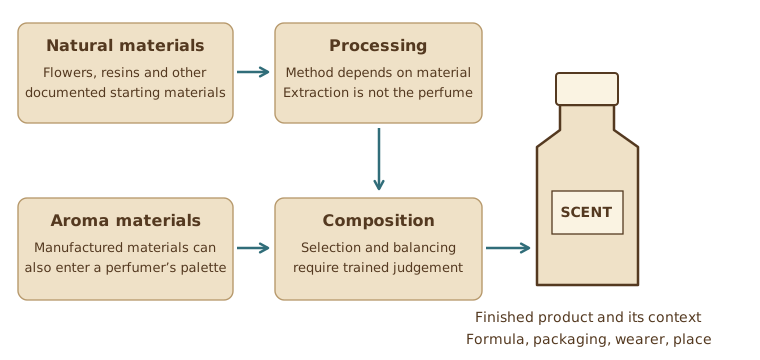
Original educational diagram, not a photograph. Original conceptual map. A perfume may combine natural and manufactured aroma materials; this is not a formula, concentration chart or manufacturing procedure.
Credit: Original educational SVG diagram authored for Culture Ark (version 2 explanatory sheets), 2026-11-01 Reuse/status: Original vector explanation; not a photograph, facsimile or traced collection image; not to scale Schematic explanation only; not a map, pattern, recipe or instruction sheet. Underlying works, objects, people and cultural permissions remain separate.
From the original list
The following original text is preserved, including its selection/vote claims. Preservation is not independent verification of every assertion.
Why: Scent made from flowers, resins and chemistry.
What to preserve: Tapputi's recipes, distillation
Year and origin: c. 1200 BC · Mesopotamia
Vote: 3/9 (historian 1 · future kid 1 · curator 1)
Learn more: Perfume on Wikipedia
Explanatory sheets
2 original explanatory sheets prepared for this pick, each with its own diagram. Codes in square brackets such as [A] point to the numbered sources at the end of the page.
A material palette is not a finished scent
Three kinds of knowledge. UNESCO describes perfume skills in Pays de Grasse through cultivation, processing of natural materials and composition. These are connected but distinct kinds of expertise. Growing a fragrant plant, obtaining an aromatic material and making a finished perfume are not the same operation. [P1]
Extraction is a choice not a universal sequence. The International Perfume Museum documents methods including distillation, solvent extraction and enfleurage. The suitable process depends on the material and desired result. The small flow diagram on the next sheet explains only the broad idea of steam distillation. [P2]
Composition also has a cultural setting. A perfumer selects and balances materials; packaging, naming, wearing and memory give the product a social life. Preserve the maker, release, intended use and accounts of perception alongside material evidence. Do not turn a sensory description into an invented chemical recipe. [P1, P3]
One extraction principle in context
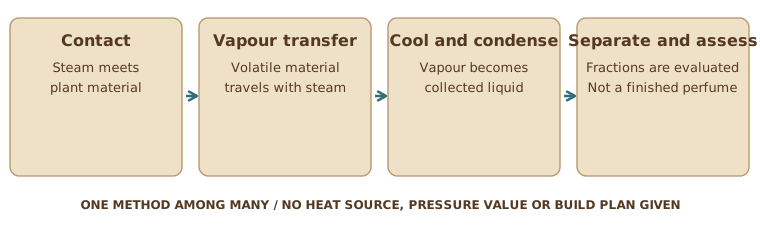
Conceptual steam-distillation flow. This is not equipment design: no pressure vessel, flame arrangement, solvent handling, operating value or wearable formulation is specified.
Keep the historical anchor separate. The Ark points to Tapputi and Mesopotamia around 1200 BC. Those preserved research prompts should not be treated as the invention of every fragrant practice or as a recovered usable recipe. The Grasse examples here describe a different place and later craft tradition. [A, P1]
Safety and preservation. Fragrances can cause sensitivities in some people. An archive should not ask a reader to apply unknown historical contents to skin or to run an extraction apparatus. Record labels and condition; use trained conservation and formulation expertise for physical samples. [P3]
Where to learn more
- https://apiarybee.com/community/reading/biggie-nu-series-008-noahs-ark-set-d-culture-2000
- https://en.wikipedia.org/wiki/Perfume
Sources and rights
- A · Existing Culture Ark record — Supplied current-live refresh; source body unchanged.
- P1 · UNESCO Perfume skills in Grasse — Cultivation, processing, composition and living transmission.
- P2 · International Perfume Museum Techniques — Museum technical guide: distillation, extraction and enfleurage; indexed text retrieved.
- P3 · FDA Fragrances in cosmetics — Complex mixtures and sensitivity caution.
Drawings: Original educational SVG schematics; no copied historical/product artwork. Not to scale. Archive note: The source’s c. 1200 BC · Mesopotamia line is retained verbatim as an archival anchor, not asserted as a complete global history or single invention date for perfume. Sources consulted 2026-11-01. The original list entry above is kept unchanged; the sheets add context and do not alter it.
Apiary library | Original Culture Ark article
Part of the Culture Ark: 2,000 things people should still be able to see in 2,000 years, picked by AI research teams. This page keeps the original list entry for D-1604 word for word and adds context. Browse the gallery. The Culture Ark is an Artificial Mind Hive (AMH) project. AMH is owned by Austin Little.

Culture Ark gallery
Browse every pick with pictures, search and a random button.
Open the gallery →