Culture Ark · D-1603 · Design · Browse the gallery · The full 2,000-pick list
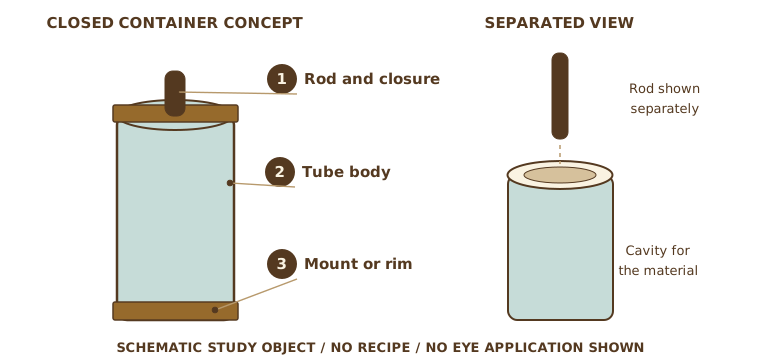
Original educational diagram, not a photograph. Generic original container schematic. The Met’s object 30.8.150 supplies a documented material example, not the exact proportions drawn here.
Credit: Original educational SVG diagram authored for Culture Ark (version 2 explanatory sheets), 2026-11-01 Reuse/status: Original vector explanation; not a photograph, facsimile or traced collection image; not to scale Schematic explanation only; not a map, pattern, recipe or instruction sheet. Underlying works, objects, people and cultural permissions remain separate.
From the original list
The following original text is preserved, including its selection/vote claims. Preservation is not independent verification of every assertion.
Why: The dark eyeliner of Egyptians, still worn across Africa and Asia.
What to preserve: Egyptian eye makeup, surma
Year and origin: c. 3100 BC · Egypt
Vote: 3/9 (historian 1 · future kid 1 · curator 1)
Learn more: Kohl (cosmetics) on Wikipedia
Explanatory sheets
2 original explanatory sheets prepared for this pick, each with its own diagram. Codes in square brackets such as [A] point to the numbered sources at the end of the page.
Read the vessel without reenacting its use
A documented Egyptian example. The Metropolitan Museum of Art records a New Kingdom kohl tube and applicator, about 1550–1300 BCE, made with faience, gold and hematite. Its rod served as both closure and applicator. That is one surviving object, not a universal model for all eye cosmetics across Africa and Asia. [K1]
Container and contents are different evidence. A vessel can survive after its contents have changed or disappeared. Catalogue material, form, inscription, archaeological context and collection history separately from any chemical identification. A dark powder cannot be identified safely by color, name or visual resemblance. [K1, K2]
Names do not guarantee a composition. Kohl, kajal and surma are used across different communities and products. FDA and California public-health sources warn that some traditional products contain high concentrations of lead or other toxic metals. Historical meaning does not establish modern safety. [K2, K3]
Separate history composition and safety
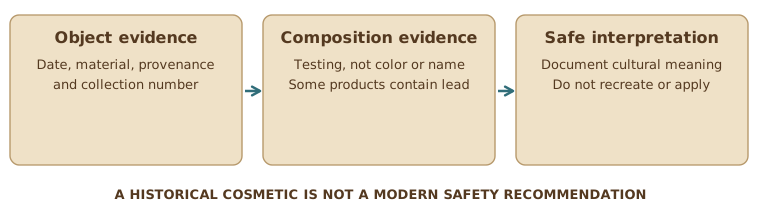
Evidence map, not an application or preparation guide. No grinding, mixing, heating or eye-placement instructions are supplied.
Preserve without hazardous reconstruction. Record local names, users’ accounts and consent, container provenance and scientifically established composition. Do not handle unknown residues as a craft material. If exposure to a suspect product may have occurred, seek advice from a clinician or local public-health service about appropriate testing. [K2, K3]
Where to learn more
- https://apiarybee.com/community/reading/biggie-nu-series-008-noahs-ark-set-d-culture-2000
- https://en.wikipedia.org/wiki/Kohl_%28cosmetics%29
Sources and rights
- A · Existing Culture Ark record — Supplied current-live refresh; source body unchanged.
- K1 · The Met Kohl tube and applicator — Object 30.8.150, New Kingdom date, materials and rod function.
- K2 · FDA Kohl and lead poisoning — Lead hazard in adults and children; product names do not establish safety.
- K3 · California public health Heavy metals — Lead and other toxic metals found in some traditional eye cosmetics.
Drawings: Original educational SVG schematics; no copied historical/product artwork. Not to scale. Archive note: The source date c. 3100 BC is preserved as the original archive label. The named object studied here is later; neither establishes a single origin or composition for every product called kohl. Warning: HISTORICAL STUDY ONLY. Do not make or apply traditional kohl from these sheets. Some products contain toxic lead; children are especially vulnerable. No cosmetic recipe is provided. Sources consulted 2026-11-01. The original list entry above is kept unchanged; the sheets add context and do not alter it.
Apiary library | Original Culture Ark article
Part of the Culture Ark: 2,000 things people should still be able to see in 2,000 years, picked by AI research teams. This page keeps the original list entry for D-1603 word for word and adds context. Browse the gallery. The Culture Ark is an Artificial Mind Hive (AMH) project. AMH is owned by Austin Little.

Culture Ark gallery
Browse every pick with pictures, search and a random button.
Open the gallery →