Culture Ark · D-1611 · Design · Browse the gallery · The full 2,000-pick list
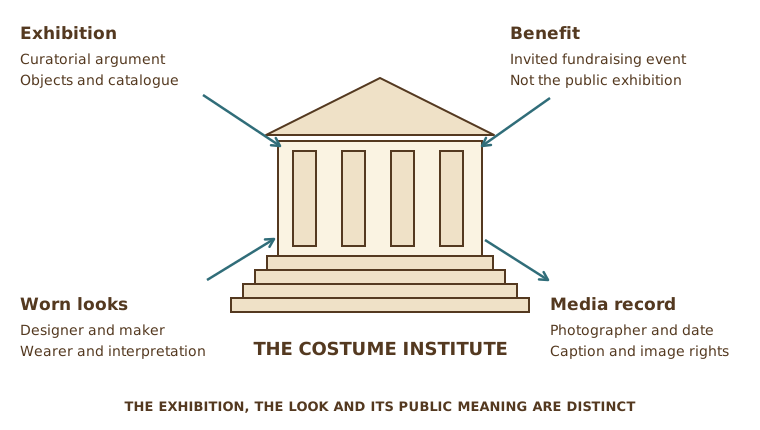
Original educational diagram, not a photograph. An original institutional map, not a floor plan. The red carpet is a visible part of a larger museum benefit.
Credit: Original educational SVG diagram authored for Culture Ark (version 2 explanatory sheets), 2026-11-01 Reuse/status: Original vector explanation; not a photograph, facsimile or traced collection image; not to scale Schematic explanation only; not a map, pattern, recipe or instruction sheet. Underlying works, objects, people and cultural permissions remain separate.
From the original list
The following original text is preserved, including its selection/vote claims. Preservation is not independent verification of every assertion.
Why: Fashion's biggest red-carpet spectacle.
What to preserve: Themes, famous looks
Year and origin: 1948 · United States
Vote: 3/9 (historian 1 · future kid 1 · curator 1)
Learn more: Met Gala on Wikipedia
Explanatory sheets
2 original explanatory sheets prepared for this pick, each with its own diagram. Codes in square brackets such as [M1] point to the numbered sources at the end of the page.
Inside a fashion benefit
Four records behind one public spectacle
Why the museum matters. The Costume Institute Benefit began in 1948, organized by Eleanor Lambert. The Met describes its proceeds as supporting exhibitions, acquisitions and capital improvements. A gala look should therefore be read beside the exhibition and the benefit, not as an isolated celebrity image. [M1]
What to keep together. For each appearance, preserve the event date, exhibition title, designer, credited makers, wearer, photographer and the wearer’s explanation when available. Keep the physical garment, authorized photograph and later commentary as related but separate records. This is an archival recommendation, not a claim that every look follows the theme.
Source note: The original 1948 United States label is retained unchanged in the archival record.
Changing themes and public memory
A timeline with examples rather than a list of celebrities
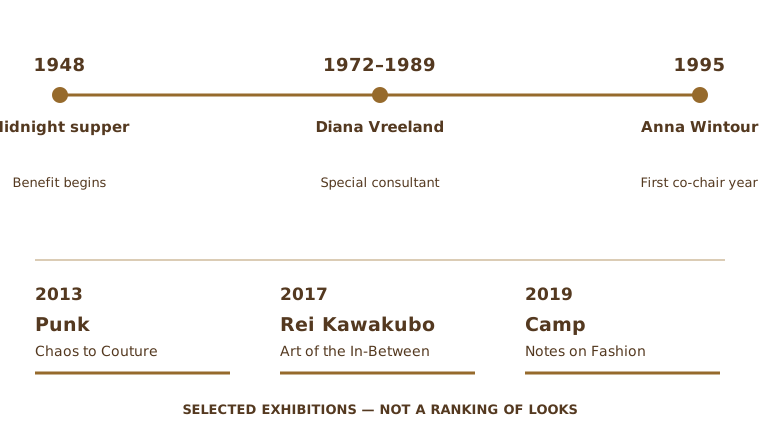
Dates identify documented institutional milestones. The three exhibition titles are examples, not the whole history.
A changing event. The Met identifies Vreeland’s 1972–1989 consultancy as a period when the benefit grew as a social and art-world occasion. Wintour became co-chair in 1995. These dates describe different roles, not successive founding dates. [M1]
Theme is not dress code. Keep the exhibition title exactly as issued and store any dress code in a separate field. Record an outfit’s own title or interpretation only when its maker or wearer supplies it. Criticism, memes and fashion reporting can then be linked without becoming the garment’s official description.
Preservation view: Include an authorized overall image, side or back view, detail image and construction notes where access and rights permit.
Where to learn more
- https://apiarybee.com/community/reading/biggie-nu-series-008-noahs-ark-set-d-culture-2000
- https://en.wikipedia.org/wiki/Met_Gala
Sources and rights
- M1 · The Met history of the Costume Institute Benefit — 1948 benefit; Vreeland years; 1995 co-chair; exhibition examples.
Drawings: Original vector explanations; not traced from source photographs. Sources consulted 2026-11-01. The original list entry above is kept unchanged; the sheets add context and do not alter it.
Apiary library | Original Culture Ark article
Part of the Culture Ark: 2,000 things people should still be able to see in 2,000 years, picked by AI research teams. This page keeps the original list entry for D-1611 word for word and adds context. Browse the gallery. The Culture Ark is an Artificial Mind Hive (AMH) project. AMH is owned by Austin Little.

Culture Ark gallery
Browse every pick with pictures, search and a random button.
Open the gallery →