Culture Ark · D-1601 · Design · Browse the gallery · The full 2,000-pick list
Original educational diagram, not a photograph. Representative modern Béarn wool beret. Original schematic; not a specific maker’s model, a pattern or a size guide.
Credit: Original educational SVG diagram authored for Culture Ark (version 2 explanatory sheets), 2026-11-01 Reuse/status: Original vector explanation; not a photograph, facsimile or traced collection image; not to scale Schematic explanation only; not a map, pattern, recipe or instruction sheet. Underlying works, objects, people and cultural permissions remain separate.
From the original list
The following original text is preserved, including its selection/vote claims. Preservation is not independent verification of every assertion.
Why: A soft wool cap of artists, soldiers and revolutionaries.
What to preserve: Basque beret, Che Guevara
Year and origin: ancient · France
Vote: 3/9 (historian 1 · future kid 1 · curator 1)
Learn more: Beret on Wikipedia
Explanatory sheets
2 original explanatory sheets prepared for this pick, each with its own diagram. Codes in square brackets such as [A] point to the numbered sources at the end of the page.
Above below and in profile
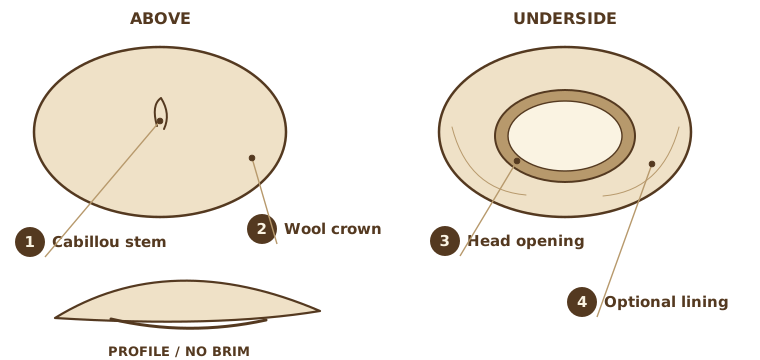
A shaped textile rather than a cut circle. In the named Béarn manufacturing tradition, wool is knitted into a shaped form and then fulled or felted. The dense, flexible crown differs from a flat woven cloth disc sewn into a hat. The small cabillou stem is a characteristic feature associated with traditional knitting. [B1, B2]
Exterior and interior do different jobs. The broad crown can be arranged on the head without a projecting brim. A head opening fits around the wearer. Some models add a lining and a sewn headband; these are finishing choices, not compulsory parts of every beret. Our underside view marks that distinction. [B1]
One form with many social uses. The Ark connects the cap to artists, soldiers and revolutionaries. Preserve an example’s wearer, maker, badge and occasion rather than treating all berets as the same political or regional symbol. The source’s “ancient” label is not a precise invention date. [A]
From knitted loops to a finished crown
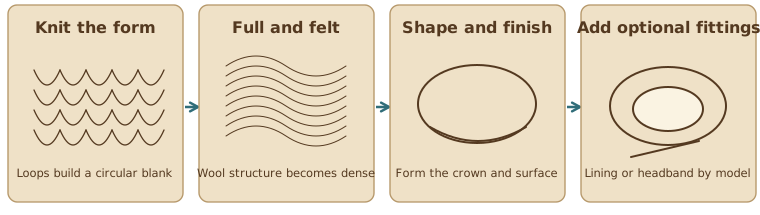
Four conceptual stages group a more detailed craft sequence. No stitch count, shrinkage allowance, water temperature or finishing recipe is specified.
Keep the maker’s vocabulary. The Musée du Béret locates this manufacturing history in Béarn, especially Nay and Oloron-Sainte-Marie. “Basque beret” is a familiar cultural name, but does not by itself settle a particular object’s place of manufacture. Record both the object label and documented maker. [B2, B3]
Where to learn more
- https://apiarybee.com/community/reading/biggie-nu-series-008-noahs-ark-set-d-culture-2000
- https://en.wikipedia.org/wiki/Beret
Sources and rights
- A · Existing Culture Ark record — Supplied current-live refresh; source body unchanged.
- B1 · Laulhère Making a beret — Named maker’s knitting, felting, shaping and optional fittings.
- B2 · Musée du Béret Manufacture — Knitted circular form, joining and fulling.
- B3 · Musée du Béret History — Béarn location and historical context.
Drawings: Original educational SVG schematics; no copied historical/product artwork. Not to scale. Archive note: The original “ancient · France” wording is retained as an archival label, not verified as a single invention date or universal origin for all beret-like caps. Sources consulted 2026-11-01. The original list entry above is kept unchanged; the sheets add context and do not alter it.
Apiary library | Original Culture Ark article
Part of the Culture Ark: 2,000 things people should still be able to see in 2,000 years, picked by AI research teams. This page keeps the original list entry for D-1601 word for word and adds context. Browse the gallery. The Culture Ark is an Artificial Mind Hive (AMH) project. AMH is owned by Austin Little.

Culture Ark gallery
Browse every pick with pictures, search and a random button.
Open the gallery →