Culture Ark · D-1598 · Design · Browse the gallery · The full 2,000-pick list
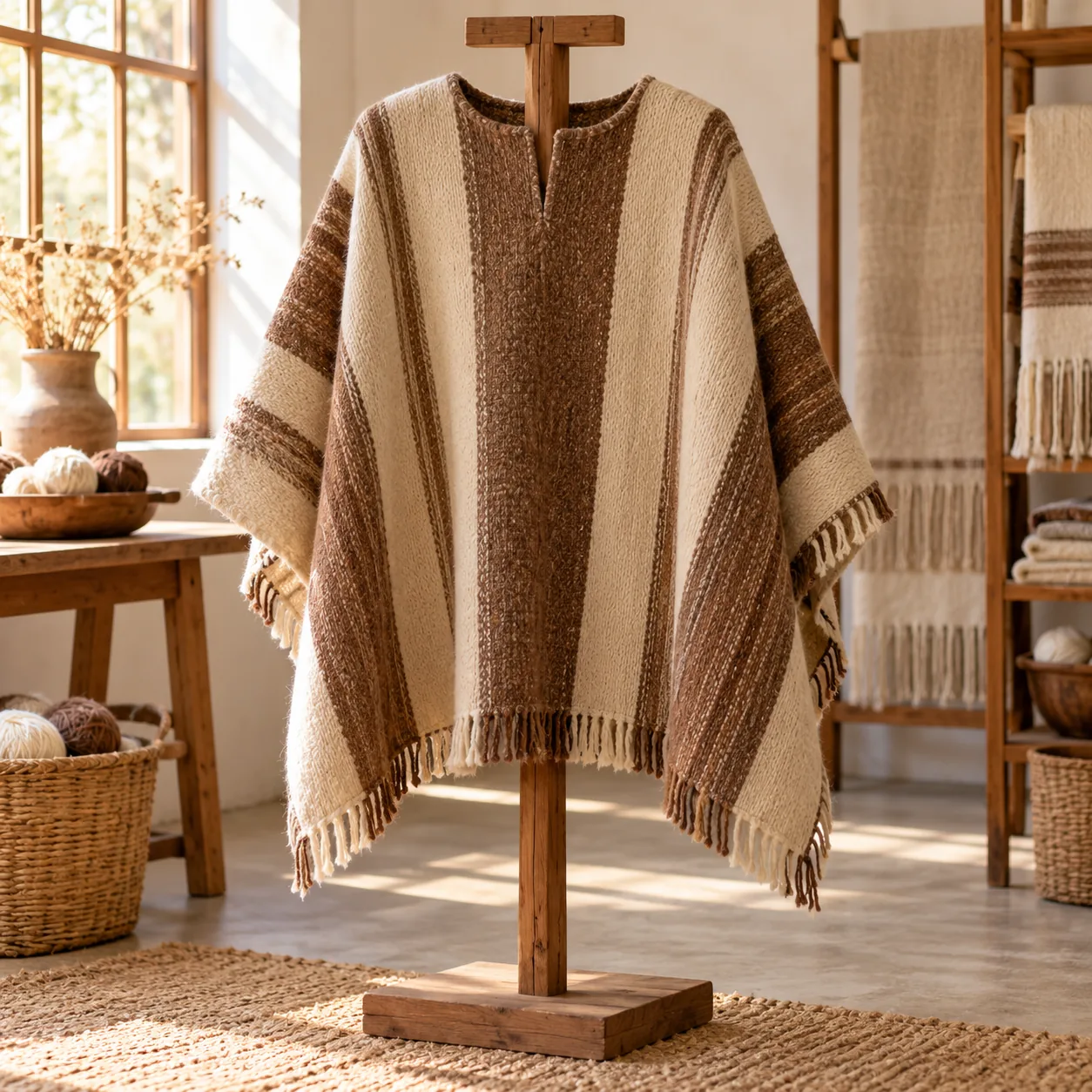
Generated interpretation, not documentary evidence. AI-generated invented cream-and-brown striped poncho on a wooden stand; not a museum textile or an authenticated pattern from a specific Andean community.
Credit: AI-generated for Culture Ark using OpenAI image generation Reuse/status: Generated content; no exclusive ownership or underlying-work rights claimed Individually inspected: central opening, drape, stripes and fringe are coherent. Fiber appearance and construction are interpretive, not technical or ethnographic documentation. No authentic-reference or endorsement claim.
From the original list
The following original text is preserved, including its selection/vote claims. Preservation is not independent verification of every assertion.
Why: A blanket with a hole, worn across the Andes.
What to preserve: Andean weaving, rain ponchos
Year and origin: pre-Columbian · Andes
Vote: 3/9 (historian 1 · future kid 1 · curator 1)
Learn more: Poncho on Wikipedia
Supplemental context
A poncho is more than a blanket with an opening: its material, weaving and regional history matter. The Metropolitan Museum describes a likely early twentieth-century Sica Sica example made from two woven panels joined while leaving space for the head. Its camelid fiber and arrangement of stripes belong to a particular Andean textile context. The museum also distinguishes ponchos from earlier tunics, explaining changes in width and open sides over time. For future readers, this is a reminder that a simple-looking garment can embody specialized work and historical adaptation. A broad category should not erase the identities and skills of particular weaving communities.
Creator/community: Distinct Andean weaving communities; the cited example is from Bolivia's Sica Sica region Place/era: Andes; evolving textile histories, with a cited early twentieth-century Bolivian example
Context and limits
The original pre-Columbian label should not imply that every modern poncho has an unchanged ancient form. The cited museum example is twentieth-century, not archaeological. Waterproof rain ponchos are a separate material application, not interchangeable evidence for Andean weaving. The generated garment is generic and does not document an Aymara pattern, fiber analysis or weaving technique.
Where to learn more
- https://apiarybee.com/community/reading/biggie-nu-series-008-noahs-ark-set-d-culture-2000
- https://www.metmuseum.org/art/collection/search/815003
Apiary library | Original Culture Ark article
Public ID and individual routes: pending publisher allocation. Internal source ID: D-1598
Part of the Culture Ark: 2,000 things people should still be able to see in 2,000 years, picked by AI research teams. This page keeps the original list entry for D-1598 word for word and adds context. Browse the gallery. The Culture Ark is an Artificial Mind Hive (AMH) project. AMH is owned by Austin Little.

Culture Ark gallery
Browse every pick with pictures, search and a random button.
Open the gallery →