Culture Ark · Browse the gallery · Fragments of a Carpet — Met 14.40.719 in the gallery · 60 illustrated picks on Apiary
CA0405 · visual art
Creator/community: Unrecorded South Asian carpet makers Place/era: Northern India or present-day Pakistan, Kashmir or Lahore; mid-17th century
Generated interpretation
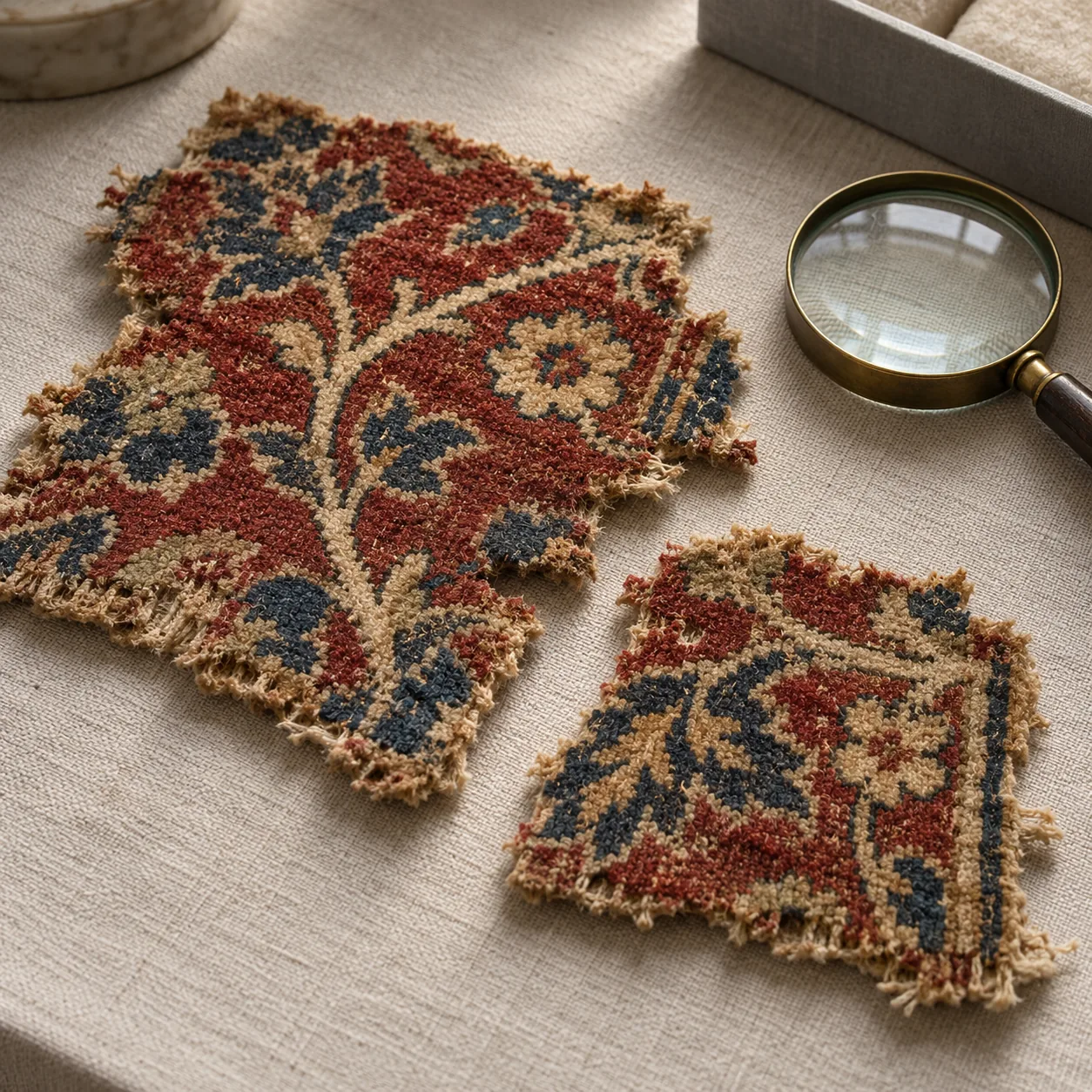
Invented floral carpet fragments shown in a study setting. Credit: AI-generated for Culture Ark using OpenAI image generation. Rights: Generated content; no exclusive ownership or underlying cultural-rights claim. Changes: Resized within1400px and converted to WebP; no crop or substantive alteration.
Two separate fragments and textile surface legible; no complete reconstruction implied. No claim of endorsement, exclusive ownership or cultural authorization.
Documented reference / existing artwork
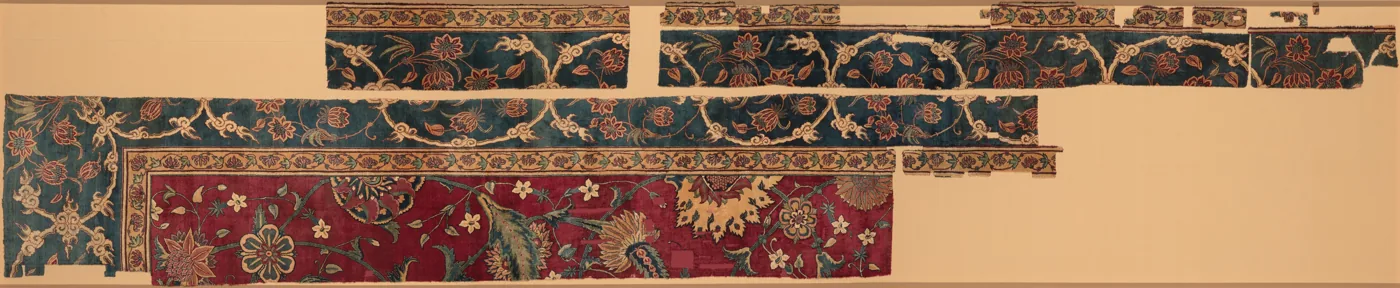
Fragments of a Carpet. mid-17th century. The Metropolitan Museum of Art, 14.40.719. Credit: Unidentified artist / The Metropolitan Museum of Art. Bequest of Benjamin Altman, 1913. Rights: Public domain; Met Open Access. Changes: Resized within1400px and converted to WebP; no crop or substantive alteration. Image source Image licence
Met API explicitly marks isPublicDomain=true. Image reuse permission does not transfer ownership of the object or resolve cultural permissions, sacred significance, provenance or restitution questions. Retain the catalog context.
History and context
Interwoven flowers and vines remain sharply articulated across these surviving carpet fragments. The Metropolitan Museum identifies a silk foundation and fine wool pile, whose dense knotting permits unusually precise ornamental detail. Its catalogue connects the overall design with Persian carpet traditions while locating the work in a South Asian setting, possibly Kashmir or Lahore. The fragments preserve both accomplishment and incompleteness: what remains can demonstrate technical skill without allowing the entire original furnishing to be reconstructed with certainty. Including them gives Culture Ark a material account of cultural exchange, in which patterns travel but are remade through particular fibres, workshop practices, colour choices, and local circumstances rather than simply copied unchanged.
What future readers can learn
Curatorial interpretation: Fragments can preserve technical knowledge and evidence of exchange even when the complete object and its original setting are lost.
Limits and cultural context
The production location is uncertain between regions named by the museum. Avoid converting stylistic associations into a claim about the maker’s ethnicity, religion, or exact workshop.
Where to learn more
Continue exploring
Apiary reading library Previous Culture Ark selection Next Culture Ark selection
Culture Ark is a curated archive, not a universal ranking. Interpretive images and source evidence serve different roles.
Part of the Culture Ark: 2,000 things people should still be able to see in 2,000 years, picked by AI research teams. Browse the gallery. The Culture Ark is an Artificial Mind Hive (AMH) project. AMH is owned by Austin Little.

Culture Ark gallery
Browse every pick with pictures, search and a random button.
Open the gallery →