Culture Ark · D-1610 · Design · Browse the gallery · The full 2,000-pick list
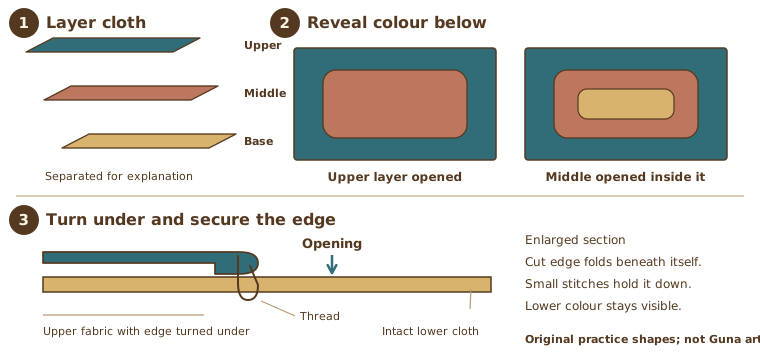
Original educational diagram, not a photograph. Differently coloured layers make the construction legible. The inset section exaggerates separation for clarity; it specifies no dimensions or cultural colour symbolism.
Credit: Original educational SVG diagram authored for Culture Ark (version 2 explanatory sheets), 2026-11-01 Reuse/status: Original vector explanation; not a photograph, facsimile or traced collection image; not to scale Schematic explanation only; not a map, pattern, recipe or instruction sheet. Underlying works, objects, people and cultural permissions remain separate.
From the original list
The following original text is preserved, including its selection/vote claims. Preservation is not independent verification of every assertion.
Why: Layered appliqué panels of Guna women.
What to preserve: Reverse appliqué: high-resolution images or 3D scans, plus its making, meaning and history
Year and origin: 19th century · Panama
Vote: 3/9 (historian 1 · future kid 1 · curator 1)
Learn more: Mola (art form) on Wikipedia
Explanatory sheets
2 original explanatory sheets prepared for this pick, each with its own diagram. Codes in square brackets such as [A] point to the numbered sources at the end of the page.
Revealing colour and securing a cut edge
A living, named tradition. Mola is a textile art associated especially with Guna women, not simply a decorative sewing effect. Guna communities live in Panama and Colombia; Guna Yala is a coastal and island territory in Panama. Artist and community attribution matter: Cleveland’s exhibition records, for example, identify Ankela Rivera of Agligandi. Such a name is evidence of an individual practice, not a label to attach to this sheet’s invented teaching shapes. [R1, R2]
Build, reveal, secure. Reverse appliqué begins with differently coloured cloth layers held together. An opening in an upper layer reveals cloth underneath. Its cut edge is turned under and secured with small stitches, making a clean boundary rather than leaving a raw slit. Further openings can reveal other layers. Surface appliqué adds pieces on top, while embroidery adds stitched detail: these operations can coexist in one panel. The diagrams separate them so a learner can follow the construction without copying an artist’s composition. [R1, R3]
A panel belongs to clothing and life. Panels are traditionally paired on the front and back of a blouse, joined to a yoke and sleeves. A detached rectangle does not show this whole relationship. “Mola” can refer to cloth, a panel or the garment in published usage; older sources also spell Guna as Kuna or Cuna. Contemporary subject matter does not make the work less Guna: artists can transform daily experience, nature and imagery encountered beyond their communities through their own decisions. [R1, R2, R3, R4]
A panel is part of a front-back relationship
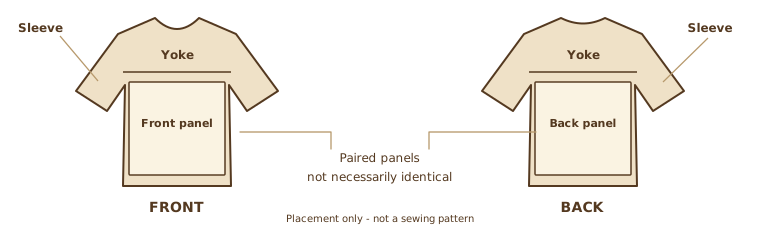
Blank panels locate the front-back pair below the yoke. These original outlines are not measured patterns, authentic garments or attributed Guna artwork.
Preserve more than a surface. Useful documentation records the maker, community, front–back pairing, construction and the meanings the maker chooses to share. MuMo in Panama reports support from five Guna congresses, reminding researchers to seek living community perspectives rather than treating museums as the only authorities. The original Ark date and wording remain separate and unchanged. Our blank blouse outlines and simple cutwork exercise explain relationships; they do not reproduce Guna artwork, certify authenticity or claim access to every design’s meaning. [R5]
Where to learn more
- https://apiarybee.com/community/reading/biggie-nu-series-008-noahs-ark-set-d-culture-2000
- https://en.wikipedia.org/wiki/Mola_%28art_form%29
Sources and rights
- A · Existing Culture Ark record — Supplied current-live refresh; original source body unchanged.
- R1 · Cleveland Museum of Art - Fashioning Identity: Mola Textiles of Panamá — Detailed layer/cut/fold/stitch sequence; paired blouse panels; Ankela Rivera of Agligandi; meaning and aesthetic context.
- R2 · International Quilt Museum, University of Nebraska–Lincoln - Mola, June 2019 — Guna people of Panama and Colombia; panel relationship to yoke, sleeves, front and back.
- R3 · Ministerio de Cultura de Panamá, Feria Nacional de Artesanías - La Mola — Women’s expertise; intergenerational transmission; reverse appliqué; cultural, social and economic roles; contemporary imagery.
- R4 · Michael C. Carlos Museum, Emory University - Engaging the New: The Creative Tradition of the Modern Guna Cutwork Blouse Panel (Dulemola) — Guna terminology and spelling; distinct contemporary artist choices; paired panels and additional appliqué.
- R5 · Museo de la Mola, Panamá - Nosotros: propósito del museo — Museum reports support from the five named Guna congresses; community-linked further learning.
Drawings: Original educational SVG schematics; no copied historical/product artwork. Not to scale. Archive note: Archival wording above is unchanged. Cleveland places the form’s emergence around the turn of the twentieth century; the original nineteenth-century wording is preserved, not silently corrected. Sources consulted 2026-11-01. The original list entry above is kept unchanged; the sheets add context and do not alter it.
Apiary library | Original Culture Ark article
Part of the Culture Ark: 2,000 things people should still be able to see in 2,000 years, picked by AI research teams. This page keeps the original list entry for D-1610 word for word and adds context. Browse the gallery. The Culture Ark is an Artificial Mind Hive (AMH) project. AMH is owned by Austin Little.

Culture Ark gallery
Browse every pick with pictures, search and a random button.
Open the gallery →