Culture Ark · D-1609 · Design · Browse the gallery · The full 2,000-pick list
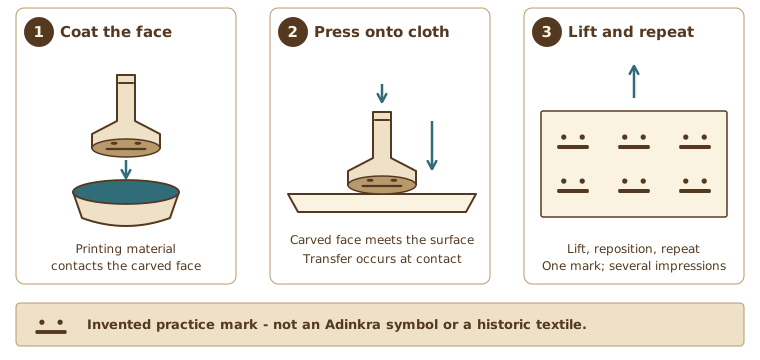
Original educational diagram, not a photograph. An original stamp-transfer schematic using one invented mark. Tool and vessel profiles are explanatory, not a reconstruction of a specific workshop.
Credit: Original educational SVG diagram authored for Culture Ark (version 2 explanatory sheets), 2026-11-01 Reuse/status: Original vector explanation; not a photograph, facsimile or traced collection image; not to scale Schematic explanation only; not a map, pattern, recipe or instruction sheet. Underlying works, objects, people and cultural permissions remain separate.
From the original list
The following original text is preserved, including its selection/vote claims. Preservation is not independent verification of every assertion.
Why: Akan symbols that pack proverbs into shapes.
What to preserve: Sankofa, Gye Nyame, stamped cloth
Year and origin: 19th century · Ghana
Vote: 3/9 (historian 1 · future kid 1 · curator 1)
Learn more: Adinkra symbols on Wikipedia
Explanatory sheets
2 original explanatory sheets prepared for this pick, each with its own diagram. Codes in square brackets such as [A] point to the numbered sources at the end of the page.
Printing is a transfer, not just a picture
Place and people. Adinkra belongs to Akan cultural traditions, especially Asante cloth practice in present-day Ghana. It is not a generic alphabet for all of Africa. A cloth can bring together named signs, proverbial knowledge and the intentions of its wearer. Funeral use is important, but it is not the whole story: Ghana’s tourism authority describes Ntonso as a major living production centre and notes the wider range of colours and uses today. [R1, R4]
How the surface is made. In filmed testimony published by the Open University, maker Gabriel Kwaku Boatye distinguishes colouring the cloth from preparing the concentrated material used to print it. Bark is softened, pounded, boiled and filtered; a carved gourd or calabash stamp transfers the mark. Repetition depends on skilled placement, pressure and replenishing the printing material. The diagram isolates that transfer using an invented practice mark. It is neither an authenticated stamp nor a recovered historical textile. [R2, R3]
Two named ideas, not a fixed code. Sankofa invites a return to retrieve or learn from the past; makers and scholars discuss more than one visual form. Gye Nyame is commonly glossed “except God.” Interpretations can emphasize courage, God’s supremacy or religious faith in particular settings. These short English explanations are starting points, not interchangeable one-word translations. OpenLearn’s maker interviews include newly devised signs, while scholarship records disagreement about some names and readings. Ask whose explanation is being used, and in what situation. [R2, R3, R5]
Names, people and occasion carry meaning
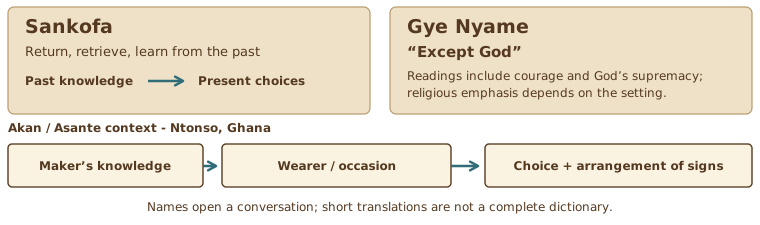
Documented meanings are stated in text; the arrows are teaching graphics, not Adinkra signs. No cultural artwork is reproduced.
What preservation should retain. Preserve the name, maker’s explanation, technique, intended use and provenance alongside any image. A motif detached from this evidence loses much of its communicative life. The original Ark’s nineteenth-century date is retained unchanged; early nineteenth-century surviving cloths do not establish a precise invention date. This new sheet adds a teaching reconstruction, not an attribution, an endorsement by a community, or a replacement for the original record. [R2, R4]
Where to learn more
- https://apiarybee.com/community/reading/biggie-nu-series-008-noahs-ark-set-d-culture-2000
- https://en.wikipedia.org/wiki/Adinkra_symbols
Sources and rights
- A · Existing Culture Ark record — Supplied current-live refresh; original source body unchanged.
- R1 · Ghana Tourism Authority / Visit Ghana - Ntonso Adinkra Cloth Village — Ntonso production context; funeral association and expanded contemporary use.
- R2 · The Open University, OpenLearn - Textiles in Ghana: maker interviews and historical context — Boatye’s account of cloth dye and printing material; calabash stamps; Sankofa meanings and innovation; history not reducible to a nineteenth-century invention.
- R3 · Smithsonian National Museum of African Art - Stamp: Gye Nyame, object 2010-10-388 — Stamp and Gye Nyame gloss; official indexed text read. Direct page retrieval failed.
- R4 · Detroit Institute of Arts - Adinkra, accession 2005.30 — Akan/Asante attribution; cloth as chosen visual message; stamp technique; a cloth collected in 1817.
- R5 · Smarthistory - Adinkra cloth — Names, meanings and interpretive variation. Indexed article text read; direct retrieval returned 403.
Drawings: Original educational SVG schematics; no copied historical/product artwork. Not to scale. Archive note: Archival wording above is unchanged. Early surviving Adinkra cloths do not establish a precise invention date. Sources consulted 2026-11-01. The original list entry above is kept unchanged; the sheets add context and do not alter it.
Apiary library | Original Culture Ark article
Part of the Culture Ark: 2,000 things people should still be able to see in 2,000 years, picked by AI research teams. This page keeps the original list entry for D-1609 word for word and adds context. Browse the gallery. The Culture Ark is an Artificial Mind Hive (AMH) project. AMH is owned by Austin Little.

Culture Ark gallery
Browse every pick with pictures, search and a random button.
Open the gallery →