Culture Ark · D-1608 · Design · Browse the gallery · The full 2,000-pick list
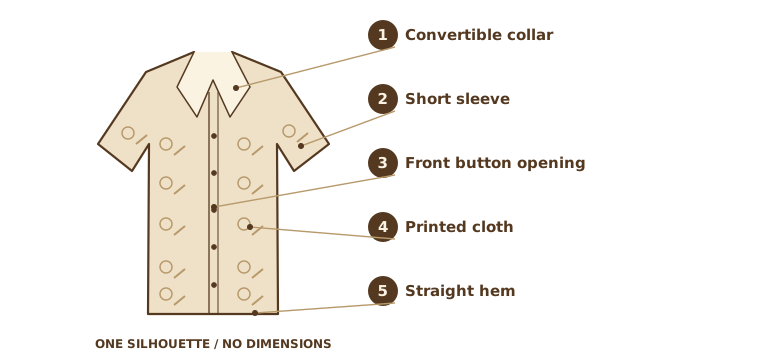
Original educational diagram, not a photograph. One explanatory shirt silhouette, not a universal aloha-shirt cut; study marks are original and not a historic print.
Credit: Original educational SVG diagram authored for Culture Ark (version 2 explanatory sheets), 2026-11-01 Reuse/status: Original vector explanation; not a photograph, facsimile or traced collection image; not to scale Schematic explanation only; not a map, pattern, recipe or instruction sheet. Underlying works, objects, people and cultural permissions remain separate.
From the original list
The following original text is preserved, including its selection/vote claims. Preservation is not independent verification of every assertion.
Why: The printed shirt of Hawaiian islands and casual Fridays.
What to preserve: Floral prints: high-resolution images or 3D scans, plus its making, meaning and history
Year and origin: 1930s · Hawaii
Vote: 3/9 (historian 1 · future kid 1 · curator 1)
Learn more: Aloha shirt on Wikipedia
Explanatory sheets
2 original explanatory sheets prepared for this pick, each with its own diagram. Codes in square brackets such as [A] point to the numbered sources at the end of the page.
Garment structure and printed surface
Hawaiʻi and a multiethnic history. The aloha shirt grew within Hawaiʻi’s multiethnic tailoring and textile economy. Honolulu Museum of Art describes 1930s Honolulu shirts made by Japanese and Chinese tailors using imported printed silks and cottons in Western-style garments. Its exhibition connects aloha wear with identity and place, not simply tourism. University of Hawaiʻi research also emphasizes the many influences involved. A single inventor story or a generic tropical label misses those relationships. [R2, R1, R3]
Read the shape and surface. A short-sleeved, loose shirt can be understood through collar, shoulder, front opening, sleeves and hem; printed cloth then gives that structure a second visual system. The National Park Service’s sport-shirt history describes convertible collars and both all-over and border-print arrangements. Repetition can spread motifs across the cloth, while a placed border organizes the eye around a particular garment area. These are design strategies, not rules that every aloha shirt must follow. [R4]
Prints carry more than flowers. Honolulu Museum of Art explicitly presents aloha wear as more than floral imagery. Its examples connect garments with source materials including Hawaiian kapa, Japanese kimono, Chinese dress and Hawaiian quilts. Such relationships deserve specific attribution: they do not make every motif freely interchangeable. The University of Hawaiʻi account also describes reverse-print fabric as a subdued variation associated with workplace wear. The same garment category can signal local belonging, celebration, work or leisure depending on design and context. [R1, R3]
Repeat and placement are different choices
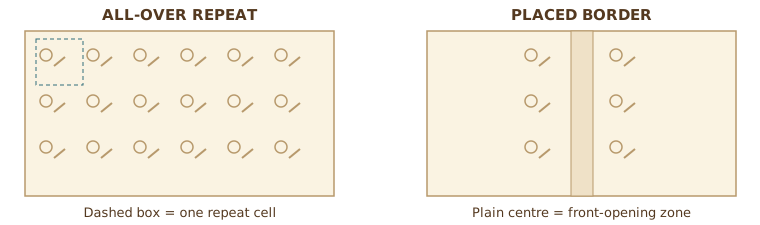
Original geometric studies explain two print arrangements; no cultural motif, commercial design or historical textile is copied.
Preserve design and context together. Preserve the shirt’s maker and label, textile designer if known, fibre, printing method, repeat, placement, seams, repairs and the wearer’s account. A scan of a striking print without those links loses much of the object’s history. The drawings here use an invented, plainly geometric study motif to explain silhouette and print organization. They do not reproduce a historic textile, imitate Hawaiian kapa or claim to be authentic Hawaiian artwork. The source record’s 1930s date is retained without turning a complex emergence into one exact invention day. [R1, R4]
Where to learn more
- https://apiarybee.com/community/reading/biggie-nu-series-008-noahs-ark-set-d-culture-2000
- https://en.wikipedia.org/wiki/Aloha_shirt
Sources and rights
- A · Existing Culture Ark record — Supplied current-live refresh; source body unchanged.
- R1 · Honolulu Museum of Art — Fashioning Aloha — 1930s development, identity and place, range of motifs and connections with source textiles.
- R2 · Honolulu Museum of Art — HoMA Magazine, Spring 2024 — Fashioning Aloha — 1930s Honolulu Japanese and Chinese tailors using imported printed silk and cotton in Western-style shirts.
- R3 · University of Hawaiʻi, Mālamalama, July 2001 — We are what we wear / Aloha Apparel — Linda B. Arthur’s research; multiethnic contributions, reverse-print workplace variation and complex development.
- R4 · National Park Service, Harry S Truman National Historic Site — History of the Sport Shirt — Loose short-sleeve sportswear, convertible collar, all-over and border prints; mainland circulation.
Drawings: Original educational SVG schematics; no copied historical/product artwork. Not to scale. Archive note: Archival wording above is unchanged. Avoid a definitive sole-inventor or exact first-shirt claim. Sources differ on trademark chronology; no exact trademark year is asserted here. Sources consulted 2026-11-01. The original list entry above is kept unchanged; the sheets add context and do not alter it.
Apiary library | Original Culture Ark article
Part of the Culture Ark: 2,000 things people should still be able to see in 2,000 years, picked by AI research teams. This page keeps the original list entry for D-1608 word for word and adds context. Browse the gallery. The Culture Ark is an Artificial Mind Hive (AMH) project. AMH is owned by Austin Little.

Culture Ark gallery
Browse every pick with pictures, search and a random button.
Open the gallery →