Culture Ark · D-1607 · Design · Browse the gallery · The full 2,000-pick list
Original educational diagram, not a photograph. The paired roles follow Inuvialuit Regional Corporation’s account. Outlines are abstract and do not copy a community-specific garment.
Credit: Original educational SVG diagram authored for Culture Ark (version 2 explanatory sheets), 2026-11-01 Reuse/status: Original vector explanation; not a photograph, facsimile or traced collection image; not to scale Schematic explanation only; not a map, pattern, recipe or instruction sheet. Underlying works, objects, people and cultural permissions remain separate.
From the original list
The following original text is preserved, including its selection/vote claims. Preservation is not independent verification of every assertion.
Why: Inuit hooded coat made for survival in the cold.
What to preserve: Caribou skin parka, fishtail parka
Year and origin: ancient · Arctic
Vote: 3/9 (historian 1 · future kid 1 · curator 1)
Learn more: Parka on Wikipedia
Explanatory sheets
2 original explanatory sheets prepared for this pick, each with its own diagram. Codes in square brackets such as [A] point to the numbered sources at the end of the page.
Inuvialuit inner and outer roles
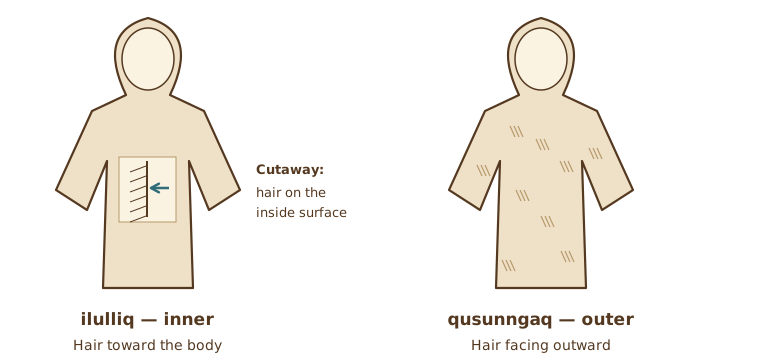
A named Arctic example. The original entry’s Arctic description is a starting point, not a single pattern shared by every northern community. Here the representative system is Inuvialuit clothing, described by the Inuvialuit Regional Corporation. Its account names an inner parka, ilulliq, worn with the hair toward the body, and an outer parka, qusunngaq, with the hair outward. These terms and arrangements are presented as Inuvialuit, not as universal terminology for all Inuit or all Arctic peoples. [R1]
Materials and skilled fitting. Caribou hide was a preferred material in the Inuvialuit account, but the outfit also included trousers, footwear and hand coverings. A coat cannot explain the whole protection system. For a distinct museum example, the Canadian Museum of History records parka IV-D-918 as Copper Inuit, made by September 1916 or earlier, with caribou skin, sinew, metal and ermine skin. Its interpretation emphasizes individual tailoring and the experienced maker’s judgement rather than an industrial standard-size template. [R1, R2]
More than insulation. Garment forms and decoration communicate identity as well as addressing weather. McCord Stewart Museum’s exhibition, developed with an Indigenous advisory committee, explains that clothing can convey community relationships, achievement and connections with the natural world. Its Nunavimmiut amauti example also shows why a child-carrying garment must not be reduced to an ordinary coat with an oversized hood. Regional form, intended wearer and use matter; no one silhouette represents them all. [R3]
Hair orientation is not a warmth rating
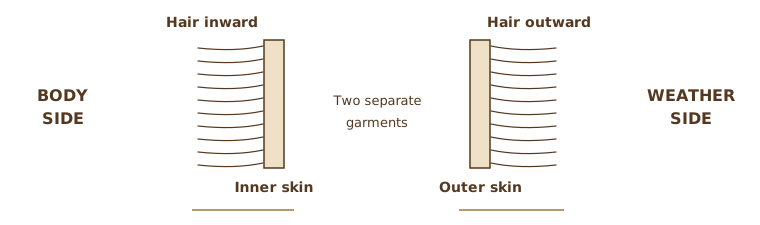
Orientation only: not a thermal model, measured thickness, cutting pattern or cold-weather safety specification.
Continuity, not a frozen past. The Inuvialuit account includes fabric parkas and contemporary sewing, not only historical skins. Preserve the maker’s account, the garment’s named community, materials, tailoring, repairs and use alongside any photographs. This sheet’s drawings explain the named two-layer relationship; they do not reproduce community-specific trim, sacred meaning or a validated survival garment. The source entry’s separate mention of a fishtail parka is retained unchanged, but is not treated as evidence that a modern military or fashion coat has the same construction or cultural identity. [R1, R2]
Where to learn more
- https://apiarybee.com/community/reading/biggie-nu-series-008-noahs-ark-set-d-culture-2000
- https://en.wikipedia.org/wiki/Parka
Sources and rights
- A · Existing Culture Ark record — Supplied current-live refresh; source body unchanged.
- R1 · Inuvialuit Regional Corporation — Clothing — Community-specific inner/outer names and hair orientation, caribou preference, broader outfit, identity and ongoing fabric-parka practice.
- R2 · Canadian Museum of History — Parka, artifact IV-D-918 — Separate Copper Inuit attribution; materials; made by September 1916 or earlier; individual fitting and experienced makers.
- R3 · McCord Stewart Museum — Wearing Our Identity — The First Peoples Collection — Exhibition developed with Indigenous advisory committee; social/cultural identity and named Nunavimmiut amauti, 1890–1897, M5837.
Drawings: Original educational SVG schematics; no copied historical/product artwork. Not to scale. Archive note: Archival wording above is unchanged. Do not equate Inuvialuit, Copper Inuit and Nunavimmiut examples: they are explicitly distinct references. Use exact Inuvialuit spelling from the community source; do not silently substitute other regional terms. Sources consulted 2026-11-01. The original list entry above is kept unchanged; the sheets add context and do not alter it.
Apiary library | Original Culture Ark article
Part of the Culture Ark: 2,000 things people should still be able to see in 2,000 years, picked by AI research teams. This page keeps the original list entry for D-1607 word for word and adds context. Browse the gallery. The Culture Ark is an Artificial Mind Hive (AMH) project. AMH is owned by Austin Little.

Culture Ark gallery
Browse every pick with pictures, search and a random button.
Open the gallery →