Culture Ark · D-1606 · Design · Browse the gallery · The full 2,000-pick list
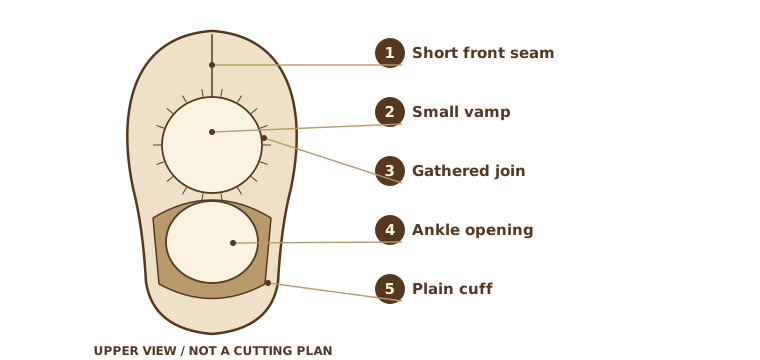
Original educational diagram, not a photograph. Structural abstraction of the Ojibwe-associated deer-nose form described by Milwaukee Public Museum; no historic beadwork is reproduced.
Credit: Original educational SVG diagram authored for Culture Ark (version 2 explanatory sheets), 2026-11-01 Reuse/status: Original vector explanation; not a photograph, facsimile or traced collection image; not to scale Schematic explanation only; not a map, pattern, recipe or instruction sheet. Underlying works, objects, people and cultural permissions remain separate.
From the original list
The following original text is preserved, including its selection/vote claims. Preservation is not independent verification of every assertion.
Why: Soft leather shoes of Indigenous North America.
What to preserve: Beadwork styles: high-resolution images or 3D scans, plus its making, meaning and history
Year and origin: ancient · North America
Vote: 3/9 (historian 1 · future kid 1 · curator 1)
Learn more: Moccasin on Wikipedia
Explanatory sheets
2 original explanatory sheets prepared for this pick, each with its own diagram. Codes in square brackets such as [A] point to the numbered sources at the end of the page.
A named Great Lakes construction
Name the community. “Moccasin” is a broad footwear label, not one universal Indigenous pattern. This sheet uses an Ojibwe-associated Great Lakes form for its structural explanation. Milwaukee Public Museum describes a small, gathered vamp above a short front seam, sometimes called the deer-nose form. The museum distinguishes this from other local constructions. The diagram therefore names its reference tradition rather than presenting its outline as a model for all Indigenous North America. [R1]
Read an individual object. A separate documentary example is the National Museum of the American Indian’s pair, catalogue 20/210, attributed to Anishinaabe (Chippewa/Ojibwa) people. Its materials include hide, wool cloth, glass beads and cotton tape; its techniques include sewing, appliqué and overlay beadwork. The museum describes its Great Lakes location as inferred and its collection history as unknown. Those qualifications belong beside the record: a museum attribution is not a recovered maker’s name or a complete life history. [R2]
Structure is not decoration. In the soft-soled construction discussed here, the hide under the foot continues upward around the sides. A vamp covers the upper front, while gathering brings curved edges together; the cuff surrounds the ankle opening. This is a relationship diagram, not a cutting plan. Beadwork can be a highly specific artistic expression, so neither a colour palette nor a flower outline should be treated as an interchangeable tribal signature. Our blank decorative fields deliberately avoid copying an existing design. [R1, R2]
Materials in section and the object record
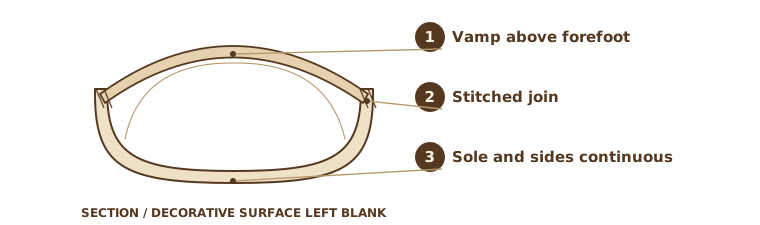
Conceptual section: relationships rather than thickness, scale or an executable construction sequence.
Preserve knowledge responsibly. Preserve maker and community identifications when known, materials, joins, wear, repairs, provenance and the permissions governing images. Keep uncertainty visible rather than filling gaps with invented tradition. Minnesota Historical Society explicitly treats its Ojibwe records as open to further research, and withholds images of items identified as culturally sensitive through consultation. A high-resolution image or scan is therefore only one possible record, not automatic permission to reproduce, teach or commercialize a design. Community knowledge and decisions remain essential. [R3]
Where to learn more
- https://apiarybee.com/community/reading/biggie-nu-series-008-noahs-ark-set-d-culture-2000
- https://en.wikipedia.org/wiki/Moccasin
Sources and rights
- A · Existing Culture Ark record — Supplied current-live refresh; source body unchanged.
- R1 · Milwaukee Public Museum — Clothing — Moccasins — Named Ojibwe-associated deer-nose form; small vamp, short seam, gathered join, continuous soft sole/sides. Use only this specific description, not all of the page’s broad historical generalizations.
- R2 · National Museum of the American Indian — Moccasins, catalogue 20/210, record NMAI_213516 — Specific Anishinaabe attribution, materials and techniques; inferred geography and unknown collection history; image restrictions.
- R3 · Minnesota Historical Society — Explore Ojibwe Material Culture — Collections uncertainty and consultation-based withholding of culturally sensitive images.
Drawings: Original educational SVG schematics; no copied historical/product artwork. Not to scale. Archive note: Archival wording above is unchanged. The diagram is not a reconstruction of NMAI catalogue 20/210. Do not substitute generic Plains beadwork or a hard outsole into this named Great Lakes example. Sources consulted 2026-11-01. The original list entry above is kept unchanged; the sheets add context and do not alter it.
Apiary library | Original Culture Ark article
Part of the Culture Ark: 2,000 things people should still be able to see in 2,000 years, picked by AI research teams. This page keeps the original list entry for D-1606 word for word and adds context. Browse the gallery. The Culture Ark is an Artificial Mind Hive (AMH) project. AMH is owned by Austin Little.

Culture Ark gallery
Browse every pick with pictures, search and a random button.
Open the gallery →