Culture Ark · D-1605 · Design · Browse the gallery · The full 2,000-pick list
Original educational diagram, not a photograph. Selected relationships from Jacob’s 1914 patent; newly drawn, not to scale and not a sewing pattern.
Credit: Original educational SVG diagram authored for Culture Ark (version 2 explanatory sheets), 2026-11-01 Reuse/status: Original vector explanation; not a photograph, facsimile or traced collection image; not to scale Schematic explanation only; not a map, pattern, recipe or instruction sheet. Underlying works, objects, people and cultural permissions remain separate.
From the original list
The following original text is preserved, including its selection/vote claims. Preservation is not independent verification of every assertion.
Why: Undergarment patented by Mary Phelps Jacob.
What to preserve: Patent, sports bra
Year and origin: 1914 · United States
Vote: 3/9 (historian 1 · future kid 1 · curator 1)
Learn more: Bra on Wikipedia
Explanatory sheets
2 original explanatory sheets prepared for this pick, each with its own diagram. Codes in square brackets such as [A] point to the numbered sources at the end of the page.
Different designs for different needs
A patent, not a single beginning. The preserved entry dates the brassiere to Mary Phelps Jacob’s 1914 patent. That is a useful documentary landmark, not the beginning of every garment made to support or shape the breasts. Jacob’s patent itself describes improvements to an existing garment category. The Metropolitan Museum of Art also documents late-nineteenth-century predecessors and a lightweight French brassiere from the 1920s. Different designs served different bodies, fashions and activities. [R1, R2]
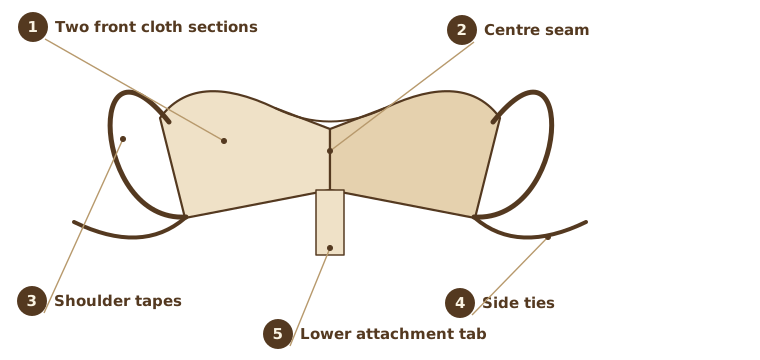
Read the construction. Jacob filed her application on 12 February 1914; the patent was granted on 3 November. Its design joined two fabric sections at the centre front, with shoulder tapes, side ties and a lower central tab that attached to another garment. The stated aim was a light, unboned garment compatible with low-backed evening dress. These are the inventor’s design intentions, not a modern fit or performance test. [R1]
A different brief: running. In 1977, Lisa Lindahl, Hinda Miller and Polly Smith developed the Jogbra in response to discomfort while running. Their athletic-brassiere patent was granted in 1979. Rather than simply miniaturizing a corset, the design addressed movement: it specified a broad elastic band, straps crossing at the back, no fastening hardware and seams directed outward to reduce rubbing. Those choices show how a change in activity can change the entire garment, not merely its appearance. [R3, R4]
Athletic construction changes the brief
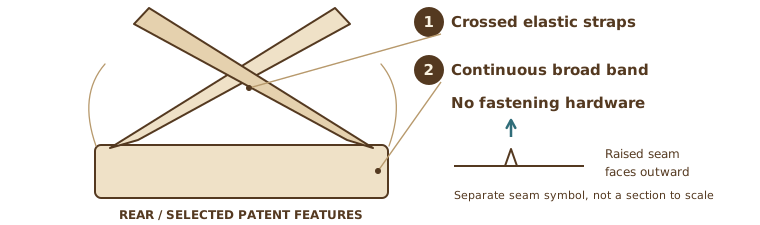
Rear-view abstraction of features described in the athletic-brassiere patent; not all sports bras use this construction.
What should survive. A useful preservation record keeps the patent alongside the physical garment, textile composition, alterations, labels, advertising and wearers’ accounts. A flat photograph alone cannot explain elasticity or how a garment behaves on different bodies. Record what was measured and what remains unknown. The two diagrams are new explanatory drawings of selected design relationships. They are not historic patent plates, usable cutting patterns, sizing instructions or evidence that either design will fit a particular person. [R2, R4]
Where to learn more
- https://apiarybee.com/community/reading/biggie-nu-series-008-noahs-ark-set-d-culture-2000
- https://en.wikipedia.org/wiki/Bra
Sources and rights
- A · Existing Culture Ark record — Supplied current-live refresh; source body unchanged.
- R1 · Mary P. Jacob — US1115674A — Brassiere — Application/grant dates, existing-category wording, fabric sections, shoulder tapes, ties and central tab.
- R2 · The Metropolitan Museum of Art — Brassiere, French, 1920s, object 1977.363.18 — Earlier breast-support garments; lightweight 1920s example; silk and cotton.
- R3 · United States Patent and Trademark Office — Establishing the new fit — Lindahl, Miller and Smith; 1977 development and 1979 patent.
- R4 · Hinda S. Schreiber, Eugenie Z. Lindahl and Polly P. Smith — US4174717A — Athletic brassiere — Broad continuous band, crossed straps, outward seams, absence of hardware and design aims.
Drawings: Original educational SVG schematics; no copied historical/product artwork. Not to scale. Archive note: Archival wording above is unchanged. Do not relabel Jacob as sole inventor of all bras. 1977 development and 1979 patent are distinct events. Sources consulted 2026-11-01. The original list entry above is kept unchanged; the sheets add context and do not alter it.
Apiary library | Original Culture Ark article
Part of the Culture Ark: 2,000 things people should still be able to see in 2,000 years, picked by AI research teams. This page keeps the original list entry for D-1605 word for word and adds context. Browse the gallery. The Culture Ark is an Artificial Mind Hive (AMH) project. AMH is owned by Austin Little.

Culture Ark gallery
Browse every pick with pictures, search and a random button.
Open the gallery →