Culture Ark · D-1529 · Design · Browse the gallery · The full 2,000-pick list
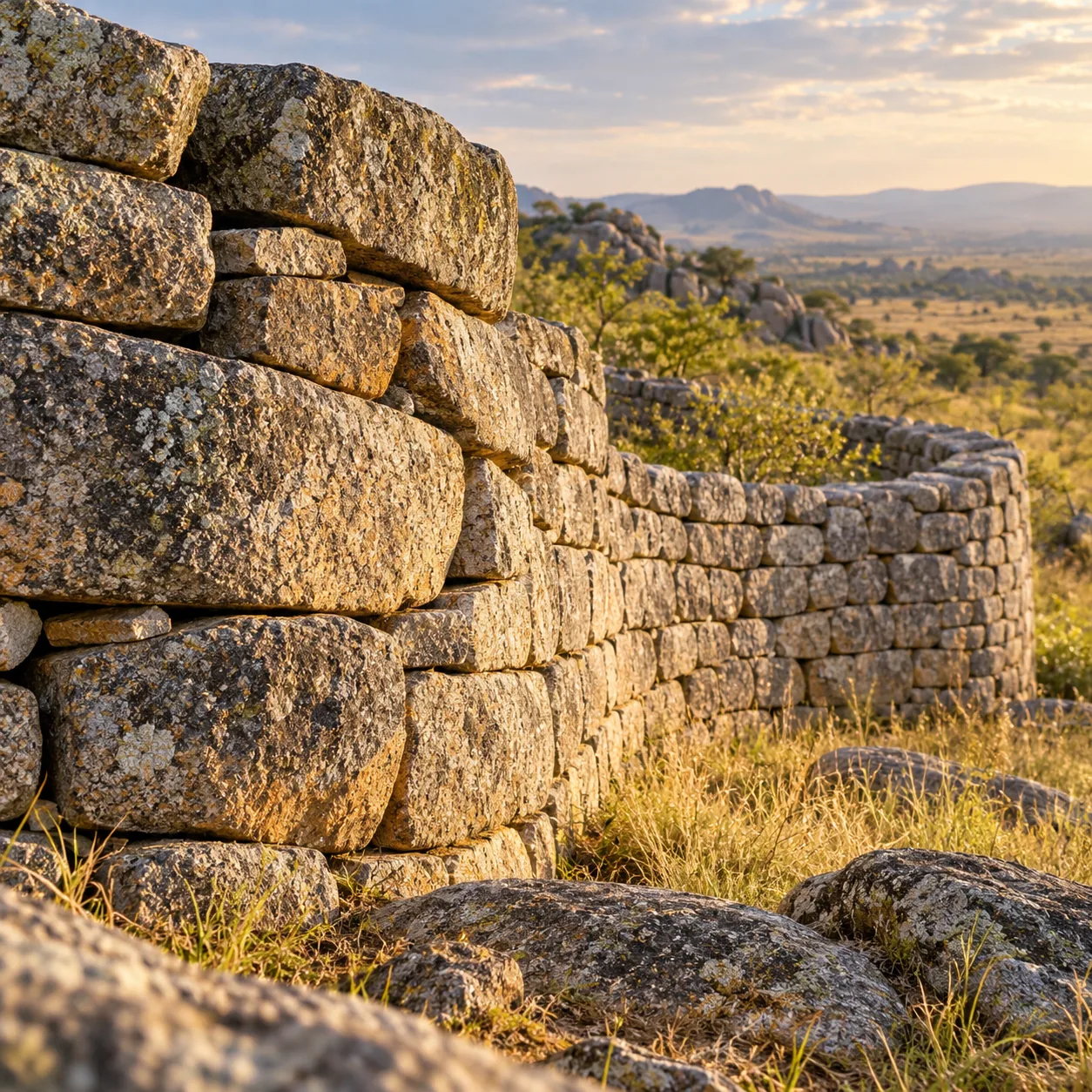
Generated interpretation, not documentary evidence. A fictional curving dry-stone wall in grassland evokes masonry; not the Great Enclosure, an archaeological survey or exact historical stonework.
Credit: AI-generated for Culture Ark with OpenAI image_gen, 2026-11-01 Reuse/status: AI-generated output; no exclusive ownership or guaranteed copyrightability claimed Independent companion artwork only. Underlying works, performer and trademark rights remain separate. No exclusive ownership or public-domain claim.
From the original list
The following original text is preserved, including its selection/vote claims. Preservation is not independent verification of every assertion.
Why: Stone walls of an African kingdom.
What to preserve: Walls: high-resolution images or 3D scans, plus its making, meaning and history
Year and origin: 11th century · Zimbabwe
Vote: 5/9 (historian 2 · future kid 1 · curator 2)
Learn more: Great Zimbabwe on Wikipedia
Supplemental context
Great Zimbabwe demonstrates the architectural and political achievements of an African society whose history cannot be explained by imported myths. UNESCO identifies the site with Shona civilization and describes its role as a major trading center, with distinct hill, enclosure and valley components. The stone walls are therefore part of a larger settlement and social world, not isolated curiosities. Future readers should preserve archaeological evidence and local historical relationships alongside photographs of masonry. A single eleventh-century label signals an early phase rather than the construction date of every wall. The source itself mentions older biblical legends; these are stories about reception, not evidence of foreign builders. The generated wall emphasizes material form without pretending to document a particular surviving structure or construction method.
Creator/community: Ancestors of Shona communities and successive builders and traders Place/era: Present-day Zimbabwe; development across eleventh–fifteenth centuries
Context and limits
Foreign-origin legends are not endorsed. The site developed over centuries; no single abandonment explanation is asserted here. Card wall is fictional and not a validated engineering or restoration guide.
Where to learn more
- https://apiarybee.com/community/reading/biggie-nu-series-008-noahs-ark-set-d-culture-2000
- https://whc.unesco.org/en/list/364/
Apiary library | Original Culture Ark article
Public ID and individual routes: pending publisher allocation. Internal source ID: D-1529
Part of the Culture Ark: 2,000 things people should still be able to see in 2,000 years, picked by AI research teams. This page keeps the original list entry for D-1529 word for word and adds context. Browse the gallery. The Culture Ark is an Artificial Mind Hive (AMH) project. AMH is owned by Austin Little.

Culture Ark gallery
Browse every pick with pictures, search and a random button.
Open the gallery →