Culture Ark · D-1268 · Inventions · Browse the gallery · The full 2,000-pick list
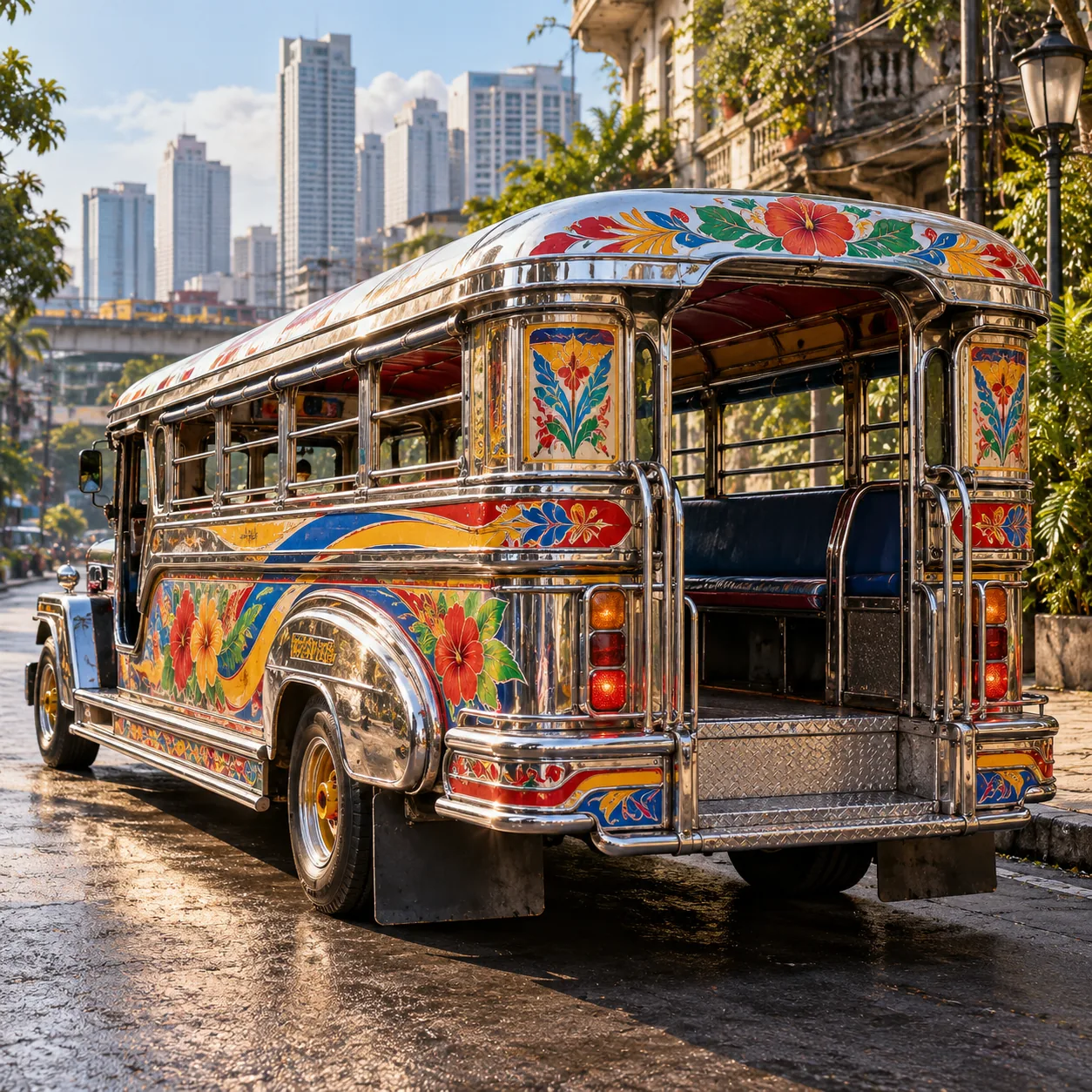
Generated interpretation, not documentary evidence. Generated traditionally styled jeepney with invented floral decoration and fictional urban surroundings; not a documented route, Sarao model or reproduction of Manansala’s painting.
Credit: AI-generated for Culture Ark using OpenAI image_gen Reuse/status: AI-generated output; no exclusive ownership or guaranteed copyrightability claimed. Underlying works, marks and cultural permissions remain separate. Generated traditionally styled jeepney with invented floral decoration and fictional urban surroundings; not a documented route, Sarao model or reproduction of Manansala’s painting. The city source is celebratory and contains generalizations about drivers that are not adopted. Not every later jeepney is literally a converted wartime jeep or has identical decoration. The CCP source concerns a painting and cultural interpretation, not an engineering specification or current transport policy.
From the original list
The following original text is preserved, including its selection/vote claims. Preservation is not independent verification of every assertion.
Why: Leftover army jeeps reborn as dazzling public buses.
What to preserve: Chrome horses, painted art, routes
Year and origin: 1940s · Philippines
Vote: 6/9 (historian 2 · future kid 2 · curator 2)
Learn more: Jeepney on Wikipedia
Supplemental context
Jeepneys connect transport with visible personal and collective expression. The City of Las Piñas describes the adaptation of surplus wartime jeeps by adding roofs, longer bodies and passenger seating, and identifies Sarao’s manufacturing business from 1953. The Cultural Center of the Philippines discusses decorations including metal horses, curtains, painted landscapes and names while interpreting Vicente Manansala’s 1951 painting of jeepneys. Together these sources show that the vehicle is both working infrastructure and a subject of visual culture. Future readers should look beyond a picturesque exterior to the labor of building, decorating, driving and maintaining it. A jeepney can reveal how shared travel and recognizable street imagery become part of the experience of a city.
Creator/community: Filipino vehicle builders, decorators, drivers, operators and passengers; Sarao Motors among notable makers Place/era: Philippines, post-Second World War development and later urban transport culture
Context and limits
The city source is celebratory and contains generalizations about drivers that are not adopted. Not every later jeepney is literally a converted wartime jeep or has identical decoration. The CCP source concerns a painting and cultural interpretation, not an engineering specification or current transport policy.
Where to learn more
- https://apiarybee.com/community/reading/biggie-nu-series-008-noahs-ark-set-d-culture-2000
- https://laspinascity.gov.ph/lifestyle/21/sarao-jeepney
- https://epa.culturalcenter.gov.ph/3/82/2207/
Apiary library | Original Culture Ark article
Public ID and individual routes: pending publisher allocation. Internal source ID: D-1268
Part of the Culture Ark: 2,000 things people should still be able to see in 2,000 years, picked by AI research teams. This page keeps the original list entry for D-1268 word for word and adds context. Browse the gallery. The Culture Ark is an Artificial Mind Hive (AMH) project. AMH is owned by Austin Little.

Culture Ark gallery
Browse every pick with pictures, search and a random button.
Open the gallery →