Culture Ark · D-1270 · Inventions · Browse the gallery · The full 2,000-pick list
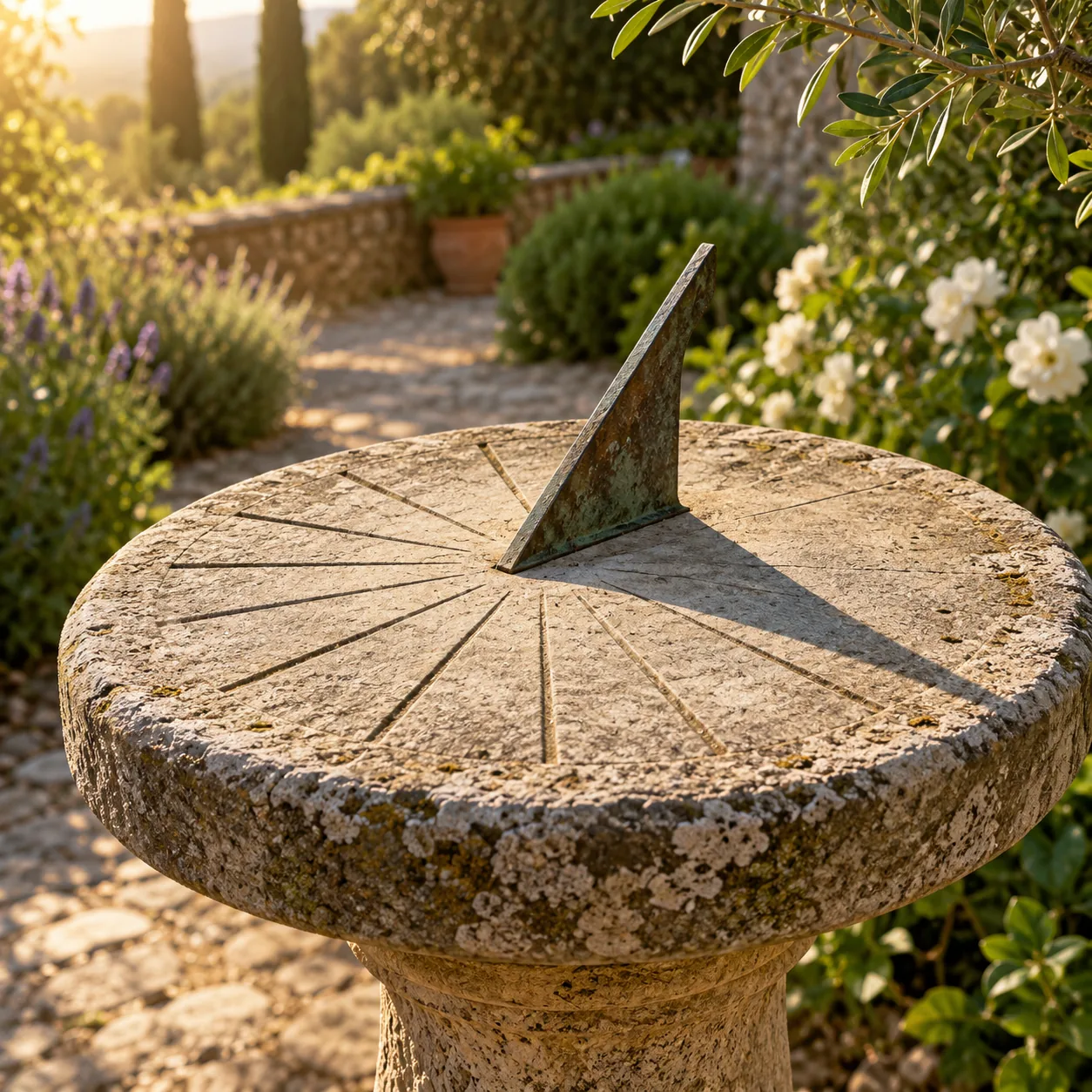
Generated interpretation, not documentary evidence. Generated garden sundial with triangular gnomon and shadow; invented unnumbered dial, not an Egyptian artifact, Jaipur instrument or calibrated clock.
Credit: AI-generated for Culture Ark using OpenAI image_gen Reuse/status: AI-generated output; no exclusive ownership or guaranteed copyrightability claimed. Underlying works, marks and cultural permissions remain separate. Generated garden sundial with triangular gnomon and shadow; invented unnumbered dial, not an Egyptian artifact, Jaipur instrument or calibrated clock. The original Egyptian date is retained as archival text but not independently established by these sources. Jantar Mantar contains multiple kinds of instruments, not just sundials. Accurate time readings require appropriate design and placement; the generated markings and shadow are illustrative and uncalibrated, not a construction plan.
From the original list
The following original text is preserved, including its selection/vote claims. Preservation is not independent verification of every assertion.
Why: Shadows as clocks.
What to preserve: Egyptian shadow clocks, Jantar Mantar
Year and origin: c. 1500 BC · Egypt
Vote: 6/9 (historian 2 · future kid 2 · curator 2)
Learn more: Sundial on Wikipedia
Supplemental context
A sundial makes changing sunlight into a visible measure of time. The Horniman Museum explains the gnomon as the part that casts the indicating shadow and distinguishes solar time from the equal-hour clock time familiar in daily schedules. Its collection includes objects that combine this function with commemorative design and garden sculpture. UNESCO’s account of Jaipur’s Jantar Mantar places monumental astronomical instruments within the learned environment of Jai Singh II in the early eighteenth century. For future readers, these examples show that timekeeping is not only a matter of precision: it also expresses patronage, knowledge and the organization of daily life. Small garden dials and architectural observatories should be compared without assuming they are interchangeable instruments.
Creator/community: Astronomers, craftspeople and patrons across societies; Jai Singh II’s observatory tradition among examples Place/era: Ancient and later traditions; Jaipur early eighteenth century and modern museum garden interpretations
Context and limits
The original Egyptian date is retained as archival text but not independently established by these sources. Jantar Mantar contains multiple kinds of instruments, not just sundials. Accurate time readings require appropriate design and placement; the generated markings and shadow are illustrative and uncalibrated, not a construction plan.
Where to learn more
- https://apiarybee.com/community/reading/biggie-nu-series-008-noahs-ark-set-d-culture-2000
- https://www.horniman.ac.uk/plan-your-visit/around-the-horniman/sundial-trail/
- https://whc.unesco.org/en/list/1338/
Apiary library | Original Culture Ark article
Public ID and individual routes: pending publisher allocation. Internal source ID: D-1270
Part of the Culture Ark: 2,000 things people should still be able to see in 2,000 years, picked by AI research teams. This page keeps the original list entry for D-1270 word for word and adds context. Browse the gallery. The Culture Ark is an Artificial Mind Hive (AMH) project. AMH is owned by Austin Little.

Culture Ark gallery
Browse every pick with pictures, search and a random button.
Open the gallery →