Culture Ark · D-1269 · Inventions · Browse the gallery · The full 2,000-pick list
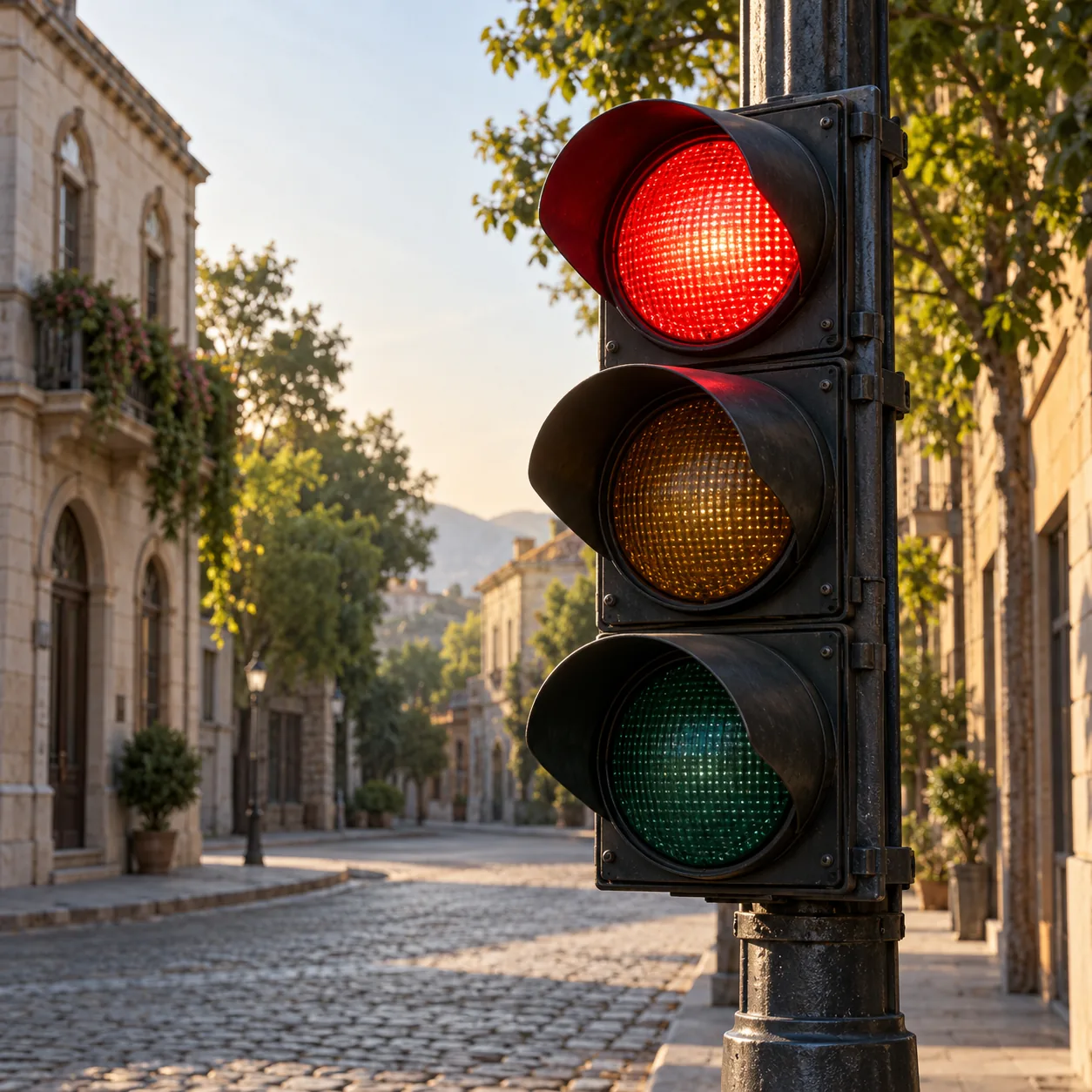
Generated interpretation, not documentary evidence. Generated modern-style three-lens signal with red illuminated, in a fictional street; not the 1920 museum object or an authoritative road-safety diagram.
Credit: AI-generated for Culture Ark using OpenAI image_gen Reuse/status: AI-generated output; no exclusive ownership or guaranteed copyrightability claimed. Underlying works, marks and cultural permissions remain separate. Generated modern-style three-lens signal with red illuminated, in a fictional street; not the 1920 museum object or an authoritative road-safety diagram. The original 1868 London date and East German pedestrian figure refer to different milestones not independently established by this object record. Signal sequences, layouts and legal meanings vary; this is cultural history, not driving guidance or a universal rulebook. The image is not Potts’s four-way artifact.
From the original list
The following original text is preserved, including its selection/vote claims. Preservation is not independent verification of every assertion.
Why: Red, amber, green: a global silent language.
What to preserve: London gas lamp, Detroit three-colour light, East German Ampelmännchen
Year and origin: 1868 · United Kingdom
Vote: 6/9 (historian 2 · future kid 2 · curator 2)
Learn more: Traffic light on Wikipedia
Supplemental context
A traffic signal turns a shared convention into an everyday negotiation over space and movement. The Henry Ford holds a 1920 four-direction signal designed by Detroit police officer William Potts. Its collection record explains the addition of amber to earlier red-and-green illuminated signals and identifies the intersection where the object was installed. This is a specific milestone within a longer history rather than the invention of all traffic control. For future readers, the signal is valuable because it makes cooperation visible: strangers are expected to interpret a small set of lights and coordinate their actions. Studying the object also raises questions about who designs streets, whose movement receives priority and how public systems teach their users to behave.
Creator/community: Traffic engineers, public authorities and road users; William L. Potts for the cited 1920 object Place/era: Detroit, United States, 1920 three-color signal; wider international signaling histories
Context and limits
The original 1868 London date and East German pedestrian figure refer to different milestones not independently established by this object record. Signal sequences, layouts and legal meanings vary; this is cultural history, not driving guidance or a universal rulebook. The image is not Potts’s four-way artifact.
Where to learn more
- https://apiarybee.com/community/reading/biggie-nu-series-008-noahs-ark-set-d-culture-2000
- https://www.thehenryford.org/collections/explore/artifact/227457
Apiary library | Original Culture Ark article
Public ID and individual routes: pending publisher allocation. Internal source ID: D-1269
Part of the Culture Ark: 2,000 things people should still be able to see in 2,000 years, picked by AI research teams. This page keeps the original list entry for D-1269 word for word and adds context. Browse the gallery. The Culture Ark is an Artificial Mind Hive (AMH) project. AMH is owned by Austin Little.

Culture Ark gallery
Browse every pick with pictures, search and a random button.
Open the gallery →