Culture Ark · D-0602 · Games · Browse the gallery · The full 2,000-pick list
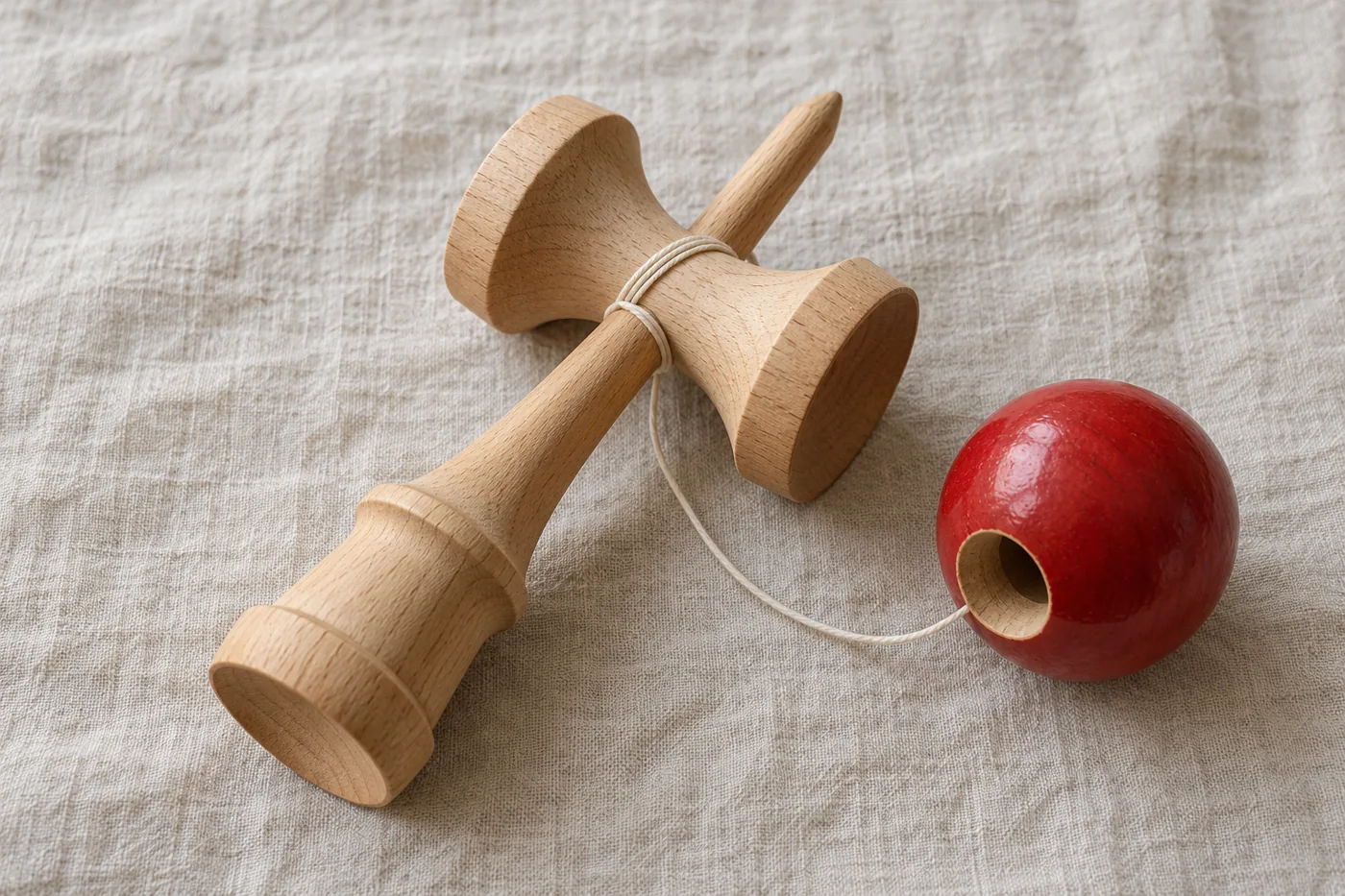
Generated interpretation, not documentary evidence. Wooden kendama-like handle and tethered red ball; interpretive object view, not a certified model or trick instruction.
Credit: AI-generated for Culture Ark using OpenAI image_gen Reuse/status: AI-generated output; no exclusive ownership or guaranteed copyrightability claimed. Underlying works, marks and cultural permissions remain separate. Wooden kendama-like handle and tethered red ball; interpretive object view, not a certified model or trick instruction. The original 1919 date is retained, but the opened Hatsukaichi municipal account dates Egusa's improvement to 1918 and local production three years later. These are different historical milestones, not a secure single invention date. Cup-and-ball toys existed elsewhere; the illustration is not a competition specification.
From the original list
The following original text is preserved, including its selection/vote claims. Preservation is not independent verification of every assertion.
Why: A cup-and-ball skill toy turned into an extreme sport.
What to preserve: A kendama, trick lists
Year and origin: 1919 (modern form) · Japan
Vote: 4/9 (historian 1 · future kid 2 · curator 1)
Learn more: Kendama on Wikipedia
Supplemental context
Kendama combines a tethered ball with a wooden handle, cups and a spike. Catching the ball becomes a demanding exercise in timing, balance and repeated practice. The Japanese embassy's account describes three cups and the spike; JapanGov's account follows the contemporary links between Nagai woodworking, teaching and international players. It is not only a purchased object: tricks circulate through demonstrations and social video, while local makers refine the implements. Future readers could see how a compact toy can connect regional manufacturing, intergenerational learning and a worldwide performance community without needing a screen for the act of play itself.
Creator/community: Japanese woodworkers and kendama players; Hamaji Egusa in the modern-form history; international skill communities Place/era: Japan; earlier cup-and-ball traditions, early twentieth-century form and contemporary global competitions
Context and limits
The original 1919 date is retained, but the opened Hatsukaichi municipal account dates Egusa's improvement to 1918 and local production three years later. These are different historical milestones, not a secure single invention date. Cup-and-ball toys existed elsewhere; the illustration is not a competition specification.
Where to learn more
- https://apiarybee.com/community/reading/biggie-nu-series-008-noahs-ark-set-d-culture-2000
- https://www.japan.go.jp/kizuna/2026/01/revitalizing_kendama.html
- https://www.sg.emb-japan.go.jp/JCC/E-Magazine-Apr-2020-Traditional-Japanese-Toys.html
- https://www.city.hatsukaichi.hiroshima.jp/uploaded/attachment/6391.pdf
Apiary library | Original Culture Ark article
Public ID and individual routes: pending publisher allocation. Internal source ID: D-0602
Part of the Culture Ark: 2,000 things people should still be able to see in 2,000 years, picked by AI research teams. This page keeps the original list entry for D-0602 word for word and adds context. Browse the gallery. The Culture Ark is an Artificial Mind Hive (AMH) project. AMH is owned by Austin Little.

Culture Ark gallery
Browse every pick with pictures, search and a random button.
Open the gallery →