Culture Ark · D-0607 · Games · Browse the gallery · The full 2,000-pick list
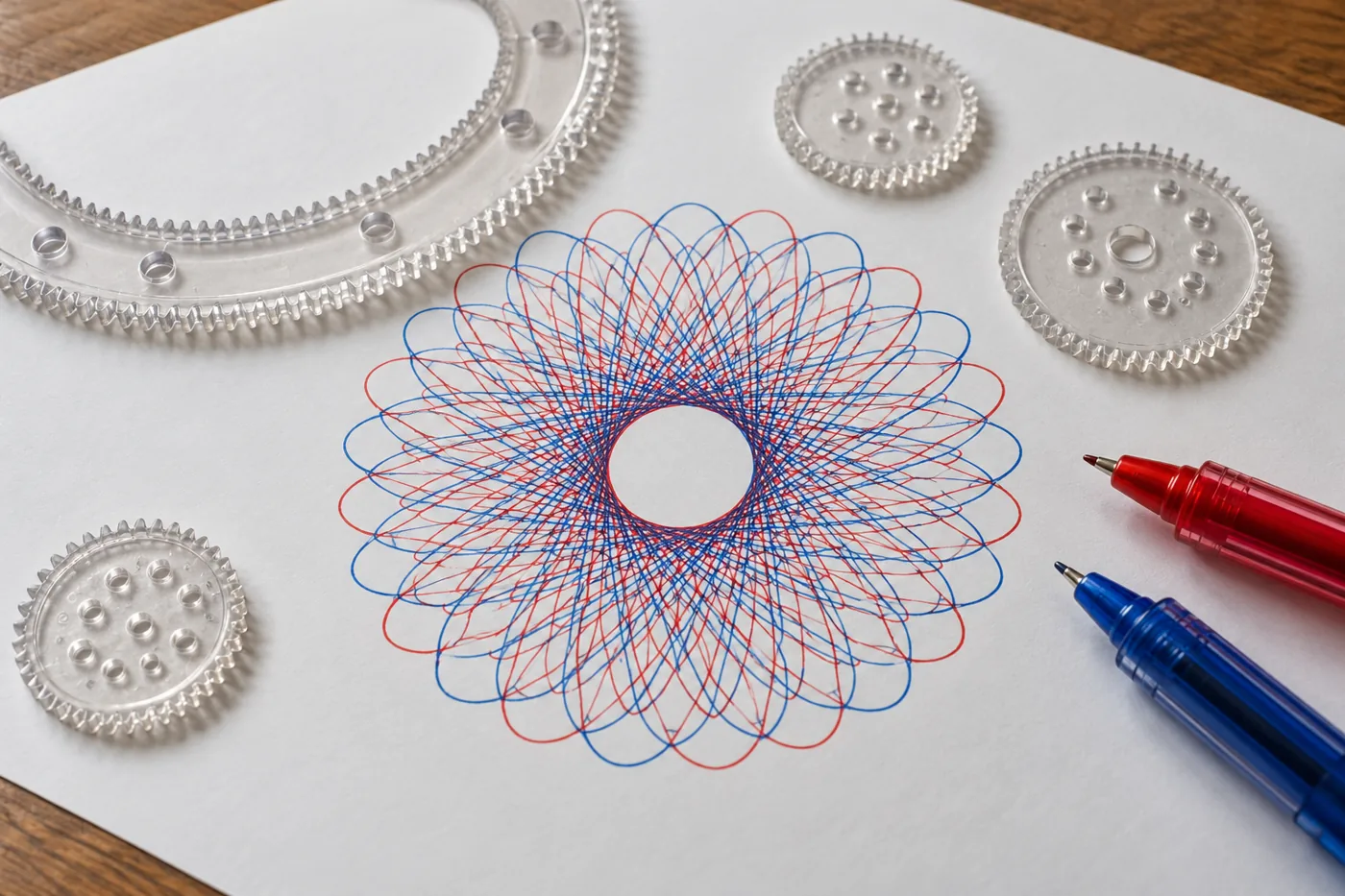
Generated interpretation, not documentary evidence. Transparent drawing gears beside an original looping rosette; not a verified Spirograph parts inventory or computed curve.
Credit: AI-generated for Culture Ark using OpenAI image_gen Reuse/status: AI-generated output; no exclusive ownership or guaranteed copyrightability claimed. Underlying works, marks and cultural permissions remain separate. Transparent drawing gears beside an original looping rosette; not a verified Spirograph parts inventory or computed curve. Gear-based drawing devices predate this branded toy; 1965 is not the invention of mathematical curves. Different sets contain different parts. The generated rosette is illustrative, not proof that the depicted gears produce that exact curve. Museum images remain separately copyrighted and were not downloaded.
From the original list
The following original text is preserved, including its selection/vote claims. Preservation is not independent verification of every assertion.
Why: Gears that draw mathematical curves.
What to preserve: Set, sample drawings
Year and origin: 1965 · United Kingdom
Vote: 4/9 (historian 1 · future kid 2 · curator 1)
Learn more: Spirograph on Wikipedia
Supplemental context
Spirograph makes elaborate-looking drawings accessible through the movement of toothed wheels and rings. London Museum holds a Denys Fisher set dated 1965–1970, while The Strong's curator places its public appearance at the 1965 Nuremberg Toy Fair. Repeated motion creates looping patterns that connect manual play with geometric structure. The attraction is not only a finished design but the process of watching a line return and interlace. Future audiences could study a drawing toy that allowed precision and experimentation to coexist, showing how a mechanical constraint could expand a child's visual imagination rather than merely restrict it.
Creator/community: Denys Fisher and his company; later distributors and generations of drawing-toy users Place/era: United Kingdom; 1960 s development and 1965 exhibition, international distribution
Context and limits
Gear-based drawing devices predate this branded toy; 1965 is not the invention of mathematical curves. Different sets contain different parts. The generated rosette is illustrative, not proof that the depicted gears produce that exact curve. Museum images remain separately copyrighted and were not downloaded.
Where to learn more
- https://apiarybee.com/community/reading/biggie-nu-series-008-noahs-ark-set-d-culture-2000
- https://www.londonmuseum.org.uk/collections/v/object-53482/spirograph/
- https://www.museumofplay.org/blog/what-goes-around-comes-around/
Apiary library | Original Culture Ark article
Public ID and individual routes: pending publisher allocation. Internal source ID: D-0607
Part of the Culture Ark: 2,000 things people should still be able to see in 2,000 years, picked by AI research teams. This page keeps the original list entry for D-0607 word for word and adds context. Browse the gallery. The Culture Ark is an Artificial Mind Hive (AMH) project. AMH is owned by Austin Little.

Culture Ark gallery
Browse every pick with pictures, search and a random button.
Open the gallery →