Culture Ark · D-0606 · Games · Browse the gallery · The full 2,000-pick list
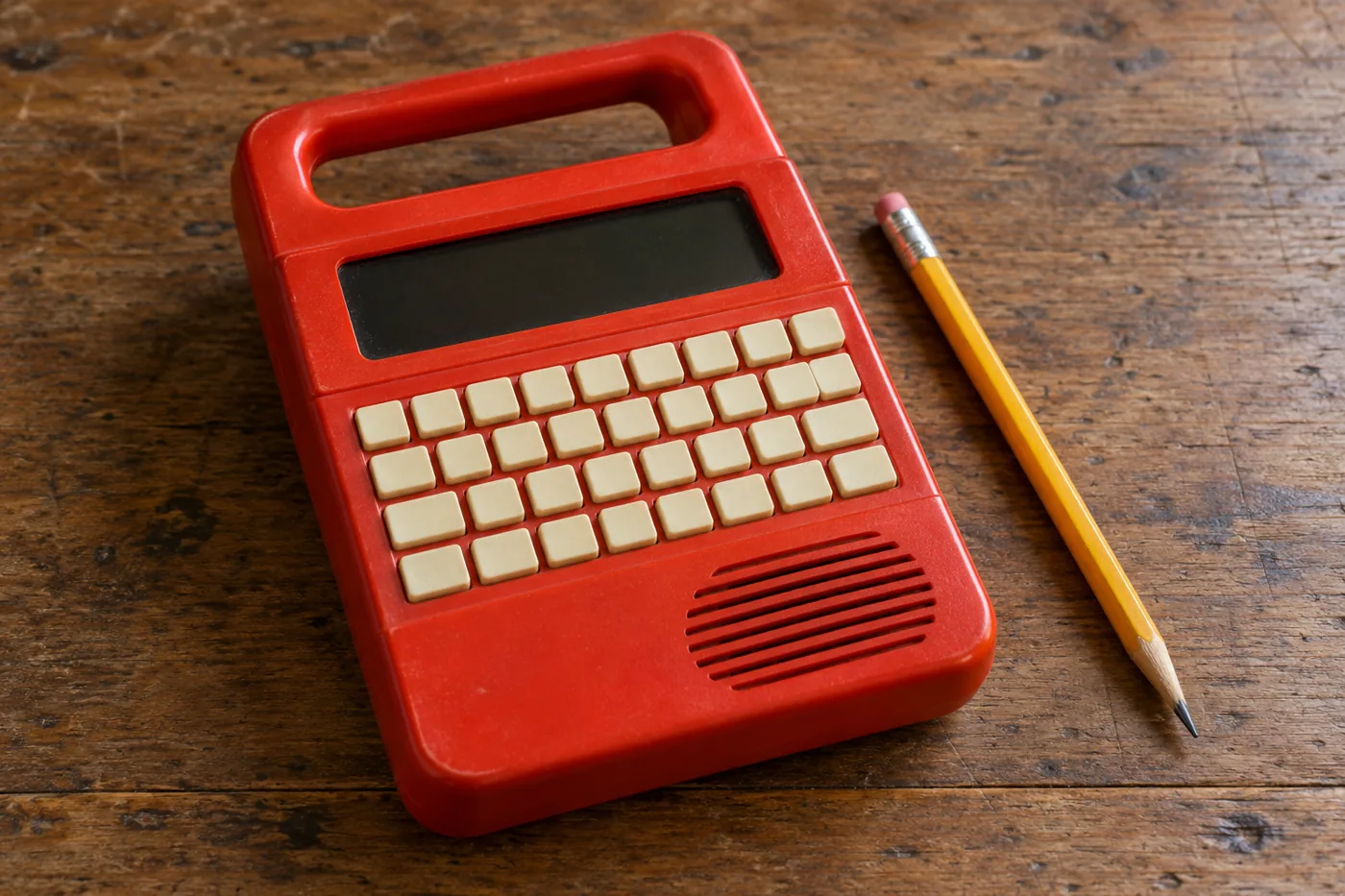
Generated interpretation, not documentary evidence. Invented red handheld learning toy with blank keys, unlit display and speaker grille; not an exact Speak & Spell model.
Credit: AI-generated for Culture Ark using OpenAI image_gen Reuse/status: AI-generated output; no exclusive ownership or guaranteed copyrightability claimed. Underlying works, marks and cultural permissions remain separate. Invented red handheld learning toy with blank keys, unlit display and speaker grille; not an exact Speak & Spell model. Speech synthesis is not the same as understanding language or recognizing a child's spoken answer. The museum unit is dated 1978–1985, not a unique verified launch-day specimen. The generated unmarked device is an interpretation, not an exact keyboard, circuit layout, repair manual or working emulator.
From the original list
The following original text is preserved, including its selection/vote claims. Preservation is not independent verification of every assertion.
Why: An early talking electronic toy with speech synthesis.
What to preserve: Device, voice chip
Year and origin: 1978 · United States
Vote: 4/9 (historian 1 · future kid 2 · curator 1)
Learn more: Speak & Spell (toy) on Wikipedia
Supplemental context
Speak & Spell brought an electronic voice into a portable spelling toy. The Henry Ford identifies Texas Instruments as maker of its surviving unit and describes the company's 1978 speech-synthesis achievement as the basis of a product for early readers. The child's interaction joined listening, keyboard input and feedback, making language practice feel like a conversation with a machine. Future readers could learn how consumer electronics became an everyday teaching presence rather than remaining specialist equipment. Preserving the device's sound and interaction would matter alongside its plastic case: a silent photograph does not communicate the peculiar experience of its synthesized speech.
Creator/community: Texas Instruments engineers and designers; families using electronic learning aids Place/era: United States, Dallas, Texas; introduced in 1978, with subsequent models
Context and limits
Speech synthesis is not the same as understanding language or recognizing a child's spoken answer. The museum unit is dated 1978–1985, not a unique verified launch-day specimen. The generated unmarked device is an interpretation, not an exact keyboard, circuit layout, repair manual or working emulator.
Where to learn more
- https://apiarybee.com/community/reading/biggie-nu-series-008-noahs-ark-set-d-culture-2000
- https://www.thehenryford.org/collections/explore/artifact/293866
Apiary library | Original Culture Ark article
Public ID and individual routes: pending publisher allocation. Internal source ID: D-0606
Part of the Culture Ark: 2,000 things people should still be able to see in 2,000 years, picked by AI research teams. This page keeps the original list entry for D-0606 word for word and adds context. Browse the gallery. The Culture Ark is an Artificial Mind Hive (AMH) project. AMH is owned by Austin Little.

Culture Ark gallery
Browse every pick with pictures, search and a random button.
Open the gallery →