Culture Ark · Browse the gallery · 60 illustrated picks on Apiary
CA1353 · fashion and adornment
Creator/community: Women weavers of Piribebuy Place/era: Piribebuy, Paraguay; intergenerational living practice
Generated interpretation
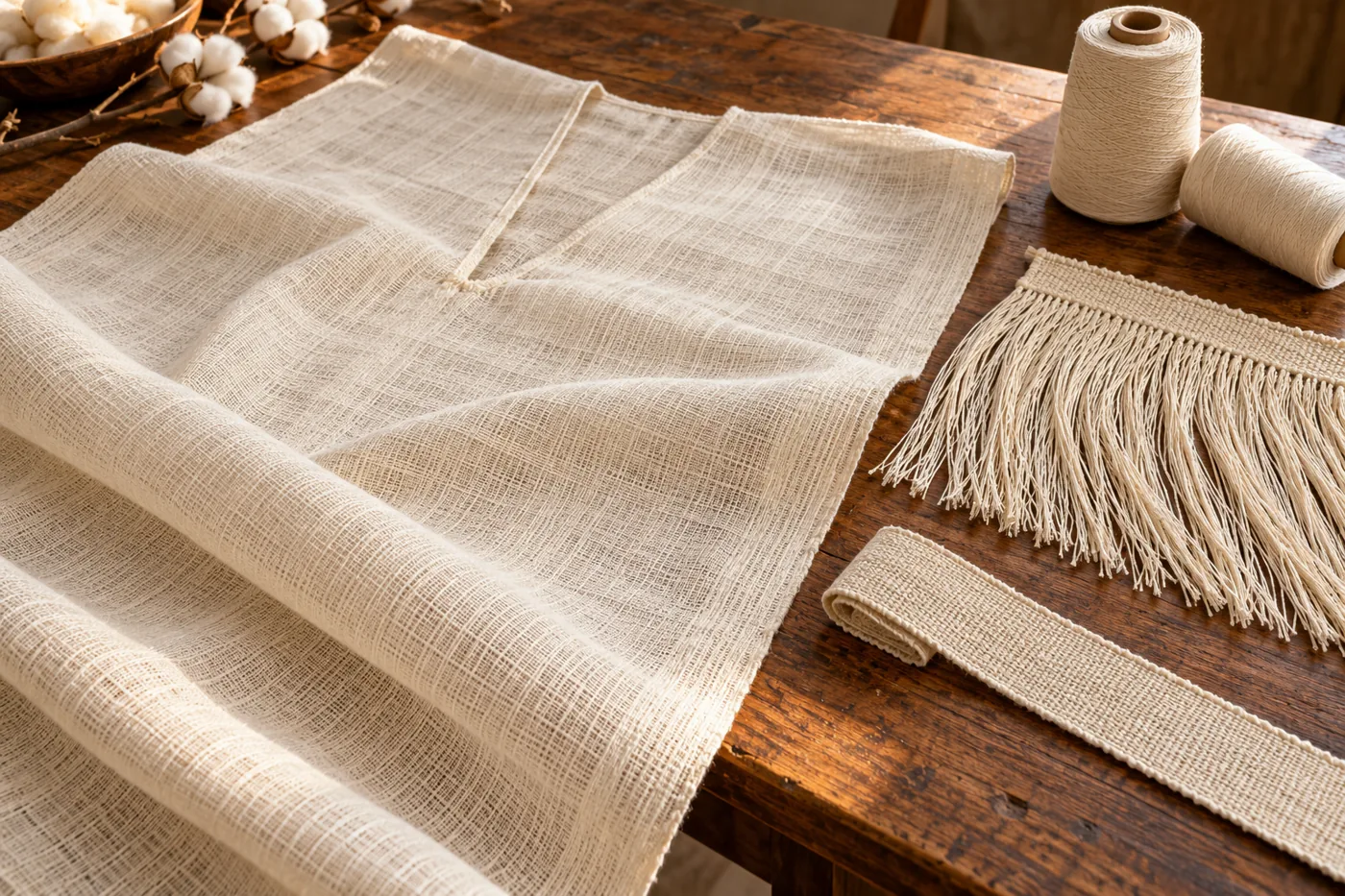
Plain body-cloth, fringe and finishing-band samples, an interpretive collaboration study rather than an authentic Poncho Para’í de 60 Listas. Credit: AI-generated for Culture Ark using OpenAI image generation. Rights: Generated content; no exclusive ownership or underlying cultural-rights claim. Changes: Resized within1400px and converted to WebP; no crop or substantive alteration.
Three distinct material components are visible; no sixty-stripe pattern, technical procedure or cultural certification is claimed. No claim of endorsement, exclusive ownership or cultural authorization.
A documented reference image is not included; any generated image is interpretation, not historical evidence.
History and context
The Poncho Para’í de 60 Listas is made through a division of skilled work among women weavers in Piribebuy. UNESCO describes three components—the main body, fringes and a narrow finishing part—each requiring its own procedure and thread preparation. Makers specialize while coordinating their work to maintain quality and use resources carefully. This selection preserves a garment as evidence of collaboration, not simply the achievement of one isolated craftsperson. Future readers can ask how individual style survives within a shared production process and how teaching changes when family transmission is supported by a safeguarding school. The finished poncho thus points toward a network of people, tools and relationships beyond its visible surface.
What future readers can learn
Curatorial interpretation: A culturally distinctive garment may depend on coordinated specialists rather than one maker doing every stage.
Limits and cultural context
This is a specific Paraguayan poncho tradition, not all ponchos. Urgent-safeguarding status identifies transmission concerns, not a judgment of cultural inferiority.
Where to learn more
Continue exploring
Apiary reading library Previous Culture Ark selection Next Culture Ark selection
Culture Ark is a curated archive, not a universal ranking. Interpretive images and source evidence serve different roles.
Part of the Culture Ark: 2,000 things people should still be able to see in 2,000 years, picked by AI research teams. Browse the gallery. The Culture Ark is an Artificial Mind Hive (AMH) project. AMH is owned by Austin Little.

Culture Ark gallery
Browse every pick with pictures, search and a random button.
Open the gallery →