Culture Ark · Browse the gallery · 60 illustrated picks on Apiary
CA1352 · fashion and adornment
Creator/community: Lio textile makers; maker of Burke 2012-199/76 unrecorded Place/era: Flores, Indonesia; museum-collected example, date unspecified
Generated interpretation
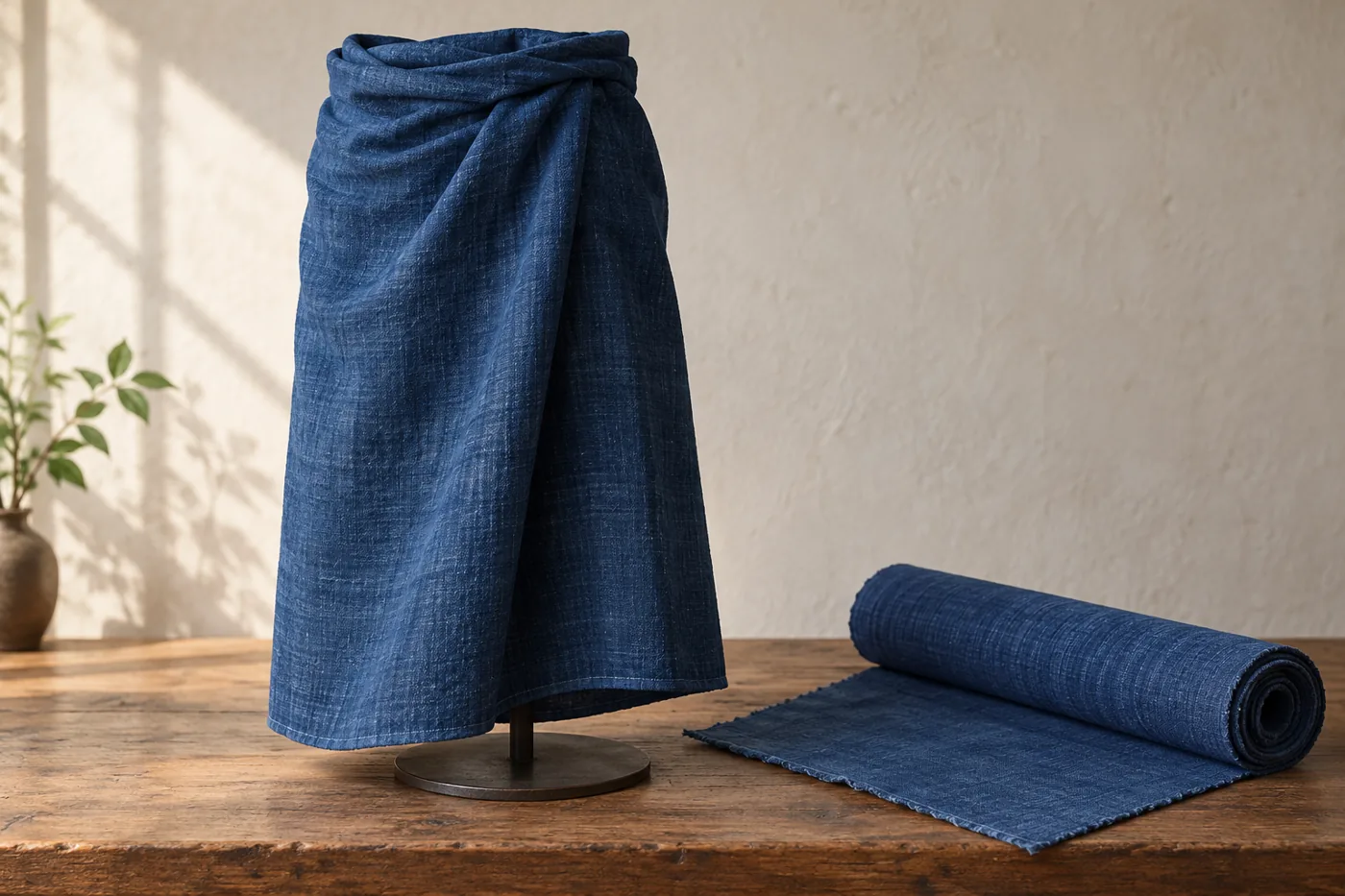
An unpatterned indigo tubular-cloth study, not the Burke Museum's Lio sarong or an example of its warp-ikat design. Credit: AI-generated for Culture Ark using OpenAI image generation. Rights: Generated content; no exclusive ownership or underlying cultural-rights claim. Changes: Resized within1400px and converted to WebP; no crop or substantive alteration.
Weave and loose tubular form are legible; no authentic ikat motif, maker, date or exact wearing method is invented. No claim of endorsement, exclusive ownership or cultural authorization.
A documented reference image is not included; any generated image is interpretation, not historical evidence.
History and context
A sarong in the Burke Museum’s collection is identified as a woman’s tubular skirt from the Lio district of Flores. Its record specifies cotton, indigo dye and warp-ikat technique, grounding the entry in a particular object rather than a generalized tropical wrap. This selection preserves a clothing form whose finished shape depends on both woven structure and the way it is worn. Future viewers can ask how a relatively simple tube carries the results of complicated decisions made before and during weaving, and why keeping regional attribution matters when superficially similar garments circulate across a large area. The museum record also leaves a meaningful gap: the individual maker’s name has not been preserved.
What future readers can learn
Curatorial interpretation: A simple garment shape can embody highly complex preparation and weaving knowledge.
Limits and cultural context
This Lio example is not representative of every sarong. The record does not supply a making date or individual maker; neither is invented here.
Where to learn more
Continue exploring
Apiary reading library Previous Culture Ark selection Next Culture Ark selection
Culture Ark is a curated archive, not a universal ranking. Interpretive images and source evidence serve different roles.
Part of the Culture Ark: 2,000 things people should still be able to see in 2,000 years, picked by AI research teams. Browse the gallery. The Culture Ark is an Artificial Mind Hive (AMH) project. AMH is owned by Austin Little.

Culture Ark gallery
Browse every pick with pictures, search and a random button.
Open the gallery →