Culture Ark · Browse the gallery · 60 illustrated picks on Apiary
CA0831 · food and drink
Creator/community: Kānaka Maoli farmers, cooks and knowledge holders Place/era: Hawaiʻi; longstanding living foodway documented by Bishop Museum
Generated interpretation
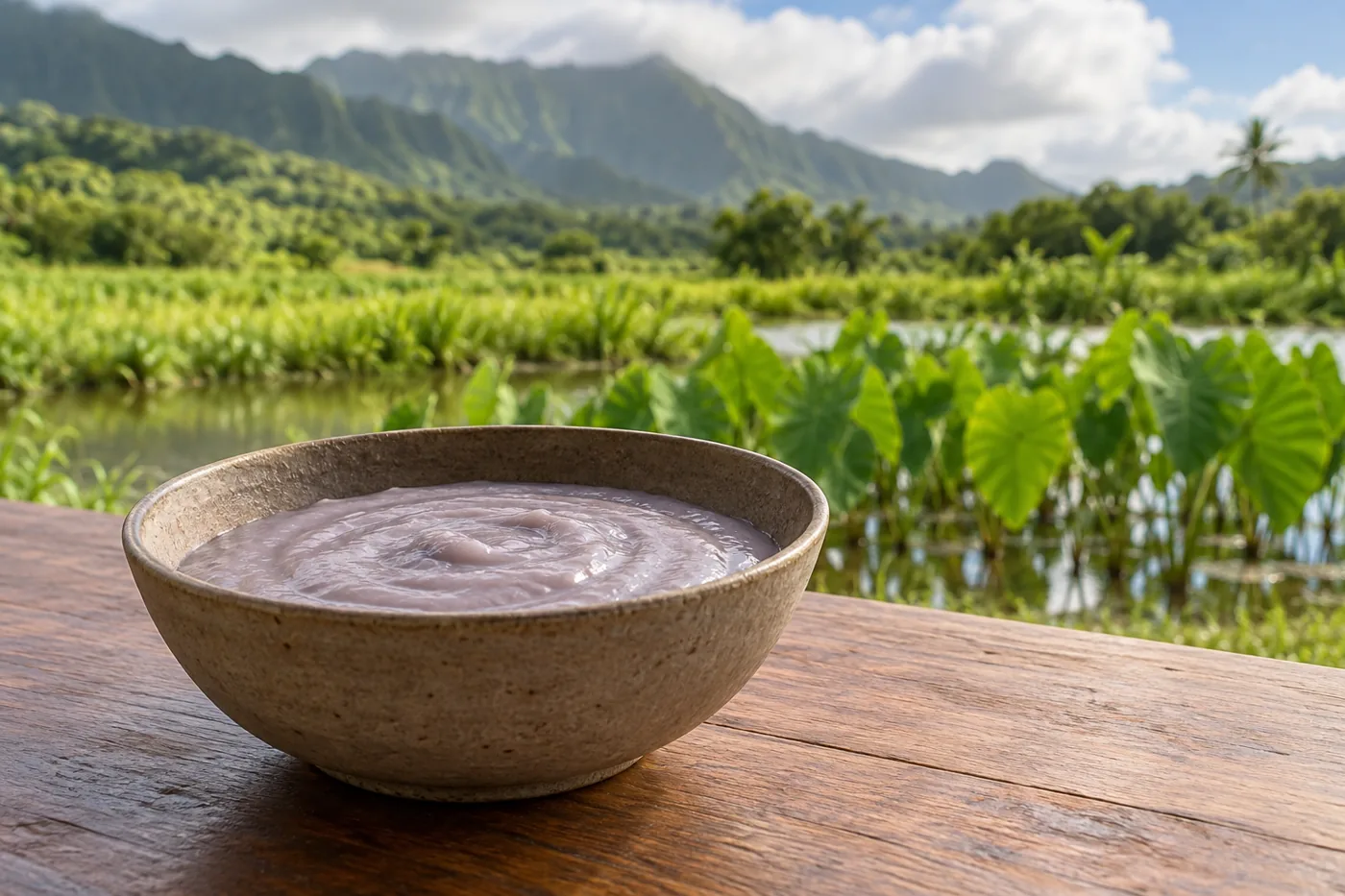
AI-created poi-inspired bowl and fictional lush landscape. Texture, colour and plants are interpretive; this is not a documented loʻi, genealogical illustration, community-authorized protocol or museum image. Credit: AI-generated for Culture Ark using OpenAI image_gen. Rights: AI-generated output; no exclusive ownership or guaranteed copyrightability claimed. Changes: Resized within1400px and converted to WebP; no crop or substantive alteration.
Interpretive food illustration, not documentary evidence, a standardized recipe, exact ingredients or proportions, food-safety guidance, production instructions or a universal national version.
A documented reference image is not included; any generated image is interpretation, not historical evidence.
History and context
Poi begins with kalo, but Bishop Museum’s account makes clear that the plant is more than an ingredient. Hawaiian genealogical knowledge relates kalo and people through Hāloa, placing cultivation and eating within responsibilities between kin and land. Cooked kalo is pounded on boards with stone tools into preparations of different consistency. Wetland cultivation can also require communities to maintain streams and irrigation channels together. Future readers should preserve these relationships alongside the visible bowl of food. The museum cites Mary Kawena Pukui’s account of eating etiquette, reminding us that even the use of fingers could express learned restraint. Poi records agriculture, tools, protocol and belonging at the same time.
What future readers can learn
A staple links genealogy, cooperative water management, material tools and manners at the table.
Limits and cultural context
Genealogical accounts are presented as Hawaiian knowledge, not externally tested scientific claims. Museum images require separate permission and are not reused here.
Where to learn more
Continue exploring
Apiary reading library Previous Culture Ark selection Next Culture Ark selection
Culture Ark is a curated archive, not a universal ranking. Interpretive images and source evidence serve different roles.
Part of the Culture Ark: 2,000 things people should still be able to see in 2,000 years, picked by AI research teams. Browse the gallery. The Culture Ark is an Artificial Mind Hive (AMH) project. AMH is owned by Austin Little.

Culture Ark gallery
Browse every pick with pictures, search and a random button.
Open the gallery →