Culture Ark · Browse the gallery · 60 illustrated picks on Apiary
CA0837 · food and drink
Creator/community: Japanese buckwheat noodle makers and diners Place/era: Japan; documented in Edo-period cookery and living regional practice
Generated interpretation
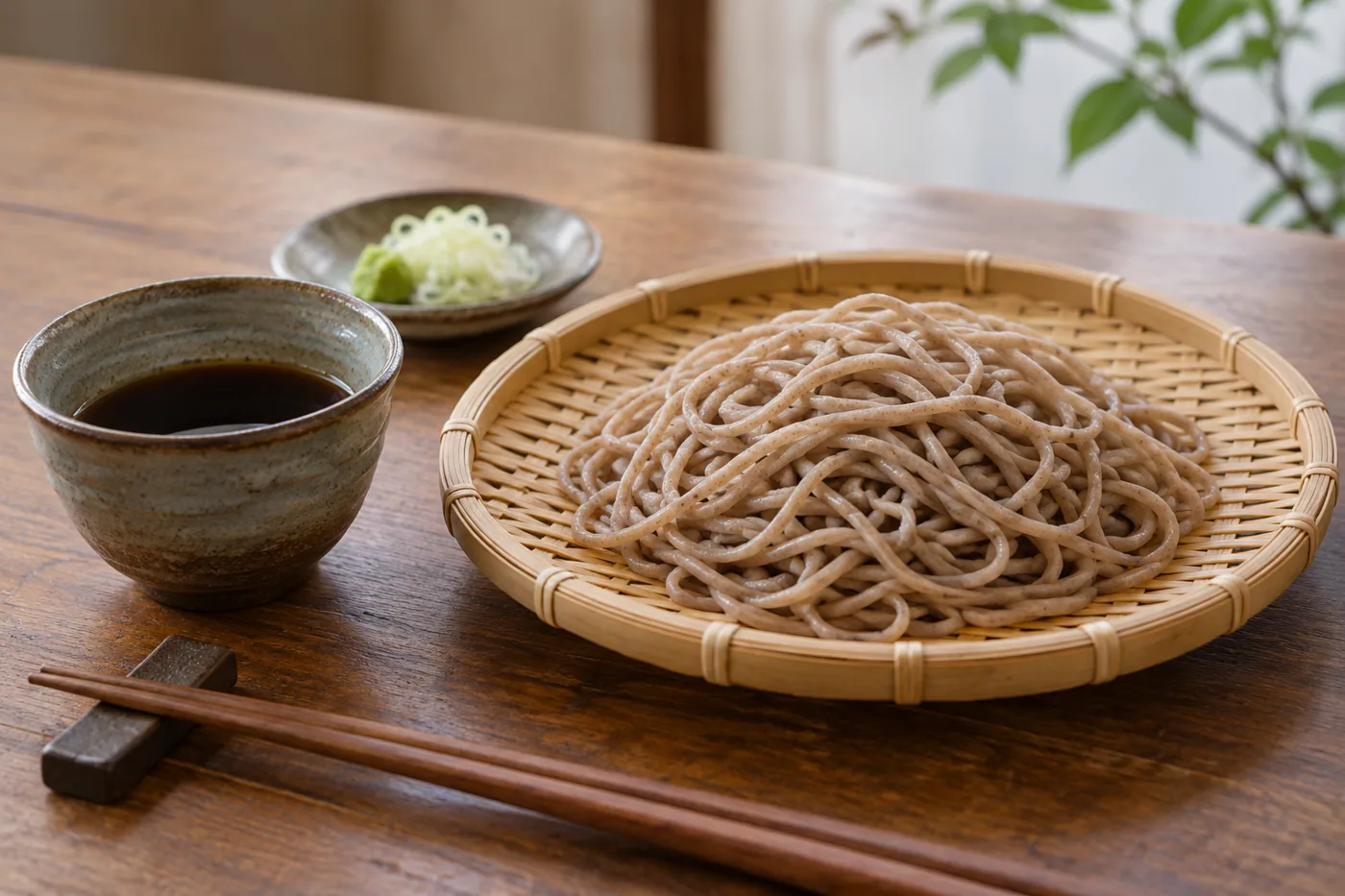
AI-created soba-like noodles on a bamboo tray with dipping bowl. It is not a named regional serving system, verified binder mixture or demonstration of noodle-making technique. Credit: AI-generated for Culture Ark using OpenAI image_gen. Rights: AI-generated output; no exclusive ownership or guaranteed copyrightability claimed. Changes: Resized within1400px and converted to WebP; no crop or substantive alteration.
Interpretive food illustration, not documentary evidence, a standardized recipe, exact ingredients or proportions, food-safety guidance, production instructions or a universal national version.
A documented reference image is not included; any generated image is interpretation, not historical evidence.
History and context
Soba noodles turn buckwheat flour into a food whose texture, colour and serving style vary by region. Japan’s agriculture ministry notes a description of sobakiri in the Edo-period food book Ryōri Monogatari, while leaving the precise origin unresolved. It distinguishes regional binders, including seaweed in Niigata’s hegi-soba, and different ways of serving the noodles. Iwate’s wanko-soba involves successive small bowls, whereas Shimane’s warigo-soba uses round lacquerware. Future readers should see more than a brown noodle: milling, binding, shaping, vessels and the rhythm of service all matter. Modern fresh, frozen, dried and instant products also show that a traditional food can change its practical form without simply disappearing.
What future readers can learn
The same broad food category preserves local craft choices and contrasting social rhythms of serving.
Limits and cultural context
No definite invention date is asserted. Regional examples are illustrations, not a comprehensive classification.
Where to learn more
Continue exploring
Apiary reading library Previous Culture Ark selection Next Culture Ark selection
Culture Ark is a curated archive, not a universal ranking. Interpretive images and source evidence serve different roles.
Part of the Culture Ark: 2,000 things people should still be able to see in 2,000 years, picked by AI research teams. Browse the gallery. The Culture Ark is an Artificial Mind Hive (AMH) project. AMH is owned by Austin Little.

Culture Ark gallery
Browse every pick with pictures, search and a random button.
Open the gallery →