Culture Ark · Browse the gallery · 60 illustrated picks on Apiary
CA0834 · food and drink
Creator/community: Ni-Vanuatu cooks, market vendors and gathering communities Place/era: Vanuatu; living foodway in markets and kastom gatherings
Generated interpretation
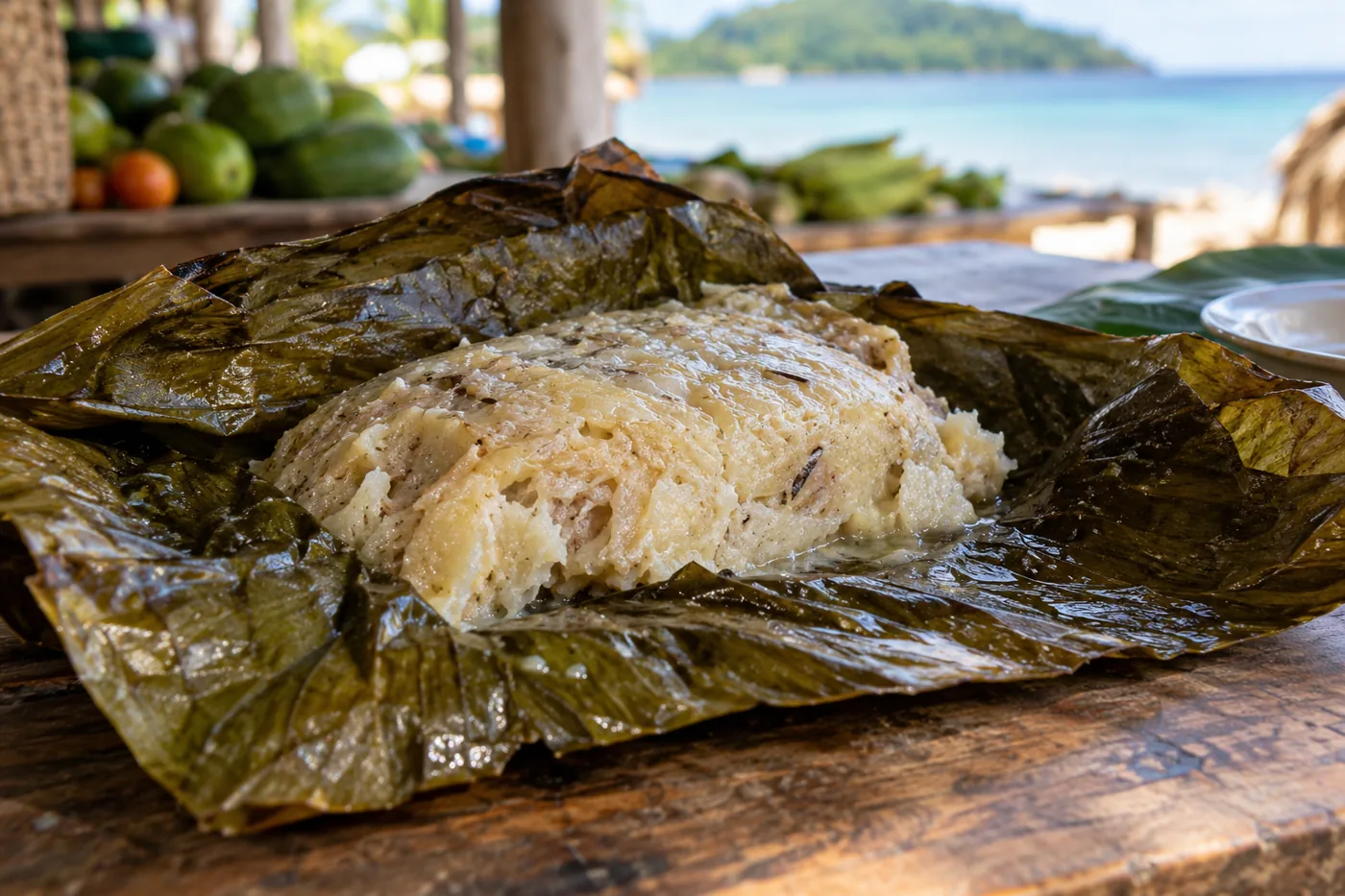
AI-created laplap-inspired portion on an opened leaf. Root type, consistency, wrapper and market setting are interpretive, not an island-specific recipe, ceremonial object or safe-processing guide. Credit: AI-generated for Culture Ark using OpenAI image_gen. Rights: AI-generated output; no exclusive ownership or guaranteed copyrightability claimed. Changes: Resized within1400px and converted to WebP; no crop or substantive alteration.
Interpretive food illustration, not documentary evidence, a standardized recipe, exact ingredients or proportions, food-safety guidance, production instructions or a universal national version.
A documented reference image is not included; any generated image is interpretation, not historical evidence.
History and context
Laplap combines grated ingredients such as taro, yam or cassava with coconut cream, wrapped in leaves and cooked with hot stones. Vanuatu Tourism’s account places it both in kastom ceremonies and in ordinary market lunches. That double setting is important: an emblematic dish need not belong only to exceptional celebrations. Different roots and local versions also make a single fixed recipe an inadequate record. Future readers should preserve who made a particular laplap and whether it was prepared for sale, household eating or a gathering. The dish connects cultivation, grating, wrapping and sharing, revealing how everyday food and public cultural identity can be made from the same sequence of work.
What future readers can learn
A national food emblem can remain part of ordinary market life rather than only ceremonial display.
Limits and cultural context
The official tourism overview is not a complete account of island-by-island variation. No safe-cooking or cassava-processing instructions are offered.
Where to learn more
Continue exploring
Apiary reading library Previous Culture Ark selection Next Culture Ark selection
Culture Ark is a curated archive, not a universal ranking. Interpretive images and source evidence serve different roles.
Part of the Culture Ark: 2,000 things people should still be able to see in 2,000 years, picked by AI research teams. Browse the gallery. The Culture Ark is an Artificial Mind Hive (AMH) project. AMH is owned by Austin Little.

Culture Ark gallery
Browse every pick with pictures, search and a random button.
Open the gallery →