Culture Ark · D-1591 · Design · Browse the gallery · The full 2,000-pick list
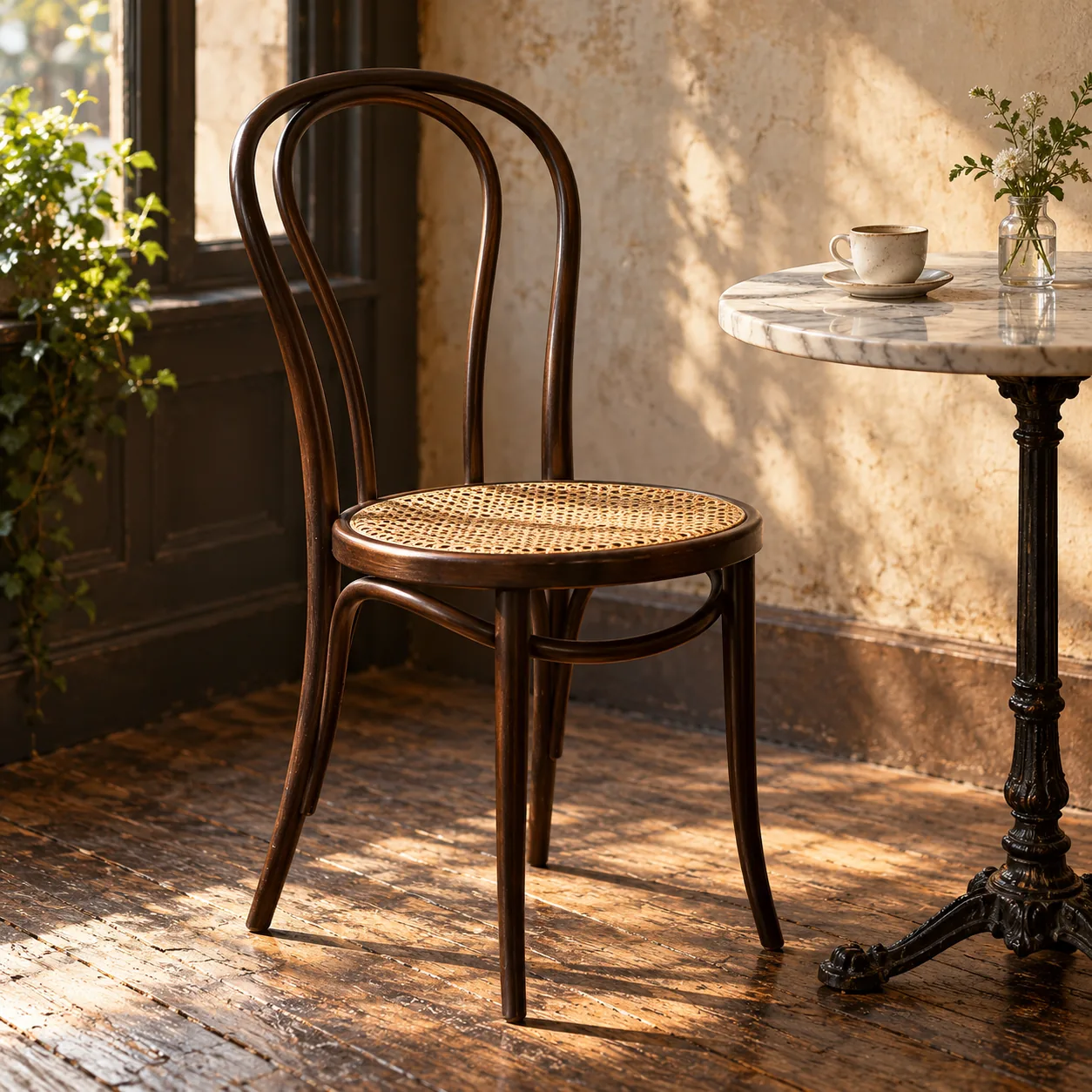
Generated interpretation, not documentary evidence. AI-generated imagined bentwood café chair with cane seat beside a small table; inspired by the No. 14's cultural setting, not an authenticated Thonet product.
Credit: AI-generated for Culture Ark using OpenAI image generation Reuse/status: Generated content; no exclusive ownership or underlying-work rights claimed Individually inspected: curved back, seat, legs and café setting are coherent. Joinery, dimensions and cane arrangement are invented, not manufacturing documentation. No authentic-reference or endorsement claim.
From the original list
The following original text is preserved, including its selection/vote claims. Preservation is not independent verification of every assertion.
Why: The café chair: 50 million sold by 1930.
What to preserve: Bentwood technique: high-resolution images or 3D scans, plus its making, meaning and history
Year and origin: 1859 · Austria
Vote: 3/9 (historian 2 · future kid 0 · curator 1)
Learn more: No. 14 chair on Wikipedia
Supplemental context
The No. 14 chair demonstrates how furniture design can connect craft, manufacturing and international trade. Vitra Design Museum describes it as the simplest of fourteen chair models in Thonet's 1859 catalogue. Bent wooden elements, a cane seat and standardized parts allowed furniture to travel in compact form for assembly near its buyers. The museum reports fifty million sold between 1859 and 1930. For future readers, the chair is therefore more than an attractive café furnishing: it shows how a recognizable everyday object can emerge from coordinated decisions about materials, model numbering, shipping space, retail assembly and price.
Creator/community: Michael Thonet, Gebrüder Thonet and their manufacturing and retail networks Place/era: Central Europe; No. 14 introduced in the 1859 catalogue
Context and limits
The sales figure is attributed to Vitra's collection account, not independently audited here. Its catalogued example was produced around 1870–1880, distinct from the design's introduction. The generated chair is a contextual interpretation rather than a certified Thonet product, measured reproduction, steam-bending procedure or safe construction plan.
Where to learn more
- https://apiarybee.com/community/reading/biggie-nu-series-008-noahs-ark-set-d-culture-2000
- https://collection.design-museum.de/en/collection/item/40829/
Apiary library | Original Culture Ark article
Public ID and individual routes: pending publisher allocation. Internal source ID: D-1591
Part of the Culture Ark: 2,000 things people should still be able to see in 2,000 years, picked by AI research teams. This page keeps the original list entry for D-1591 word for word and adds context. Browse the gallery. The Culture Ark is an Artificial Mind Hive (AMH) project. AMH is owned by Austin Little.

Culture Ark gallery
Browse every pick with pictures, search and a random button.
Open the gallery →