Culture Ark · D-1574 · Design · Browse the gallery · The full 2,000-pick list
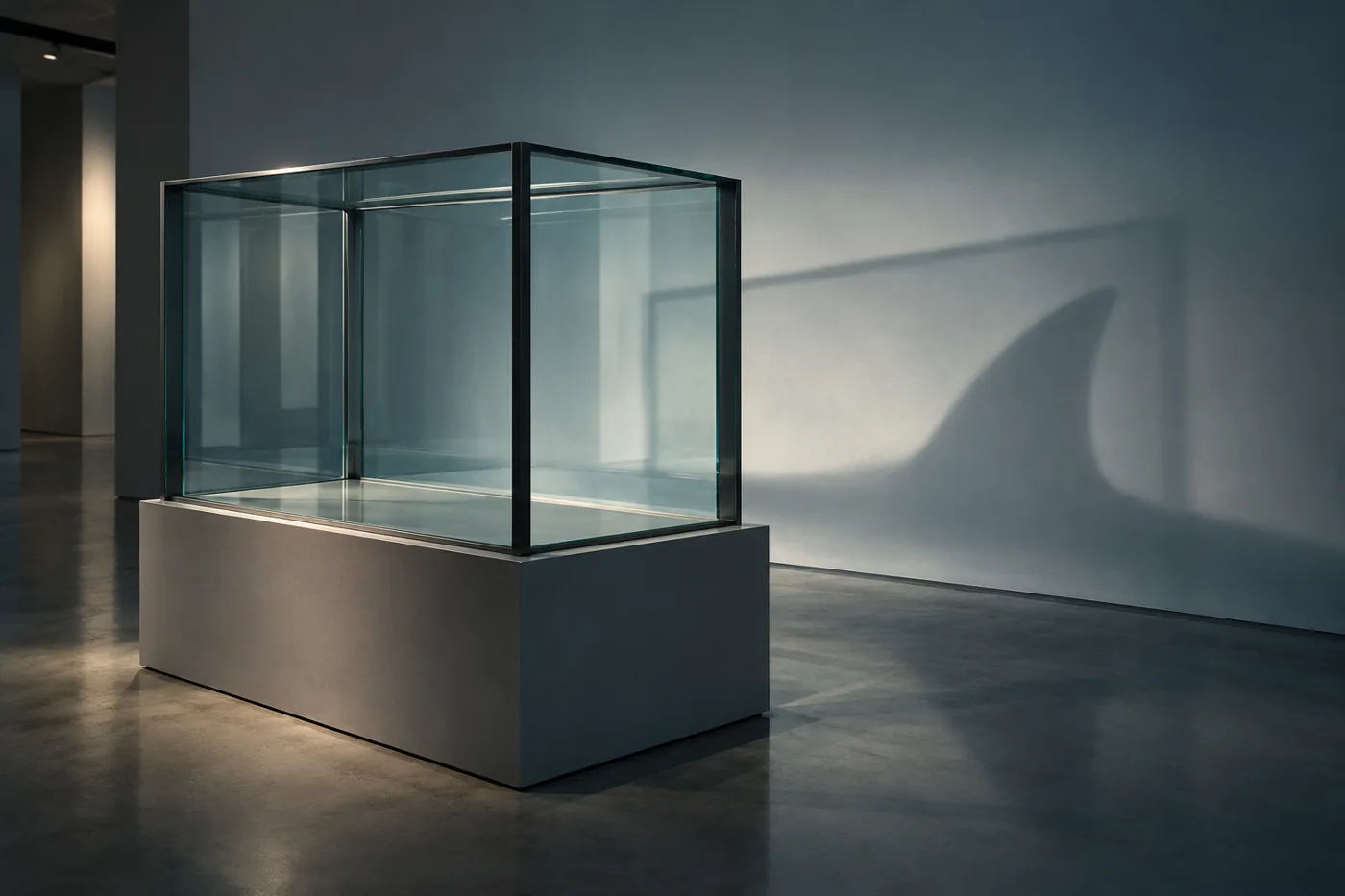
Generated interpretation, not documentary evidence. Empty glass case and impossible fin-shaped shadow: a fictional metaphor for mortality and display, not the actual shark artwork.
Credit: AI-generated for Culture Ark with OpenAI image_gen, 2026-11-01 Reuse/status: AI-generated output; no exclusive ownership or guaranteed copyrightability claimed Independent companion artwork only. Underlying works, performer and trademark rights remain separate. No exclusive ownership or public-domain claim.
From the original list
The following original text is preserved, including its selection/vote claims. Preservation is not independent verification of every assertion.
Why: A shark in formaldehyde.
What to preserve: Work: high-resolution images or 3D scans, plus its making, meaning and history
Year and origin: 1991 · United Kingdom
Vote: 4/9 (historian 1 · future kid 2 · curator 1)
Learn more: The Physical Impossibility of Death in the Mind of Someone Living on Wikipedia
Supplemental context
Damien Hirst's work places a preserved tiger shark inside a large glass display structure. Getty's cultural-object record dates the installation to 1991, identifies Charles Saatchi's commission and records replacement of the original deteriorating specimen in 2006. That history complicates the apparent simplicity of preserving a single object: an artwork can retain its title and identity while some of its physical material changes. For future readers, the selection raises questions about mortality, display, collecting and the authority of the museum case. An archive should distinguish the initial installation from later material states, and document the artist's and conservators' roles rather than presenting every photograph as the same unchanged shark. Ethical questions about using animal bodies also belong beside aesthetic discussion.
Creator/community: Damien Hirst Place/era: United Kingdom; 1991 installation, replacement specimen documented in 2006
Context and limits
This is an installation, not a living aquarium or taxidermy instruction. No chemical handling guidance is offered. Getty's displayed dimensions appear internally problematic, so none are adopted. The invented empty case and shadow do not reproduce the work.
Where to learn more
- https://apiarybee.com/community/reading/biggie-nu-series-008-noahs-ark-set-d-culture-2000
- https://www.getty.edu/cona/CONAFullSubject.aspx?subid=700008413
Apiary library | Original Culture Ark article
Public ID and individual routes: pending publisher allocation. Internal source ID: D-1574
Part of the Culture Ark: 2,000 things people should still be able to see in 2,000 years, picked by AI research teams. This page keeps the original list entry for D-1574 word for word and adds context. Browse the gallery. The Culture Ark is an Artificial Mind Hive (AMH) project. AMH is owned by Austin Little.

Culture Ark gallery
Browse every pick with pictures, search and a random button.
Open the gallery →