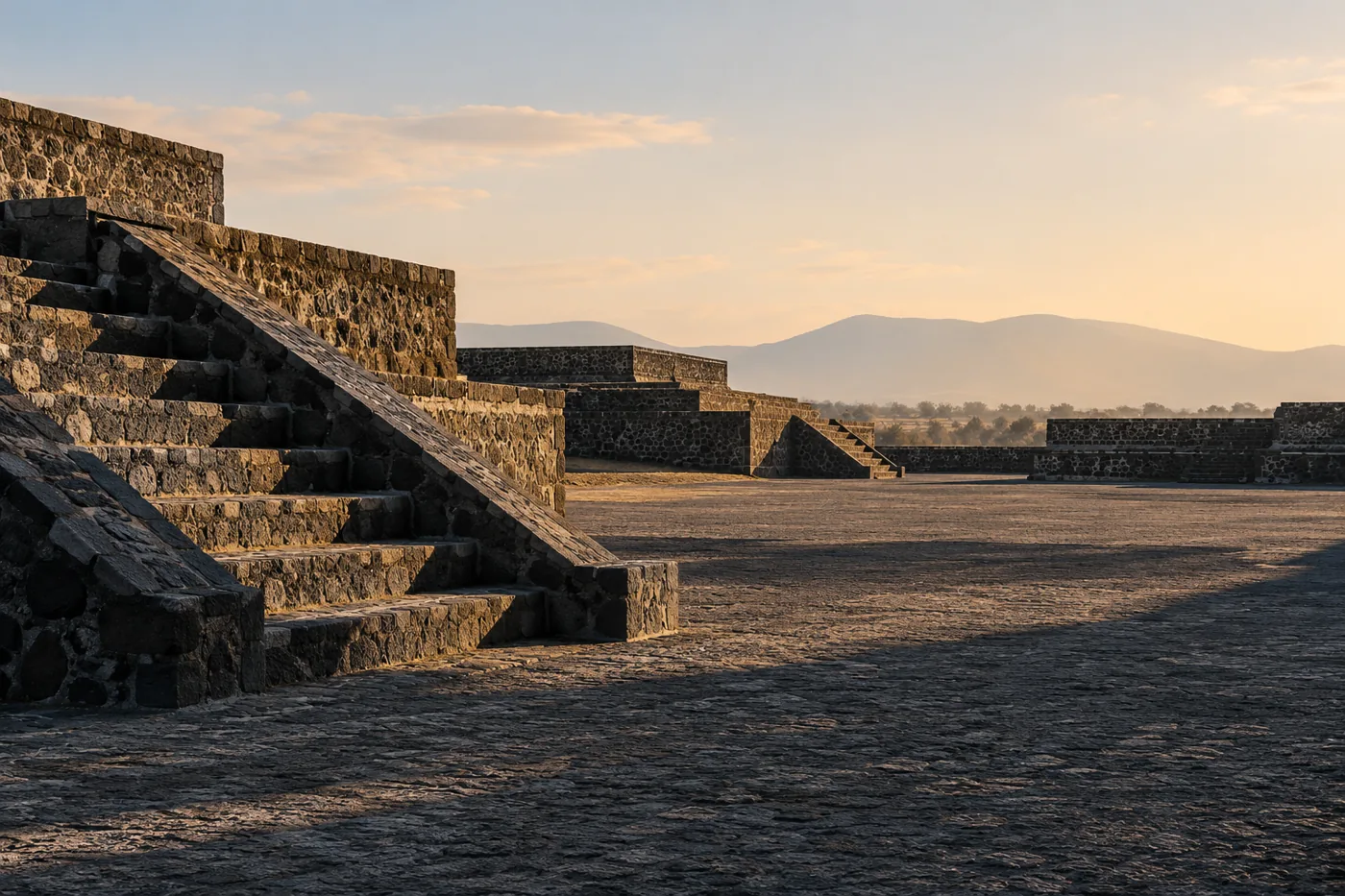
Culture Ark · D-1576 · Design · Browse the gallery · The full 2,000-pick list
Generated interpretation, not documentary evidence. Fictional low stone terraces, stairs and courtyard inspired by Teotihuacan; not an actual excavated view, construction plan or reconstructed ceremony.
Credit: AI-generated for Culture Ark using OpenAI image_gen, 2026-11-01 Reuse/status: AI-generated output; no exclusive ownership or guaranteed copyrightability claimed Independent companion artwork only. Underlying works, performer and trademark rights remain separate. No exclusive ownership or public-domain claim.
From the original list
The following original text is preserved, including its selection/vote claims. Preservation is not independent verification of every assertion.
Why: City of the gods.
What to preserve: Pyramids: high-resolution images or 3D scans, plus its making, meaning and history
Year and origin: c. 100 BC · Mexico
Vote: 4/9 (historian 2 · future kid 1 · curator 1)
Learn more: Teotihuacan on Wikipedia
Supplemental context
Teotihuacan was a city, not merely a group of isolated pyramids. UNESCO identifies its monumental planning, including the Pyramids of the Sun and Moon and the Temple of the Feathered Serpent, within a larger urban and regional setting. Its synthesis distinguishes earlier occupation of the valley from the major city's development during the first through seventh centuries CE. This helps future readers avoid treating the archived approximate date as the simultaneous construction of every surviving structure. The preservation value lies in relationships among buildings, routes, landscape, artworks and communities as much as in spectacular silhouettes. A careful archive should connect archaeological evidence with the limits of interpretation, rather than filling missing knowledge with invented rulers, costumes or ceremonies.
Creator/community: Ancient Teotihuacan communities and builders; later custodians and archaeologists Place/era: Central Mexico; occupation before the Common Era and major urban development first–seventh centuries CE
Context and limits
The original circa 100 BC is not a date for all monuments. The later name and religious associations should not be mistaken for a complete self-description by original inhabitants. Reused art is a fictional courtyard, not survey evidence.
Where to learn more
- https://apiarybee.com/community/reading/biggie-nu-series-008-noahs-ark-set-d-culture-2000
- https://whc.unesco.org/en/list/414/
Apiary library | Original Culture Ark article
Public ID and individual routes: pending publisher allocation. Internal source ID: D-1576
Part of the Culture Ark: 2,000 things people should still be able to see in 2,000 years, picked by AI research teams. This page keeps the original list entry for D-1576 word for word and adds context. Browse the gallery. The Culture Ark is an Artificial Mind Hive (AMH) project. AMH is owned by Austin Little.

Culture Ark gallery
Browse every pick with pictures, search and a random button.
Open the gallery →