Culture Ark · D-1578 · Design · Browse the gallery · The full 2,000-pick list
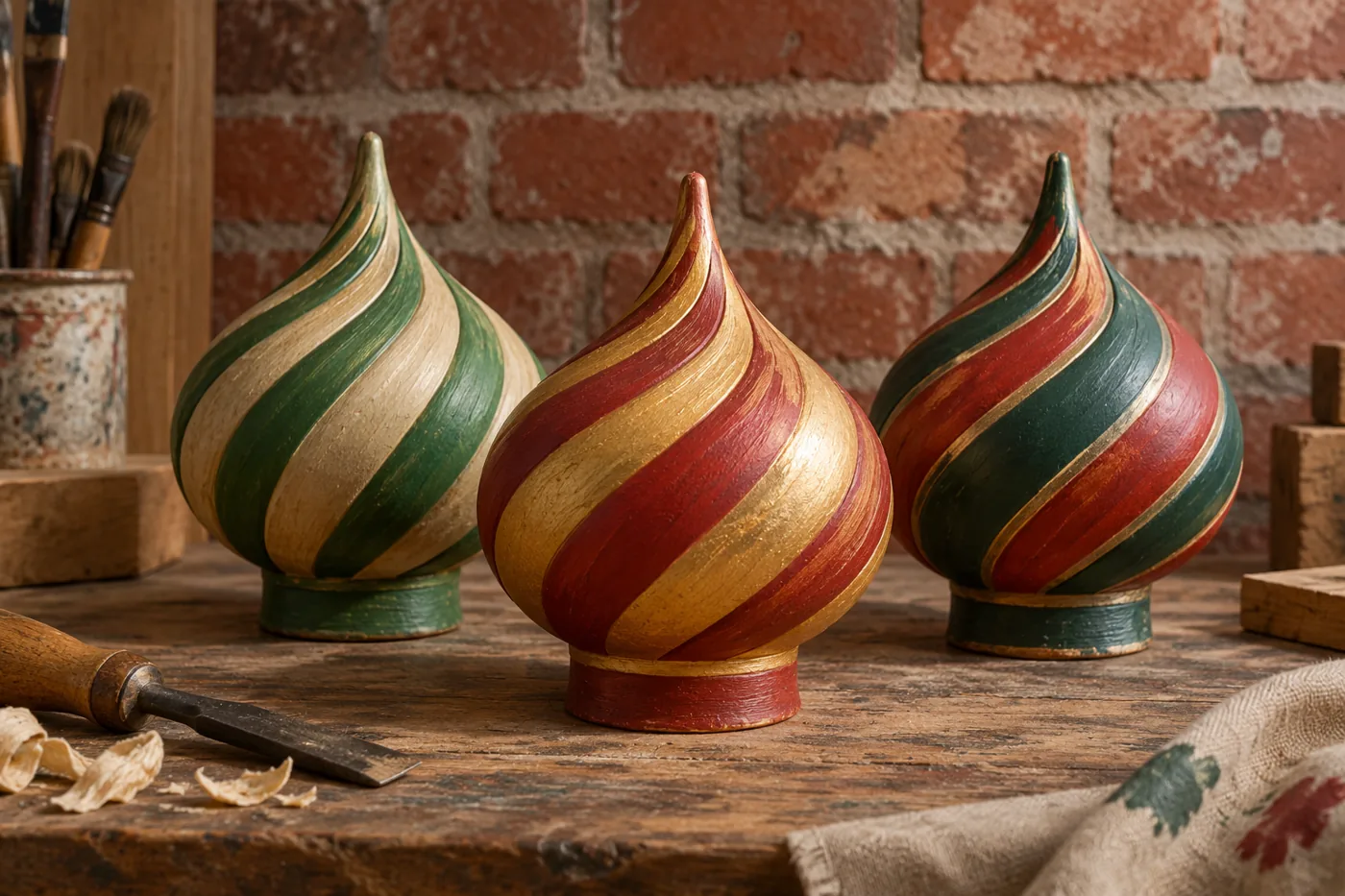
Generated interpretation, not documentary evidence. Three fictional painted onion-shaped wooden forms on a workbench; an ornament metaphor, not authentic cathedral models or sacred objects.
Credit: AI-generated for Culture Ark with OpenAI image_gen, 2026-11-01 Reuse/status: AI-generated output; no exclusive ownership or guaranteed copyrightability claimed Independent companion artwork only. Underlying works, performer and trademark rights remain separate. No exclusive ownership or public-domain claim.
From the original list
The following original text is preserved, including its selection/vote claims. Preservation is not independent verification of every assertion.
Why: Candy-coloured onion domes.
What to preserve: Cathedral: high-resolution images or 3D scans, plus its making, meaning and history
Year and origin: 1561 · Russia
Vote: 4/9 (historian 1 · future kid 2 · curator 1)
Learn more: Saint Basil's Cathedral on Wikipedia
Supplemental context
Saint Basil's Cathedral is also known as the Cathedral of the Intercession on the Moat, or Pokrovsky Cathedral. The State Historical Museum dates its principal construction to 1555–1561 under Ivan IV and relates the commission to victory over the Kazan Khanate. Its account describes a complex of churches rather than a single undivided hall, with interiors representing several later centuries. A church dedicated to Basil the Blessed was added in 1588. These distinctions give future readers more than a picturesque collection of colored domes: they connect architecture to religious dedication, political conquest and subsequent alteration. Preservation should record interior spaces, different building phases and devotional meaning as well as the exterior that circulates so readily in tourist photographs.
Creator/community: Builders commissioned by Ivan IV; later religious and museum custodians Place/era: Moscow; principal building 1555–1561, later additions
Context and limits
The original candy-colored phrase is a visual shorthand, not a historical explanation. The opened museum source represents an institutional perspective; conquest should not be treated as politically neutral celebration. Our wooden shapes are invented ornaments, not measured dome models.
Where to learn more
- https://apiarybee.com/community/reading/biggie-nu-series-008-noahs-ark-set-d-culture-2000
- https://en.shm.ru/museum/hvb/
Apiary library | Original Culture Ark article
Public ID and individual routes: pending publisher allocation. Internal source ID: D-1578
Part of the Culture Ark: 2,000 things people should still be able to see in 2,000 years, picked by AI research teams. This page keeps the original list entry for D-1578 word for word and adds context. Browse the gallery. The Culture Ark is an Artificial Mind Hive (AMH) project. AMH is owned by Austin Little.

Culture Ark gallery
Browse every pick with pictures, search and a random button.
Open the gallery →