Culture Ark · D-1569 · Design · Browse the gallery · The full 2,000-pick list
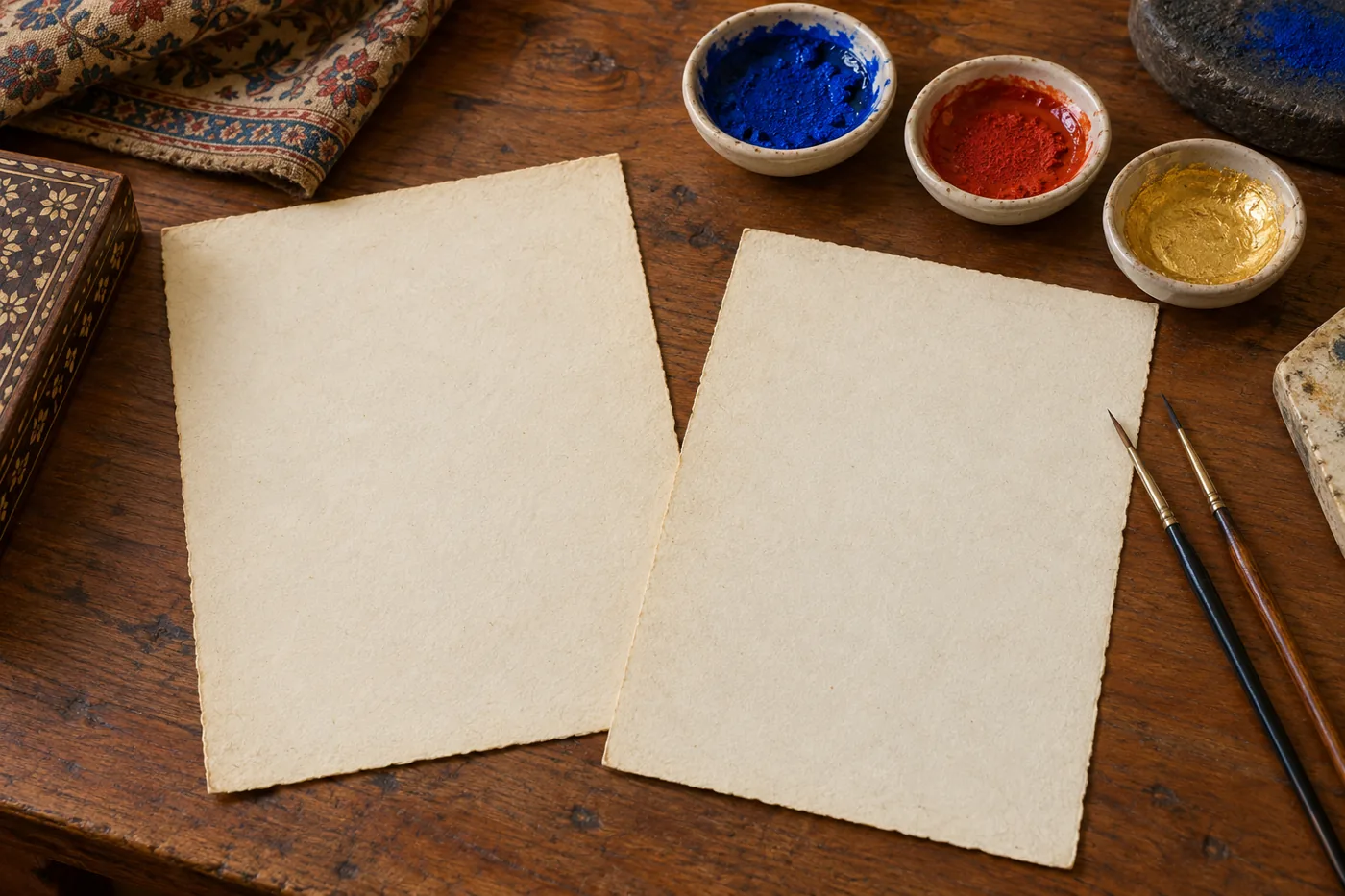
Generated interpretation, not documentary evidence. AI-generated manuscript-painting materials study; not an Akbarnama folio, Mughal painting, imperial portrait or documented atelier.
Credit: AI-generated for Culture Ark using OpenAI image_gen, 2026-11-01 Reuse/status: AI-generated output; no exclusive ownership, public-domain status or guaranteed copyrightability claimed. Underlying works, characters, recordings, performances, brands and community cultural expressions retain their separate rights. Paper, pigments, brushes and incidental ornament are invented, not an authenticated historical kit. No script, textual translation, court scene or claim about pigment composition is provided.
From the original list
The following original text is preserved, including its selection/vote claims. Preservation is not independent verification of every assertion.
Why: Miniatures of Mughal emperors.
What to preserve: Akbarnama: high-resolution images or 3D scans, plus its making, meaning and history
Year and origin: 16th century · India
Vote: 4/9 (historian 1 · future kid 1 · curator 2)
Learn more: Mughal painting on Wikipedia
Supplemental context
Mughal painting includes far more than isolated portraits of emperors. The V&A describes royal workshops where artists and book workers with different regional traditions contributed to manuscript production. For the Akbarnama, it identifies Abu'l Fazl as the author of the history and records inscriptions assigning different parts of an illustration to different painters. Composition, coloring and sometimes portrait features could involve separate hands. Culture Ark could preserve a named folio with its text, sequence, maker attributions and relationship to the larger manuscript. Such a record would make collaboration visible while keeping a court's account of power distinct from a neutral view of every person it governed.
Creator/community: Mughal court artists, calligraphers, illuminators and book workers; Abu'l Fazl authored the Akbarnama text Place/era: South Asia, especially Mughal royal workshops; Akbarnama text begun in 1590 and illustrated manuscript work in the late sixteenth century
Context and limits
The sixteenth-century label does not date every Mughal painting or every later copy of the Akbarnama. A detached folio is not the complete manuscript; event date and illustration date may differ. Court narrative, later attribution and present custody require separate documentation. No authenticated page, translation or pigment recipe is supplied.
Where to learn more
- https://apiarybee.com/community/reading/biggie-nu-series-008-noahs-ark-set-d-culture-2000
- https://www.vam.ac.uk/articles/the-arts-of-the-mughal-empire/
- https://en.wikipedia.org/wiki/Mughal_painting
Apiary library | Original Culture Ark article
Public ID and individual routes: pending publisher allocation. Internal source ID: D-1569
Part of the Culture Ark: 2,000 things people should still be able to see in 2,000 years, picked by AI research teams. This page keeps the original list entry for D-1569 word for word and adds context. Browse the gallery. The Culture Ark is an Artificial Mind Hive (AMH) project. AMH is owned by Austin Little.

Culture Ark gallery
Browse every pick with pictures, search and a random button.
Open the gallery →