Culture Ark · D-1572 · Design · Browse the gallery · The full 2,000-pick list
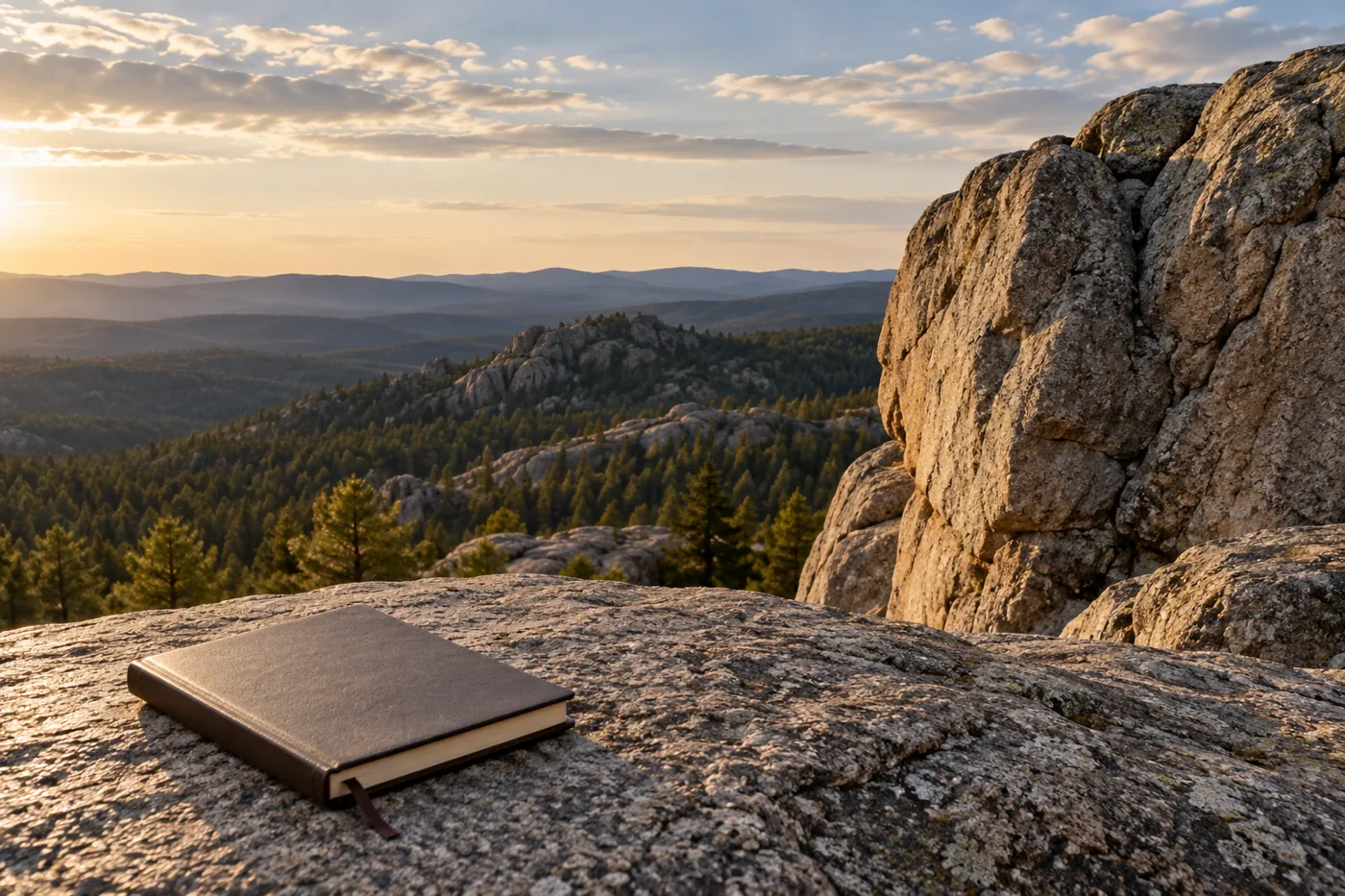
Generated interpretation, not documentary evidence. Blank notebook on granite overlooking fictional forested hills; reflective landscape metaphor, no carved presidents or actual sacred-site documentation.
Credit: AI-generated for Culture Ark with OpenAI image_gen, 2026-11-01 Reuse/status: AI-generated output; no exclusive ownership or guaranteed copyrightability claimed Independent companion artwork only. Underlying works, performer and trademark rights remain separate. No exclusive ownership or public-domain claim.
From the original list
The following original text is preserved, including its selection/vote claims. Preservation is not independent verification of every assertion.
Why: Four presidents carved in a mountain on sacred Lakota land.
What to preserve: Carving, controversy: high-resolution images or 3D scans, plus its making, meaning and history
Year and origin: 1941 · United States
Vote: 4/9 (historian 1 · future kid 2 · curator 1)
Learn more: Mount Rushmore on Wikipedia
Supplemental context
Mount Rushmore presents Washington, Jefferson, Lincoln and Theodore Roosevelt as a monumental account of United States history. The National Park Service describes the memorial through themes of national founding, expansion, preservation and unification. Those institutional themes are a viewpoint, not a complete history of the surrounding land. The same agency identifies tribal nations with historical, spiritual and cultural connections to the Black Hills. A future archive should therefore preserve more than a frontal photograph of four faces: it should retain who commissioned and carved the monument, how its message was framed, and Indigenous relationships that predate it. This selection can teach how public sculpture makes political narratives appear permanent while the meaning and legitimacy of those narratives remain contested.
Creator/community: Gutzon Borglum, Lincoln Borglum and carving workers; distinct Indigenous relationships to the land Place/era: Black Hills, South Dakota; twentieth-century monument, carving ended 1941
Context and limits
The original acknowledges sacred Lakota land. NPS's celebratory national account must not be presented as universal consent; tribal voices and treaty histories need further primary documentation. The generated landscape is not the actual mountain.
Where to learn more
- https://apiarybee.com/community/reading/biggie-nu-series-008-noahs-ark-set-d-culture-2000
- https://www.nps.gov/moru/learn/historyculture/index.htm
- https://www.nps.gov/moru/learn/historyculture/the-associated-tribal-nations-of-mount-rushmore-national-memorial.htm
Apiary library | Original Culture Ark article
Public ID and individual routes: pending publisher allocation. Internal source ID: D-1572
Part of the Culture Ark: 2,000 things people should still be able to see in 2,000 years, picked by AI research teams. This page keeps the original list entry for D-1572 word for word and adds context. Browse the gallery. The Culture Ark is an Artificial Mind Hive (AMH) project. AMH is owned by Austin Little.

Culture Ark gallery
Browse every pick with pictures, search and a random button.
Open the gallery →