Culture Ark · D-1527 · Design · Browse the gallery · The full 2,000-pick list
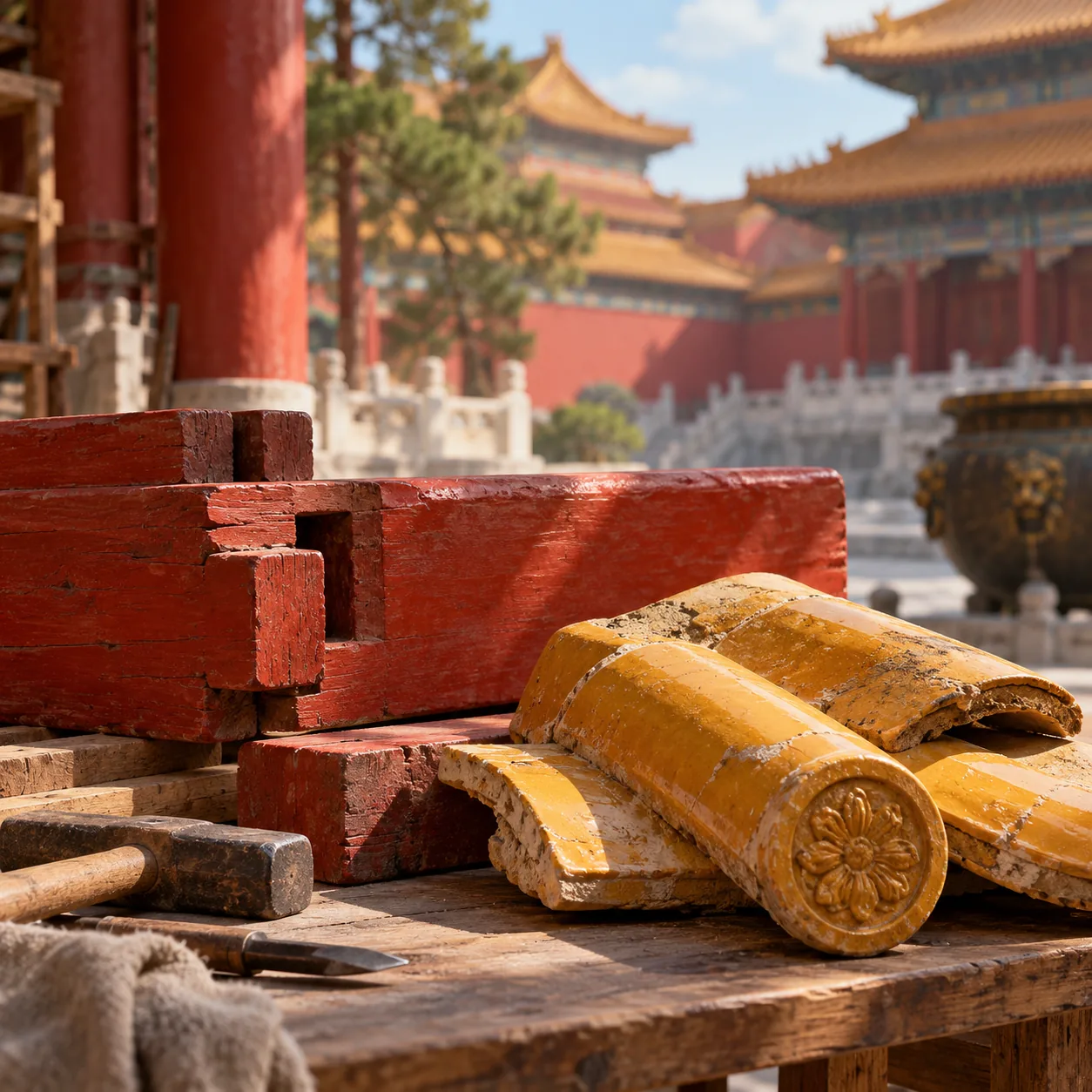
Generated interpretation, not documentary evidence. Red-painted timber and yellow glazed tiles evoke palace materials; floral tile-end decoration and background courtyard are fictional, not exact Forbidden City components.
Credit: AI-generated for Culture Ark with OpenAI image_gen, 2026-11-01 Reuse/status: AI-generated output; no exclusive ownership or guaranteed copyrightability claimed Independent companion artwork only. Underlying works, performer and trademark rights remain separate. No exclusive ownership or public-domain claim.
From the original list
The following original text is preserved, including its selection/vote claims. Preservation is not independent verification of every assertion.
Why: The palace of emperors.
What to preserve: Palace: high-resolution images or 3D scans, plus its making, meaning and history
Year and origin: 1420 · China
Vote: 5/9 (historian 2 · future kid 1 · curator 2)
Learn more: Forbidden City on Wikipedia
Supplemental context
The Forbidden City was a setting for government and court life, not simply a collection of picturesque roofs. UNESCO's account dates its principal Ming construction to 1406–1420 and places it within the history of both Ming and Qing imperial rule. Future readers should connect spatial arrangements and materials with the institutions and labor that sustained the complex. The surviving palace also has histories of rebuilding, conservation and museum use, so 1420 does not date every visible surface. The wider World Heritage property includes the imperial palace at Shenyang, which is distinct from the Beijing selection. This card focuses on imagined timber and glazed tiles to emphasize material work while avoiding the claim that a generated courtyard is an accurate plan, historical view or architectural survey.
Creator/community: Ming and Qing imperial patrons, builders, craftspeople and later museum custodians Place/era: Beijing, China; principal construction 1406–1420 and later changes
Context and limits
Beijing Forbidden City and Shenyang palace are different components of the UNESCO property. Card joinery, tile ornament and courtyard are invented, not restoration specifications or imperial-symbol evidence.
Where to learn more
- https://apiarybee.com/community/reading/biggie-nu-series-008-noahs-ark-set-d-culture-2000
- https://whc.unesco.org/en/list/439/
Apiary library | Original Culture Ark article
Public ID and individual routes: pending publisher allocation. Internal source ID: D-1527
Part of the Culture Ark: 2,000 things people should still be able to see in 2,000 years, picked by AI research teams. This page keeps the original list entry for D-1527 word for word and adds context. Browse the gallery. The Culture Ark is an Artificial Mind Hive (AMH) project. AMH is owned by Austin Little.

Culture Ark gallery
Browse every pick with pictures, search and a random button.
Open the gallery →