Culture Ark · D-1524 · Design · Browse the gallery · The full 2,000-pick list
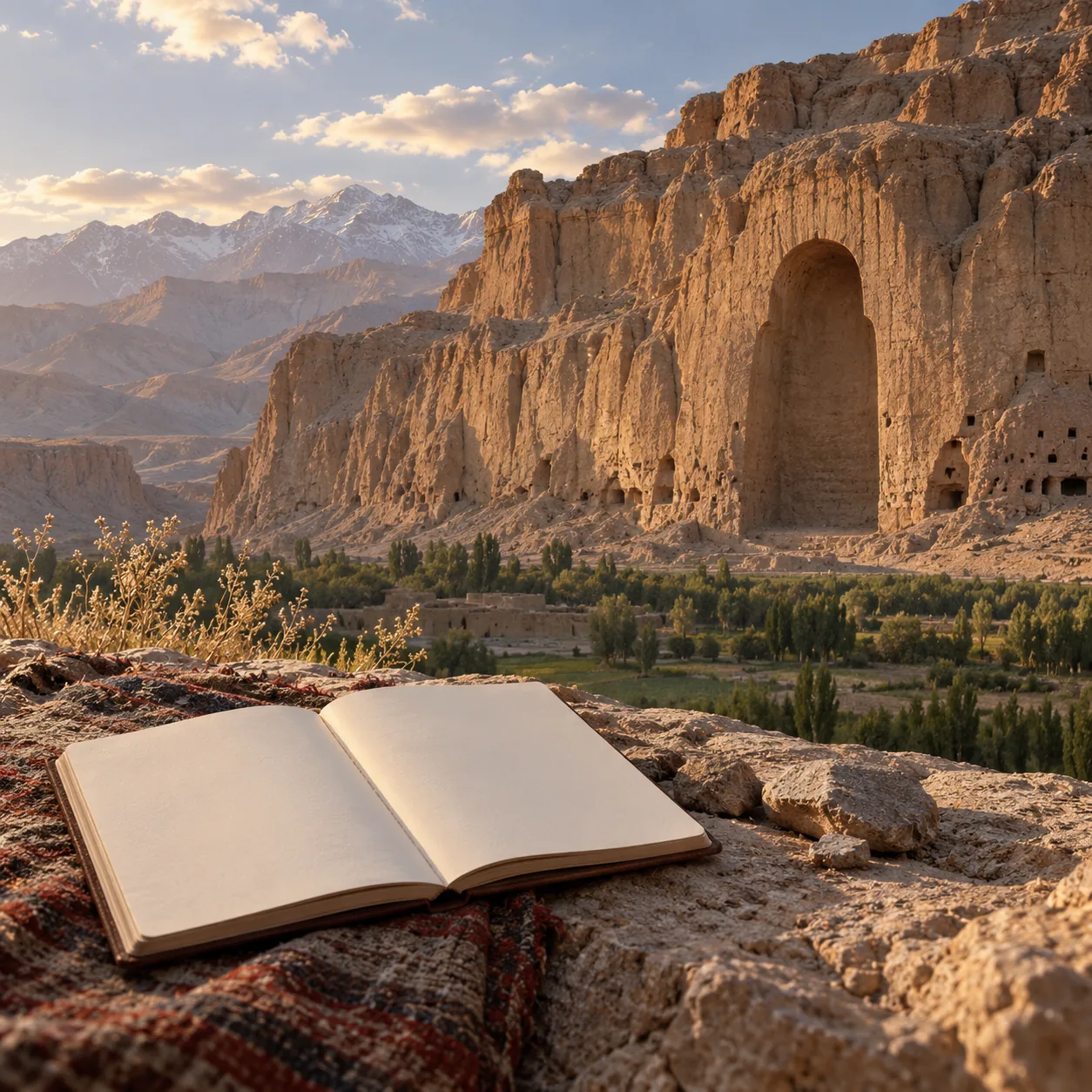
Generated interpretation, not documentary evidence. An invented empty cliff recess and blank notebook evoke loss and documentation; surrounding caves, mountains and textile are fictional, not site evidence.
Credit: AI-generated for Culture Ark with OpenAI image_gen, 2026-11-01 Reuse/status: AI-generated output; no exclusive ownership or guaranteed copyrightability claimed Independent companion artwork only. Underlying works, performer and trademark rights remain separate. No exclusive ownership or public-domain claim.
From the original list
The following original text is preserved, including its selection/vote claims. Preservation is not independent verification of every assertion.
Why: Giant Buddhas destroyed in 2001.
What to preserve: Before and after photos
Year and origin: 6th century · Afghanistan
Vote: 5/9 (historian 2 · future kid 1 · curator 2)
Learn more: Buddhas of Bamiyan on Wikipedia
Supplemental context
The Buddhas of Bamiyan belonged to a much wider cultural landscape of caves, paintings, monasteries and routes of exchange. UNESCO's account treats the valley as a layered historical place rather than only as two lost statues. The Taliban's destruction of the standing Buddhas in March 2001 was a major loss, but it did not erase every surviving element or the people connected to the landscape. Future readers should preserve before-and-after records with dates and viewpoints, alongside conservation debates and local perspectives. A generated image cannot fill the evidentiary gap left by destruction. The companion therefore emphasizes absence and documentation through a fictional cliff recess and blank notebook, avoiding a speculative sacred reconstruction or a sensational depiction of the attack.
Creator/community: Historic Buddhist communities and artists; contemporary Afghan custodians and communities Place/era: Bamiyan Valley, Afghanistan; ancient monuments destroyed in March 2001
Context and limits
The fictional recess is not a measured Bamiyan niche or before/after record. UNESCO’s property spans several periods; the original sixth-century shorthand does not date every component. Current access and conservation conditions are not asserted.
Where to learn more
- https://apiarybee.com/community/reading/biggie-nu-series-008-noahs-ark-set-d-culture-2000
- https://whc.unesco.org/en/list/208/
Apiary library | Original Culture Ark article
Public ID and individual routes: pending publisher allocation. Internal source ID: D-1524
Part of the Culture Ark: 2,000 things people should still be able to see in 2,000 years, picked by AI research teams. This page keeps the original list entry for D-1524 word for word and adds context. Browse the gallery. The Culture Ark is an Artificial Mind Hive (AMH) project. AMH is owned by Austin Little.

Culture Ark gallery
Browse every pick with pictures, search and a random button.
Open the gallery →