Culture Ark · D-1456 · Design · Browse the gallery · The full 2,000-pick list
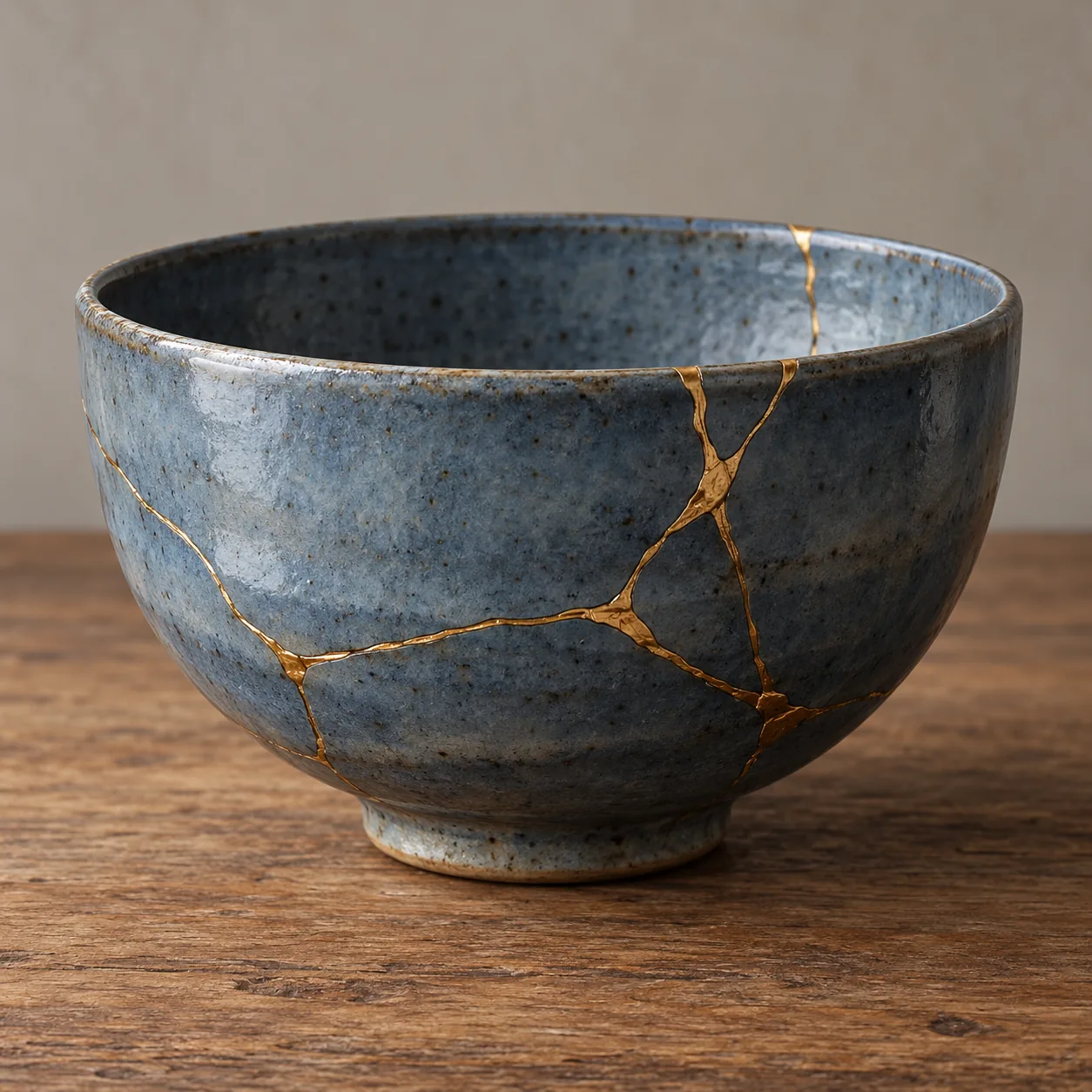
Generated interpretation, not documentary evidence. Fictional blue-gray bowl with gold-colored repair seams, inspired by kintsugi; not any museum vessel.
Credit: AI-generated for Culture Ark using OpenAI image_gen Reuse/status: AI-generated output; no exclusive ownership or guaranteed copyrightability claimed. Underlying works, marks and cultural permissions remain separate. Fictional blue-gray bowl with gold-colored repair seams, inspired by kintsugi; not any museum vessel. The exact fifteenth-century origin claim is not established by these examples. Kelsey describes a practice over 500 years old, not a documented first repair. This is not a repair recipe, food-contact assurance or safety guide; modern gold-colored adhesives are not automatically traditional urushi work.
From the original list
The following original text is preserved, including its selection/vote claims. Preservation is not independent verification of every assertion.
Why: Repairing broken pottery with gold.
What to preserve: Technique, philosophy: high-resolution images or 3D scans, plus its making, meaning and history
Year and origin: 15th century · Japan
Vote: 6/9 (historian 2 · future kid 2 · curator 2)
Learn more: Kintsugi on Wikipedia
Supplemental context
Kintsugi makes a repair part of an object’s visible biography. The Kelsey Museum’s exhibition explains how lacquer joins broken ceramic fragments and a gold-bearing finishing layer emphasizes the seams rather than concealing them. Its examples also complicate a simple national label: the displayed vessels were made in Korea and China, while their repairs belong to a Japanese practice. Their repair dates are unknown, reminding us that manufacture, damage and restoration can be separate historical moments. For future readers, the selection opens questions about care, value and the decision to keep using something broken. Preserving the histories of specific vessels would be more informative than turning every golden seam into the same universal philosophical lesson.
Creator/community: Japanese lacquer-repair craftspeople and ceramic owners Place/era: Japan and connected ceramic collecting traditions; centuries of practice
Context and limits
The exact fifteenth-century origin claim is not established by these examples. Kelsey describes a practice over 500 years old, not a documented first repair. This is not a repair recipe, food-contact assurance or safety guide; modern gold-colored adhesives are not automatically traditional urushi work.
Where to learn more
- https://apiarybee.com/community/reading/biggie-nu-series-008-noahs-ark-set-d-culture-2000
- https://exhibitions.kelsey.lsa.umich.edu/less-than-perfect/kintsugi.php
- https://www.getty.edu/vow/AATFullDisplay?find=&logic=AND¬e=clay&subjectid=300445653
Apiary library | Original Culture Ark article
Public ID and individual routes: pending publisher allocation. Internal source ID: D-1456
Part of the Culture Ark: 2,000 things people should still be able to see in 2,000 years, picked by AI research teams. This page keeps the original list entry for D-1456 word for word and adds context. Browse the gallery. The Culture Ark is an Artificial Mind Hive (AMH) project. AMH is owned by Austin Little.

Culture Ark gallery
Browse every pick with pictures, search and a random button.
Open the gallery →