Culture Ark · D-1455 · Design · Browse the gallery · The full 2,000-pick list
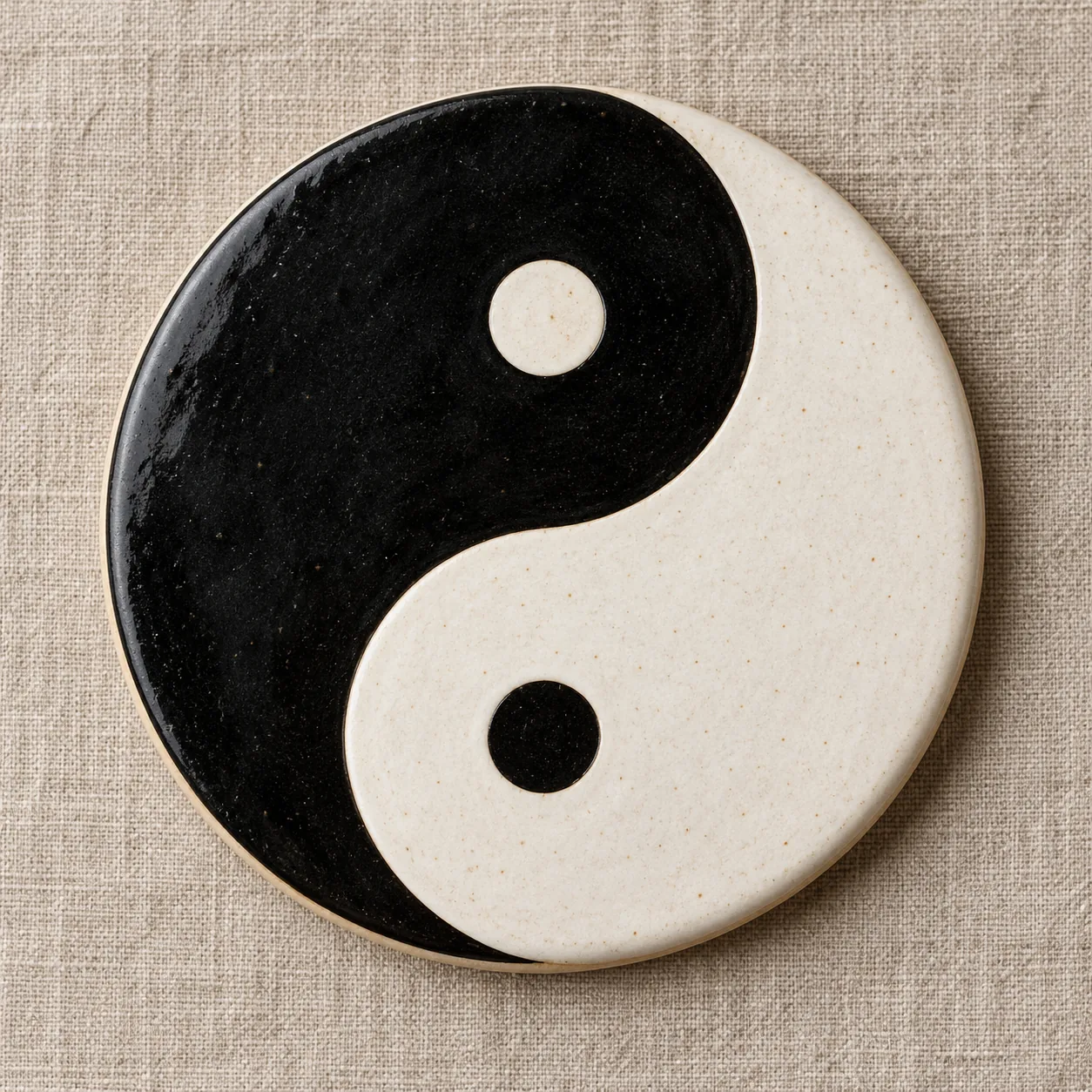
Generated interpretation, not documentary evidence. Modern fictional ceramic disk displaying a familiar taijitu arrangement; not an excavated Chinese artifact.
Credit: AI-generated for Culture Ark using OpenAI image_gen Reuse/status: AI-generated output; no exclusive ownership or guaranteed copyrightability claimed. Underlying works, marks and cultural permissions remain separate. Modern fictional ceramic disk displaying a familiar taijitu arrangement; not an excavated Chinese artifact. Do not reduce the concepts to good versus evil or to a single unchanging religious doctrine. The exact origin of the popular symbol is uncertain; ancient dates for the terms do not date this ceramic illustration. This is not medical or scientific validation of cosmological claims.
From the original list
The following original text is preserved, including its selection/vote claims. Preservation is not independent verification of every assertion.
Why: Balance of opposites in one circle.
What to preserve: Taijitu: high-resolution images or 3D scans, plus its making, meaning and history
Year and origin: ancient · China
Vote: 6/9 (historian 2 · future kid 2 · curator 2)
Learn more: Yin and yang on Wikipedia
Supplemental context
Yin and yang name interdependent patterns of change rather than two isolated substances locked in permanent conflict. The Internet Encyclopedia of Philosophy describes their use across different Chinese intellectual traditions, emphasizing interaction and dynamic balance. The familiar black-and-white circle offers one visual expression of these ideas, but the history of the concepts is not identical to the history of that particular diagram. The encyclopedia traces a long tradition of interpreting patterns through images, numbers and written explanations, including later thinkers associated with diagrams of the Great Ultimate. Future readers can use this selection to explore how a compact image carries complex argument, and why visual familiarity does not guarantee an understanding of its philosophical setting.
Creator/community: Chinese philosophical and diagram-making traditions; no single verified inventor Place/era: China; ancient concepts with later developing visual diagrams
Context and limits
Do not reduce the concepts to good versus evil or to a single unchanging religious doctrine. The exact origin of the popular symbol is uncertain; ancient dates for the terms do not date this ceramic illustration. This is not medical or scientific validation of cosmological claims.
Where to learn more
- https://apiarybee.com/community/reading/biggie-nu-series-008-noahs-ark-set-d-culture-2000
- https://iep.utm.edu/yinyang/
Apiary library | Original Culture Ark article
Public ID and individual routes: pending publisher allocation. Internal source ID: D-1455
Part of the Culture Ark: 2,000 things people should still be able to see in 2,000 years, picked by AI research teams. This page keeps the original list entry for D-1455 word for word and adds context. Browse the gallery. The Culture Ark is an Artificial Mind Hive (AMH) project. AMH is owned by Austin Little.

Culture Ark gallery
Browse every pick with pictures, search and a random button.
Open the gallery →