Culture Ark · D-1460 · Design · Browse the gallery · The full 2,000-pick list
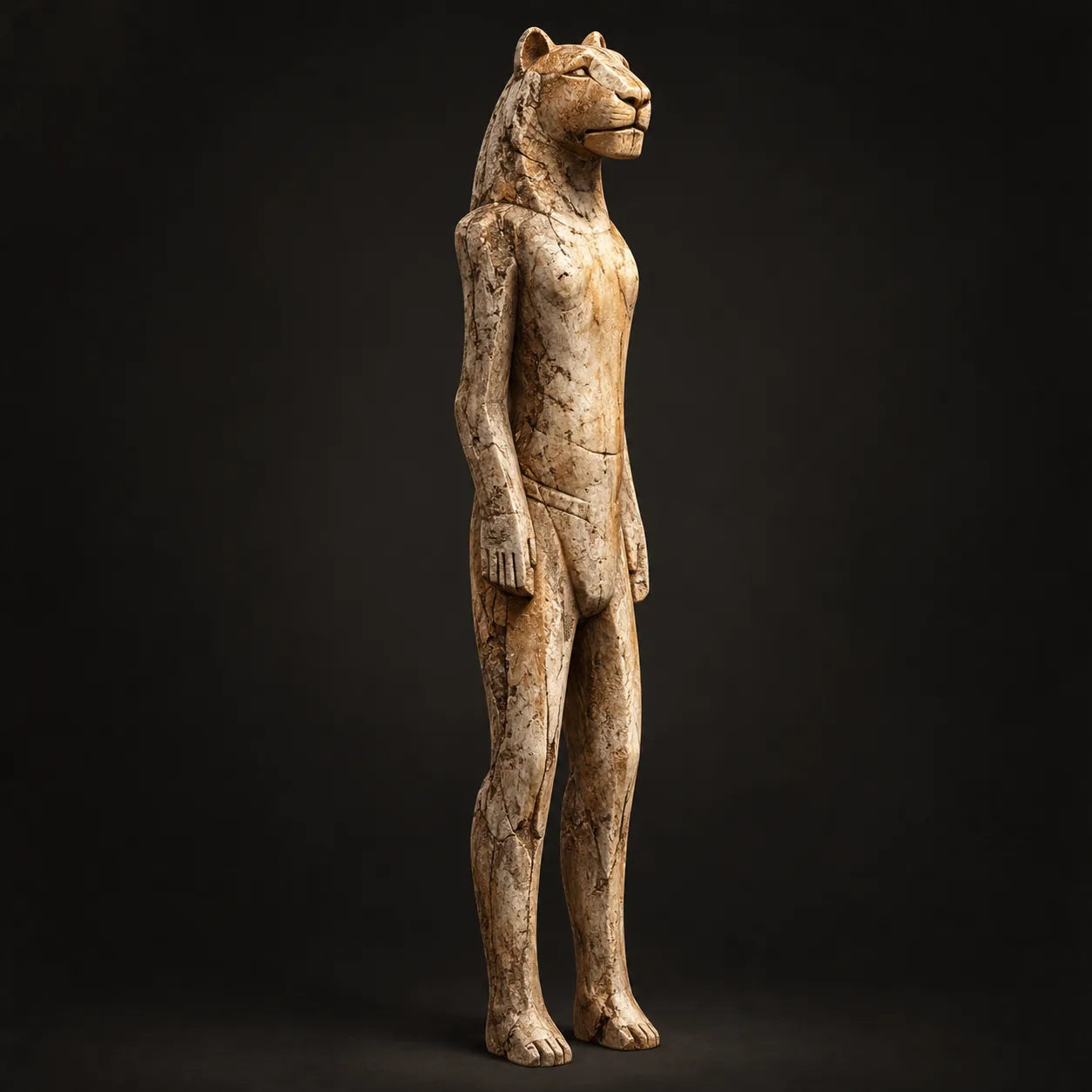
Generated interpretation, not documentary evidence. Free interpretive lion-human sculpture study with invented anatomy and surface; NOT an image or reconstruction of the actual Löwenmensch.
Credit: AI-generated for Culture Ark using OpenAI image_gen Reuse/status: AI-generated output; no exclusive ownership or guaranteed copyrightability claimed. Underlying works, marks and cultural permissions remain separate. Free interpretive lion-human sculpture study with invented anatomy and surface; NOT an image or reconstruction of the actual Löwenmensch. Earliest known imaginative sculpture is a stronger priority claim than needed and depends on definitions and discoveries. No specific deity, ritual or maker’s gender is established here. The generated hybrid is a FREE INTERPRETATION with invented facial details, anatomy, surface cracks and proportions, not the Löwenmensch artifact or a measured replica.
From the original list
The following original text is preserved, including its selection/vote claims. Preservation is not independent verification of every assertion.
Why: A lion-headed human: earliest known imaginative sculpture.
What to preserve: Ivory figure: high-resolution images or 3D scans, plus its making, meaning and history
Year and origin: c. 40,000 BP · Germany
Vote: 6/9 (historian 2 · future kid 2 · curator 2)
Learn more: Lion-man of Hohlenstein-Stadel on Wikipedia
Supplemental context
The Löwenmensch combines a feline head with an upright, human-like body. Museum Ulm identifies its material as mammoth ivory and places it in the Aurignacian period about 40,000 years ago. The museum’s interpretation stresses the unusual combination: unlike sculptures of animals recognizable in the surrounding world, this figure represents a hybrid being. It provides evidence that its maker could give material form to an imagined combination, but not a transcript of what that being meant. Future readers could use it to discuss the limits of interpreting very old images, the skill invested in carving and the role of reconstruction in presenting fragmentary objects. Its mystery is part of its historical value, not a gap to fill with invented certainty.
Creator/community: Unknown Upper Paleolithic carver; Museum Ulm research and conservation community Place/era: Hohlenstein-Stadel cave, Swabian Alb, present-day Germany; approximately 40,000 years ago
Context and limits
Earliest known imaginative sculpture is a stronger priority claim than needed and depends on definitions and discoveries. No specific deity, ritual or maker’s gender is established here. The generated hybrid is a FREE INTERPRETATION with invented facial details, anatomy, surface cracks and proportions, not the Löwenmensch artifact or a measured replica.
Where to learn more
- https://apiarybee.com/community/reading/biggie-nu-series-008-noahs-ark-set-d-culture-2000
- https://museumulm.de/wp-content/uploads/2024/12/M-Z_TextBook_EN.pdf
- https://museumulm.de/en/collections/archaeology/
Apiary library | Original Culture Ark article
Public ID and individual routes: pending publisher allocation. Internal source ID: D-1460
Part of the Culture Ark: 2,000 things people should still be able to see in 2,000 years, picked by AI research teams. This page keeps the original list entry for D-1460 word for word and adds context. Browse the gallery. The Culture Ark is an Artificial Mind Hive (AMH) project. AMH is owned by Austin Little.

Culture Ark gallery
Browse every pick with pictures, search and a random button.
Open the gallery →