Culture Ark · D-1453 · Design · Browse the gallery · The full 2,000-pick list
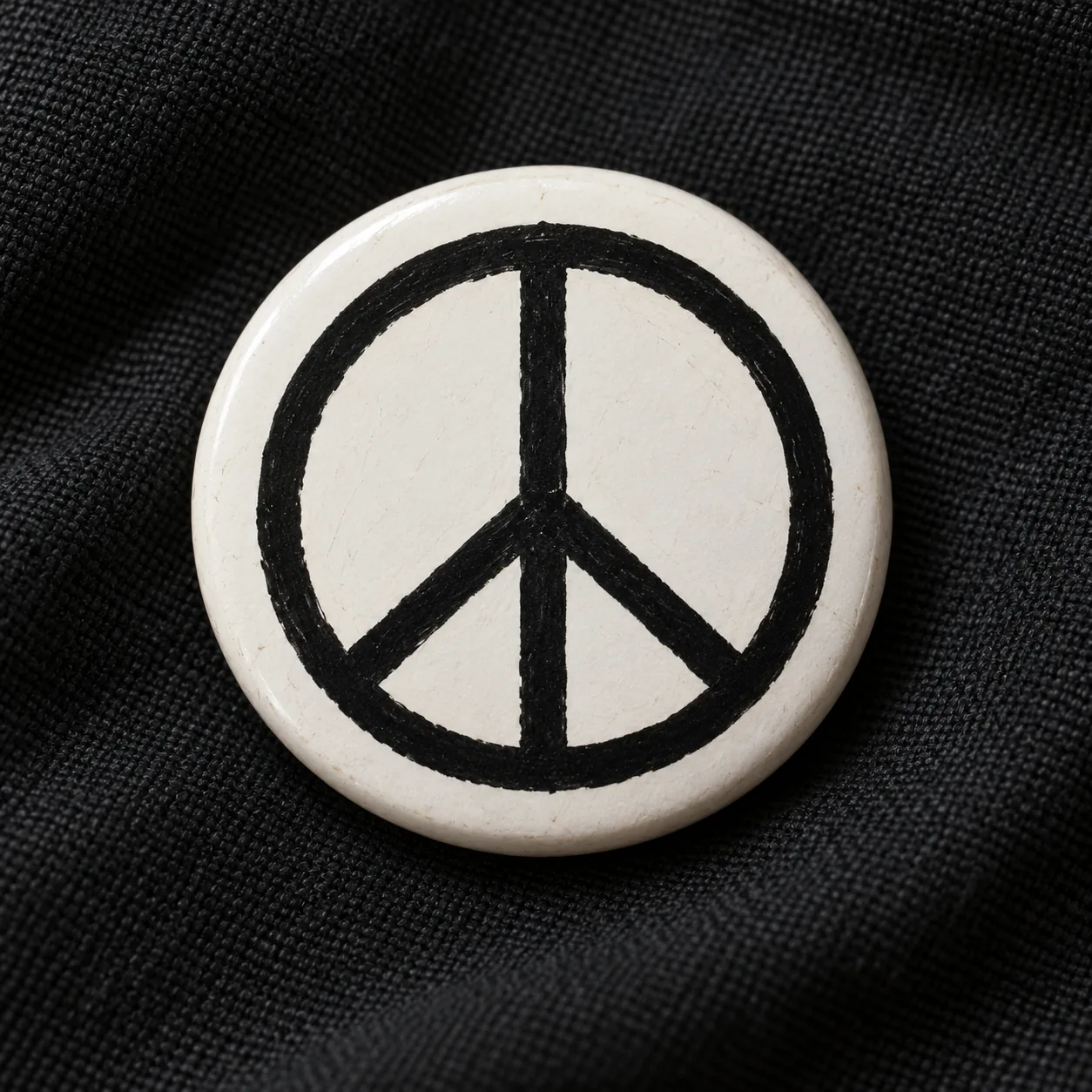
Generated interpretation, not documentary evidence. Fictional ceramic badge bearing the peace symbol; not a recovered 1958 badge.
Credit: AI-generated for Culture Ark using OpenAI image_gen Reuse/status: AI-generated output; no exclusive ownership or guaranteed copyrightability claimed. Underlying works, marks and cultural permissions remain separate. Fictional ceramic badge bearing the peace symbol; not a recovered 1958 badge. Universal is an overstatement: recognition and interpretation vary. CND documents both the semaphore account and Holtom’s personal explanation of despair. The badge is fictional, not an original march object or proof of participation.
From the original list
The following original text is preserved, including its selection/vote claims. Preservation is not independent verification of every assertion.
Why: Designed for nuclear disarmament, became a universal sign.
What to preserve: Gerald Holtom design, semaphore
Year and origin: 1958 · United Kingdom
Vote: 6/9 (historian 2 · future kid 2 · curator 2)
Learn more: Peace symbols on Wikipedia
Supplemental context
The familiar circular peace sign began with a specific demand: nuclear disarmament. CND’s own history credits designer Gerald Holtom in 1958 and explains its combination of semaphore letters N and D. The organization records its public appearance on the Easter march from London to Aldermaston, where cardboard signs and ceramic badges made the design portable. Its later circulation through protest, fashion and commercial imagery shows how a precise political message can become a broader visual vocabulary. Future readers would learn more by preserving the march context and Holtom’s explanation than by keeping only the outline. They could then ask how shared symbols retain, lose or transform their original political commitments.
Creator/community: Gerald Holtom; Direct Action Committee and Campaign for Nuclear Disarmament Place/era: United Kingdom; designed 1958, subsequently used internationally
Context and limits
Universal is an overstatement: recognition and interpretation vary. CND documents both the semaphore account and Holtom’s personal explanation of despair. The badge is fictional, not an original march object or proof of participation.
Where to learn more
- https://apiarybee.com/community/reading/biggie-nu-series-008-noahs-ark-set-d-culture-2000
- https://cnduk.org/the-symbol/
Apiary library | Original Culture Ark article
Public ID and individual routes: pending publisher allocation. Internal source ID: D-1453
Part of the Culture Ark: 2,000 things people should still be able to see in 2,000 years, picked by AI research teams. This page keeps the original list entry for D-1453 word for word and adds context. Browse the gallery. The Culture Ark is an Artificial Mind Hive (AMH) project. AMH is owned by Austin Little.

Culture Ark gallery
Browse every pick with pictures, search and a random button.
Open the gallery →