Culture Ark · D-1356 · Inventions · Browse the gallery · The full 2,000-pick list
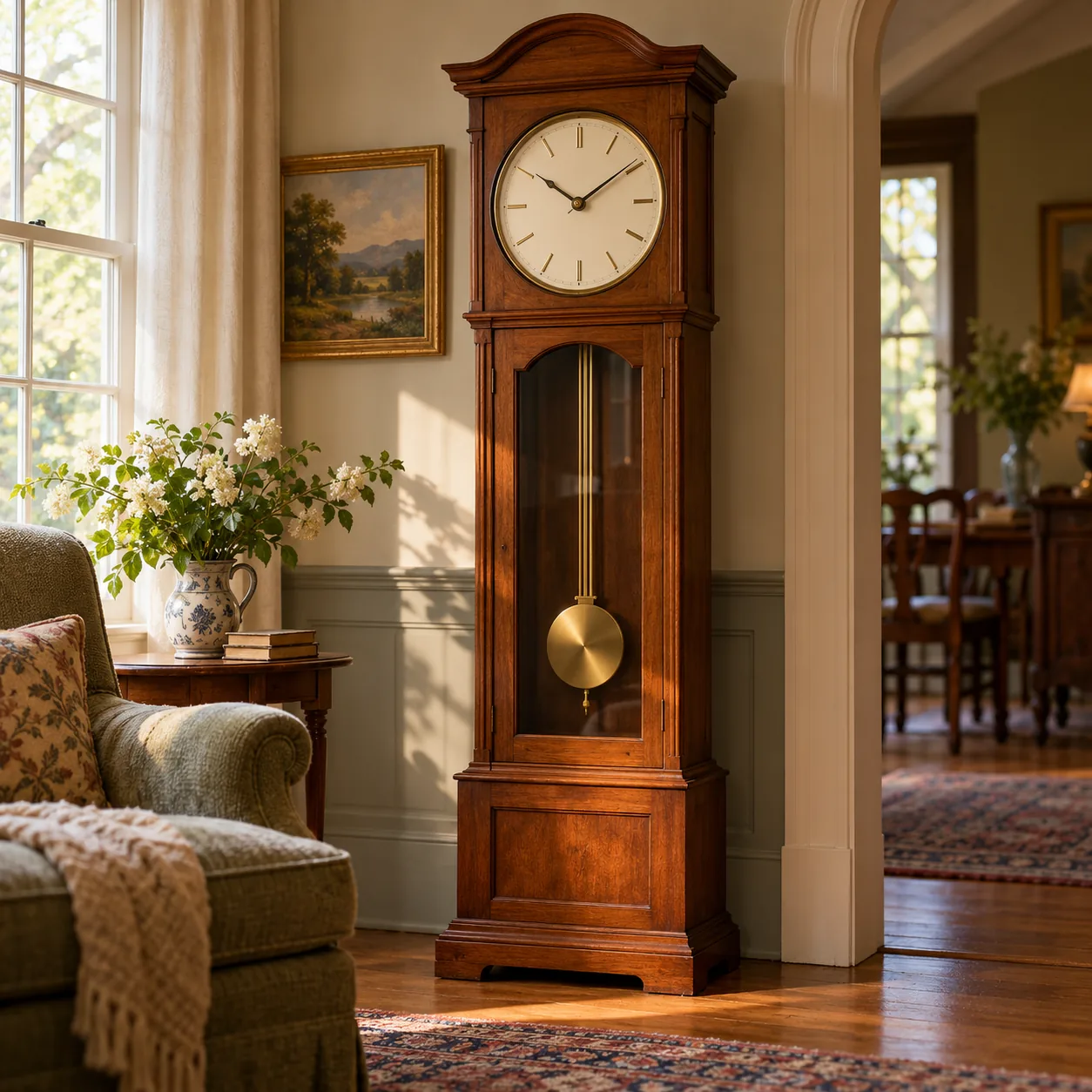
Generated interpretation, not documentary evidence. Generated longcase clock with visible pendulum in a fictional home; not Huygens’s prototype or the Bruce–Oosterwijck sea clock.
Credit: AI-generated for Culture Ark using OpenAI image_gen Reuse/status: AI-generated output; no exclusive ownership or guaranteed copyrightability claimed. Underlying works, marks and cultural permissions remain separate. Generated longcase clock with visible pendulum in a fictional home; not Huygens’s prototype or the Bruce–Oosterwijck sea clock. The original’s“300 years”is a broad summary, not a uniform worldwide duration or accuracy specification. Huygens’s development and later surviving clocks are distinct. The museum’s sea-clock example is not a grandfather clock. No navigation, repair or engineering instructions are supplied.
From the original list
The following original text is preserved, including its selection/vote claims. Preservation is not independent verification of every assertion.
Why: Precise timekeeping for 300 years.
What to preserve: Huygens design, grandfather clocks
Year and origin: 1656 · Netherlands
Vote: 4/9 (historian 2 · future kid 1 · curator 1)
Learn more: Pendulum clock on Wikipedia
Supplemental context
A pendulum clock connects repeated motion with the social expectation that time can be measured consistently. National Museums Scotland dates Huygens's practical pendulum clock to 1656, then follows a less triumphant extension of the idea: attempts to keep accurate time aboard ships. Its Bruce–Oosterwijck clock was commissioned in 1662, and initially encouraging trial reports did not produce the hoped-for maritime solution. This is useful cultural evidence because it interrupts a simple story of inevitable progress. Future readers can see that instruments have careers involving experiment, reputation, profit and later reinterpretation. Domestic longcase clocks also give this technology a different setting, where a visible pendulum can become part of a room's rhythms and inherited furnishings.
Creator/community: Christiaan Huygens and collaborating clockmakers; many later makers and households Place/era: Netherlands,1656 development; later domestic and scientific timekeeping
Context and limits
The original’s“300 years”is a broad summary, not a uniform worldwide duration or accuracy specification. Huygens’s development and later surviving clocks are distinct. The museum’s sea-clock example is not a grandfather clock. No navigation, repair or engineering instructions are supplied.
Where to learn more
- https://apiarybee.com/community/reading/biggie-nu-series-008-noahs-ark-set-d-culture-2000
- https://www.nms.ac.uk/discover-catalogue/calculating-longitude-at-sea-the-clock-that-tried-to-solve-the-problem
Apiary library | Original Culture Ark article
Public ID and individual routes: pending publisher allocation. Internal source ID: D-1356
Part of the Culture Ark: 2,000 things people should still be able to see in 2,000 years, picked by AI research teams. This page keeps the original list entry for D-1356 word for word and adds context. Browse the gallery. The Culture Ark is an Artificial Mind Hive (AMH) project. AMH is owned by Austin Little.

Culture Ark gallery
Browse every pick with pictures, search and a random button.
Open the gallery →