Culture Ark · D-1359 · Inventions · Browse the gallery · The full 2,000-pick list
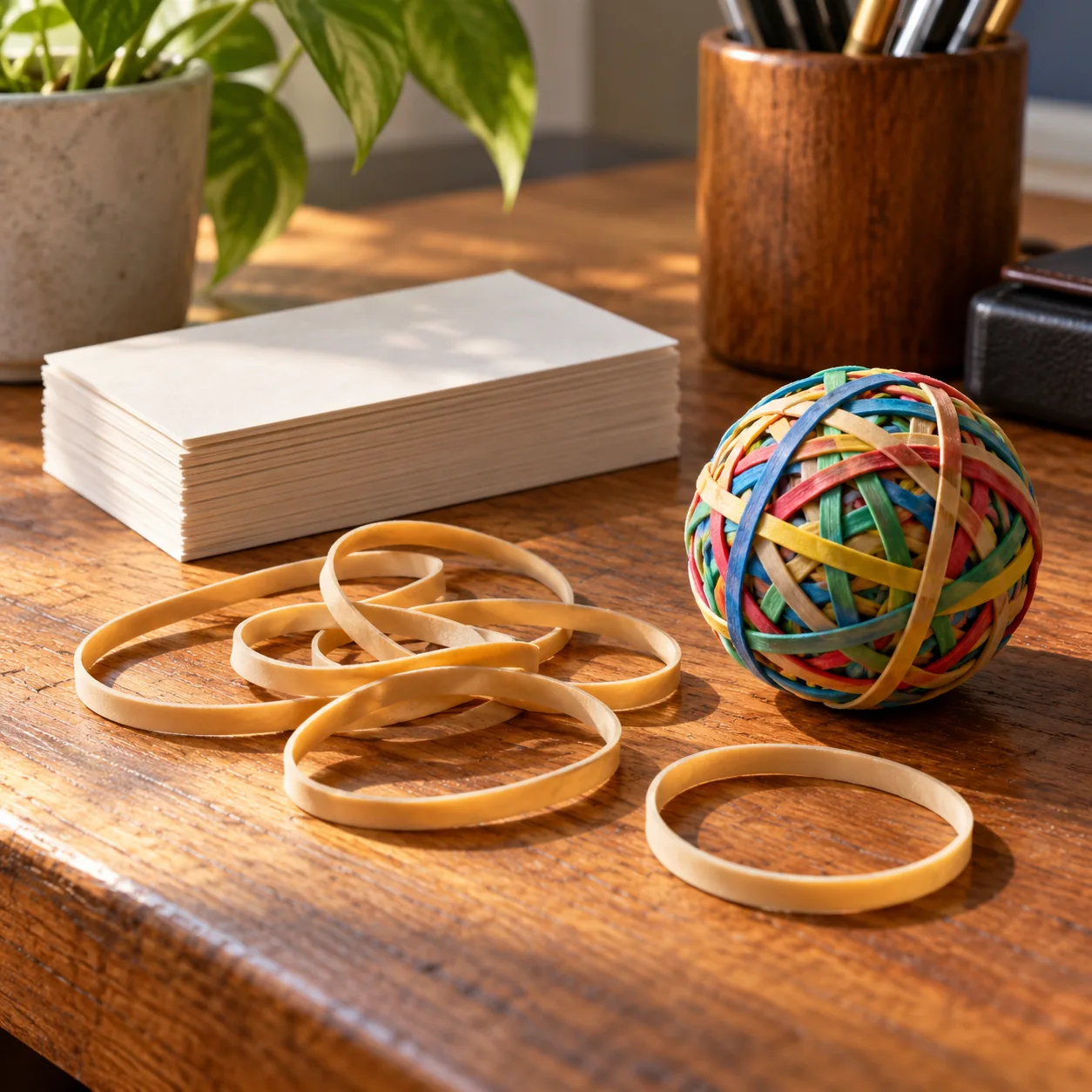
Generated interpretation, not documentary evidence. Generated ordinary elastic loops and a rubber-band ball beside blank cards; not a patent reconstruction or performance-tested material.
Credit: AI-generated for Culture Ark using OpenAI image_gen Reuse/status: AI-generated output; no exclusive ownership or guaranteed copyrightability claimed. Underlying works, marks and cultural permissions remain separate. Generated ordinary elastic loops and a rubber-band ball beside blank cards; not a patent reconstruction or performance-tested material. The patent is a specific British legal milestone, not the beginning of human knowledge of rubber. Daft’s co-credit corrects a lone-inventor simplification. A historical patent transcription is not modern production, medical or materials-safety guidance; no manufacturing instructions are reproduced.
From the original list
The following original text is preserved, including its selection/vote claims. Preservation is not independent verification of every assertion.
Why: Small elastic loops with endless uses.
What to preserve: Perry patent, rubber band balls
Year and origin: 1845 · United Kingdom
Vote: 4/9 (historian 1 · future kid 2 · curator 1)
Learn more: Rubber band on Wikipedia
Supplemental context
A rubber band is easy to overlook because its work is small: gathering loose things into a temporary whole. The 1845 British patent associated with this selection names both Stephen Perry and Thomas Barnabas Daft. Its text describes improvements involving elastic bands while explicitly distinguishing those claims from the preparation of rubber itself. That distinction is culturally instructive: a familiar object's history may concern a particular form or application rather than a material being invented from nothing. Future readers could place elastic loops beside bundled correspondence, packaging and improvised collections to understand ordinary habits of organizing. A rubber-band ball adds a playful possibility, turning a useful fastener into something accumulated, handled and displayed for its own sake.
Creator/community: Stephen Perry and Thomas Barnabas Daft for the1845British patent; many rubber producers and users Place/era: Britain,1845 patent milestone; later everyday office and household use
Context and limits
The patent is a specific British legal milestone, not the beginning of human knowledge of rubber. Daft’s co-credit corrects a lone-inventor simplification. A historical patent transcription is not modern production, medical or materials-safety guidance; no manufacturing instructions are reproduced.
Where to learn more
- https://apiarybee.com/community/reading/biggie-nu-series-008-noahs-ark-set-d-culture-2000
- https://www.todayinsci.com/Events/Misc/Perry-ElasticBandsPatent.htm
- https://assets.cambridge.org/97810092/68851/excerpt/9781009268851_excerpt.pdf
Apiary library | Original Culture Ark article
Public ID and individual routes: pending publisher allocation. Internal source ID: D-1359
Part of the Culture Ark: 2,000 things people should still be able to see in 2,000 years, picked by AI research teams. This page keeps the original list entry for D-1359 word for word and adds context. Browse the gallery. The Culture Ark is an Artificial Mind Hive (AMH) project. AMH is owned by Austin Little.

Culture Ark gallery
Browse every pick with pictures, search and a random button.
Open the gallery →