Culture Ark · D-1320 · Inventions · Browse the gallery · The full 2,000-pick list
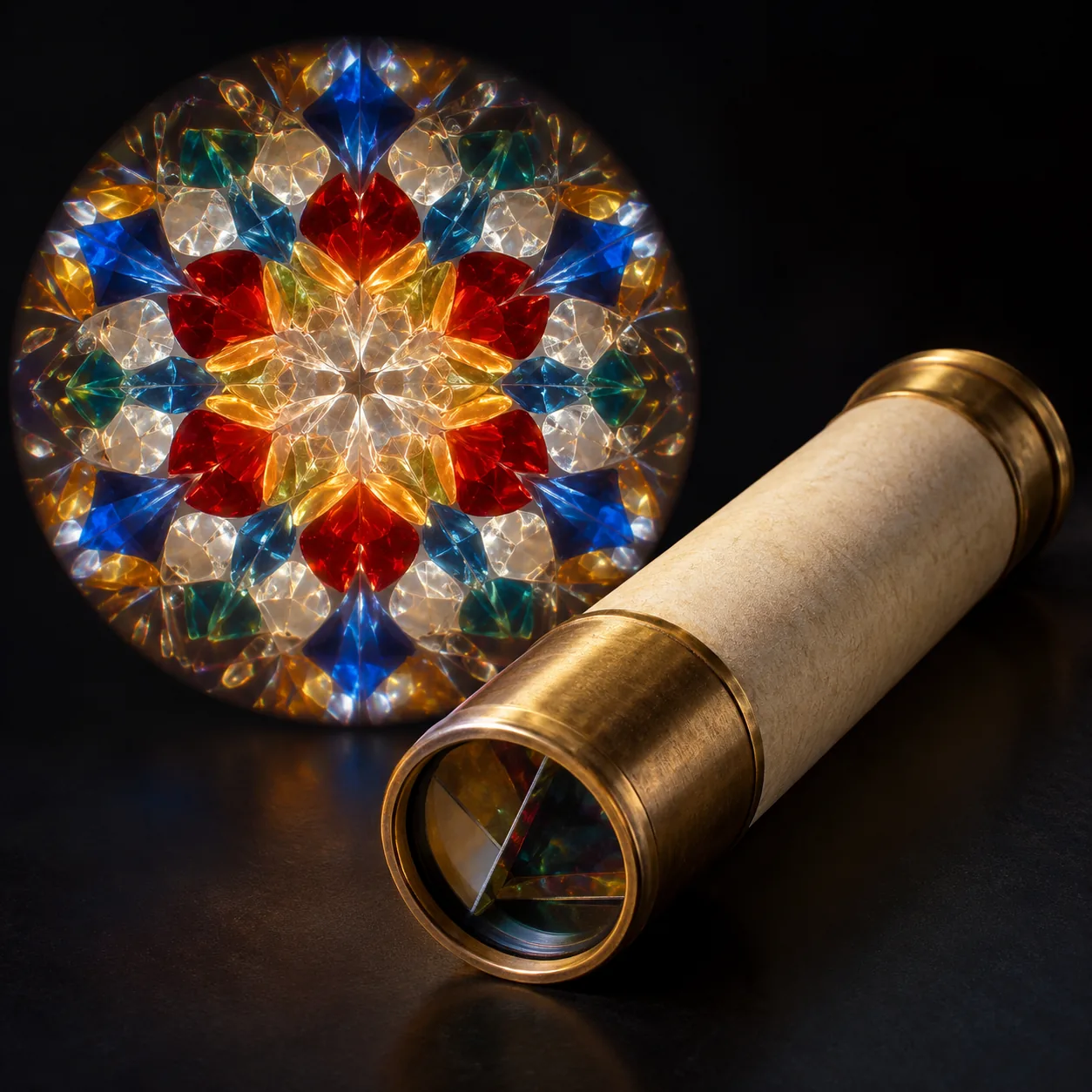
Generated interpretation, not documentary evidence. Generated kaleidoscope-like tube with a separate artistic symmetrical pattern; not an authenticated Brewster instrument, actual photographed view or ray-tracing diagram.
Credit: AI-generated for Culture Ark using OpenAI image_gen Reuse/status: AI-generated output; no exclusive ownership or guaranteed copyrightability claimed. Underlying works, marks and cultural permissions remain separate. Generated kaleidoscope-like tube with a separate artistic symmetrical pattern; not an authenticated Brewster instrument, actual photographed view or ray-tracing diagram. The original 1816 date is retained but the consulted research reports Brewster’s own 1814 claim and an 1817 patent/release; these milestones are not interchangeable. Earlier reflection principles complicate first-ever claims. The generated pattern is an artistic illustration, not a verified optical output or precise mirror-angle diagram.
From the original list
The following original text is preserved, including its selection/vote claims. Preservation is not independent verification of every assertion.
Why: Mirrors and coloured glass make endless patterns.
What to preserve: Brewster's design: high-resolution images or 3D scans, plus its making, meaning and history
Year and origin: 1816 · United Kingdom
Vote: 5/9 (historian 1 · future kid 3 · curator 1)
Learn more: Kaleidoscope on Wikipedia
Supplemental context
A kaleidoscope turns reflected fragments into patterns that change as the viewer moves the instrument. Research published by the Science Museum Group places David Brewster’s device within the business of optical entertainment and emphasizes Philip Carpenter’s manufacturing role. It distinguishes the 1817 patent and release from earlier ideas and describes both instruments with colored object cells and versions that transformed views of external scenes. Future readers can learn that science and amusement were not neatly separate markets: an optical instrument could be educational, fashionable and pleasurable at once. The changing pattern also makes the viewer part of the experience. Preserving only one decorative image would miss the relationship among movement, reflection and repeated visual surprise that made the toy engaging.
Creator/community: David Brewster, optician Philip Carpenter and later optical-toy makers and users Place/era: Britain;early nineteenth-century optical research, 1817 patent and commercial craze
Context and limits
The original 1816 date is retained but the consulted research reports Brewster’s own 1814 claim and an 1817 patent/release; these milestones are not interchangeable. Earlier reflection principles complicate first-ever claims. The generated pattern is an artistic illustration, not a verified optical output or precise mirror-angle diagram.
Where to learn more
- https://apiarybee.com/community/reading/biggie-nu-series-008-noahs-ark-set-d-culture-2000
- https://journal.sciencemuseum.ac.uk/article/philip-carpenter/
Apiary library | Original Culture Ark article
Public ID and individual routes: pending publisher allocation. Internal source ID: D-1320
Part of the Culture Ark: 2,000 things people should still be able to see in 2,000 years, picked by AI research teams. This page keeps the original list entry for D-1320 word for word and adds context. Browse the gallery. The Culture Ark is an Artificial Mind Hive (AMH) project. AMH is owned by Austin Little.

Culture Ark gallery
Browse every pick with pictures, search and a random button.
Open the gallery →