Culture Ark · D-1314 · Inventions · Browse the gallery · The full 2,000-pick list
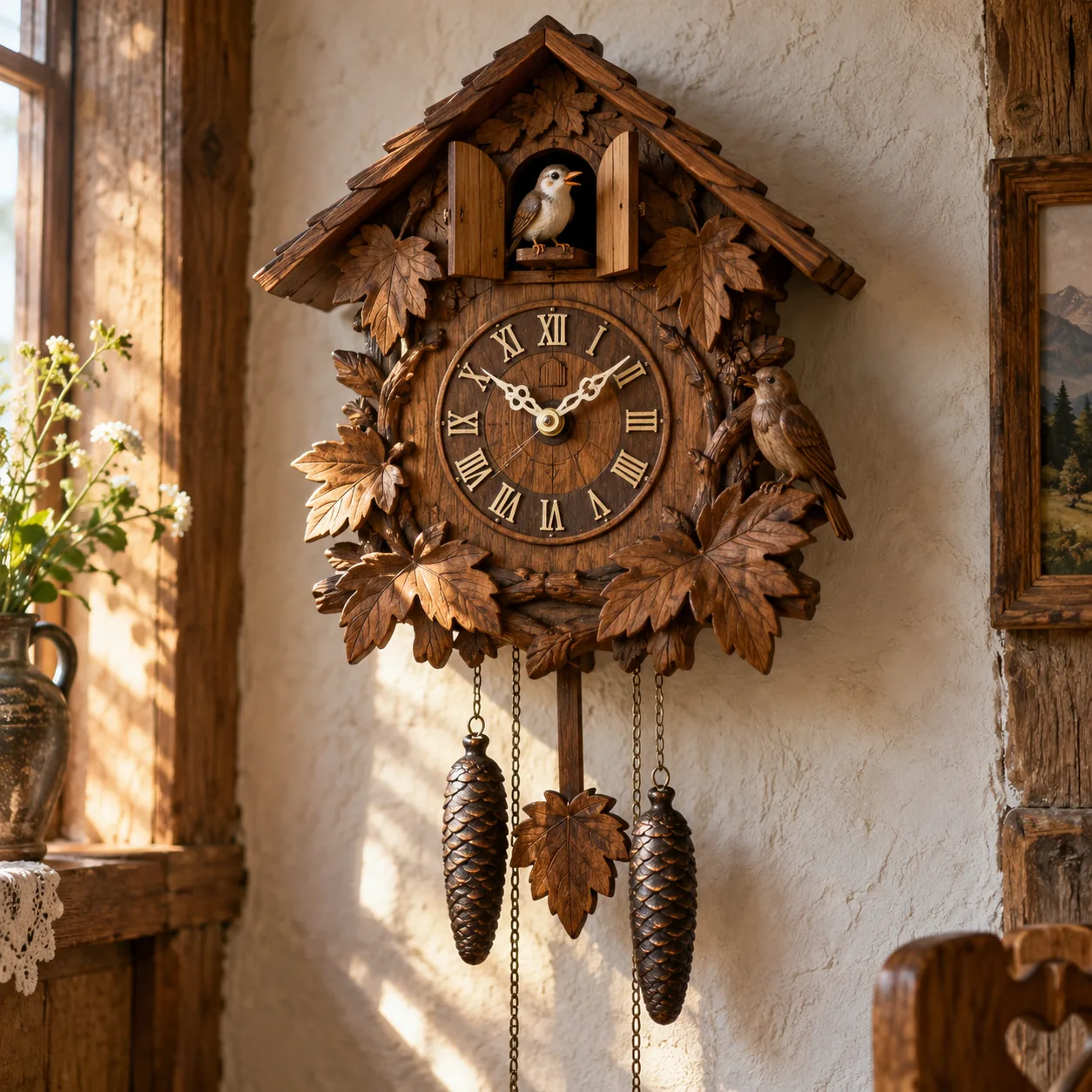
Generated interpretation, not documentary evidence. Generated Black Forest-inspired carved cuckoo clock; invented case and staged emerging bird, not an authenticated historic model or mechanism diagram.
Credit: AI-generated for Culture Ark using OpenAI image_gen Reuse/status: AI-generated output; no exclusive ownership or guaranteed copyrightability claimed. Underlying works, marks and cultural permissions remain separate. Generated Black Forest-inspired carved cuckoo clock; invented case and staged emerging bird, not an authenticated historic model or mechanism diagram. The eighteenth-century origin label is shorthand, not proof that the complete familiar form appeared then. Museum sources distinguish earlier cuckoo mechanisms from nineteenth-century cases. The bird and hands in the generated picture are staged together, not evidence of a functioning hourly sequence or accurate mechanism.
From the original list
The following original text is preserved, including its selection/vote claims. Preservation is not independent verification of every assertion.
Why: A bird pops out to announce the hour.
What to preserve: Black Forest carving, cuckoo call
Year and origin: 18th century · Germany
Vote: 5/9 (historian 1 · future kid 3 · curator 1)
Learn more: Cuckoo clock on Wikipedia
Supplemental context
A cuckoo clock makes time audible and theatrical, joining a clock face with a small recurring performance. The Saarland clock museum cautions that the identity of the first maker is unclear and records earlier examples of mechanical cuckoo sounds. The Deutsches Uhrenmuseum explains how Friedrich Eisenlohr’s railway-house-inspired design emerged from an 1850 call for improved clock cases. Later carving, woodland animals and pinecone-shaped weights helped form the souvenir image now associated with the Black Forest. Future readers can therefore distinguish an older sound mechanism from the later visual identity of a familiar object. The clock is valuable as evidence of domestic decoration, regional craft marketing and the transformation of an everyday time signal into entertainment.
Creator/community: Black Forest clockmakers and carvers; Friedrich Eisenlohr among influential case designers Place/era: German-speaking clock traditions; nineteenth-century Black Forest house-shaped design development
Context and limits
The eighteenth-century origin label is shorthand, not proof that the complete familiar form appeared then. Museum sources distinguish earlier cuckoo mechanisms from nineteenth-century cases. The bird and hands in the generated picture are staged together, not evidence of a functioning hourly sequence or accurate mechanism.
Where to learn more
- https://apiarybee.com/community/reading/biggie-nu-series-008-noahs-ark-set-d-culture-2000
- https://guide.uhrenmuseum.saarland/monitor9/9-3/
- https://blog.deutsches-uhrenmuseum.de/2017/07/27/bahnhaeusle1/
Apiary library | Original Culture Ark article
Public ID and individual routes: pending publisher allocation. Internal source ID: D-1314
Part of the Culture Ark: 2,000 things people should still be able to see in 2,000 years, picked by AI research teams. This page keeps the original list entry for D-1314 word for word and adds context. Browse the gallery. The Culture Ark is an Artificial Mind Hive (AMH) project. AMH is owned by Austin Little.

Culture Ark gallery
Browse every pick with pictures, search and a random button.
Open the gallery →