Culture Ark · D-1042 · Language and humor · Browse the gallery · The full 2,000-pick list
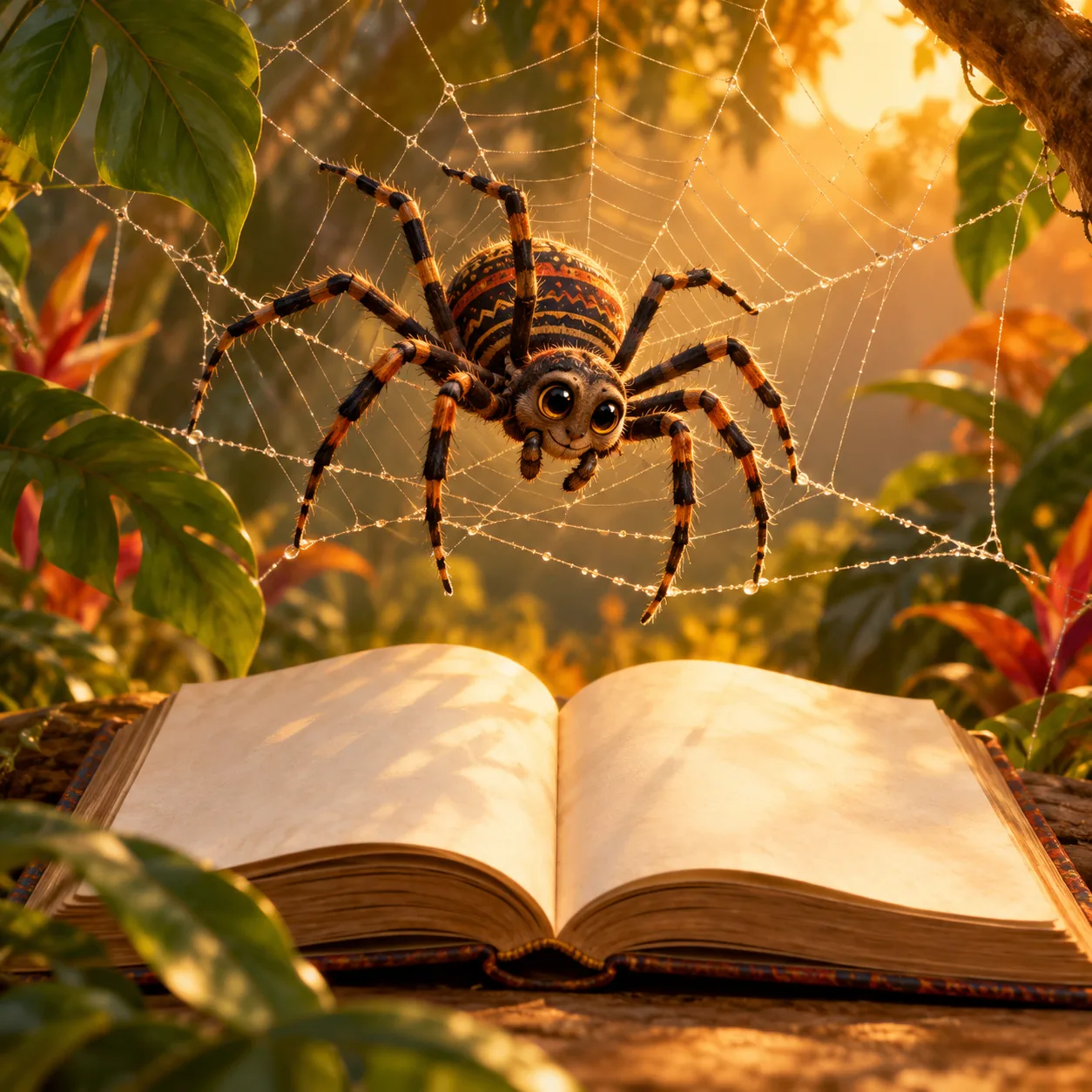
Generated interpretation, not documentary evidence. Invented friendly spider, web and blank book; a storytelling metaphor, not an authenticated traditional depiction.
Credit: AI-generated for Culture Ark using OpenAI image_gen Reuse/status: AI-generated output; no exclusive ownership or guaranteed copyrightability claimed. Underlying works, marks and cultural permissions remain separate. Invented friendly spider, web and blank book; a storytelling metaphor, not an authenticated traditional depiction. The original 1700 date is not verified as the beginning of Anansi storytelling. Akan heritage, diaspora transmission and specific modern adaptations should not be collapsed into one timeless version. The generated spider is a storybook invention, not an ethnographic artifact or a zoologically precise species illustration; modern recordings and artworks have separate rights.
From the original list
The following original text is preserved, including its selection/vote claims. Preservation is not independent verification of every assertion.
Why: The spider trickster of Akan stories, carried to the Caribbean.
What to preserve: key tales, the Caribbean versions
Year and origin: 1700 · Ghana
Vote: 7/9 (historian 2 · future kid 2 · curator 3)
Learn more: Anansi on Wikipedia
Supplemental context
Anansi stories preserve more than the adventures of a clever spider. They carry relationships among tellers, listeners, elders and the places where families remember hearing them. The Natural History Museum's community project credits storyteller Mama D Ujuaje, young artists and Caribbean elders, providing identifiable voices rather than treating folklore as anonymous raw material. Its spelling Ananse is one of several forms used for the character. Future readers can compare how wisdom, mistakes and resourcefulness are presented in different tellings without demanding a single definitive version. The invented spider and blank book symbolize narrative possibilities, while the linked community films provide a route toward actual voices and their contexts.
Creator/community: Akan and African-diaspora storytellers; individual tellers including Mama D Ujuaje Place/era: West African heritage and Caribbean diasporic traditions; contemporary community storytelling in London
Context and limits
The original 1700 date is not verified as the beginning of Anansi storytelling. Akan heritage, diaspora transmission and specific modern adaptations should not be collapsed into one timeless version. The generated spider is a storybook invention, not an ethnographic artifact or a zoologically precise species illustration; modern recordings and artworks have separate rights.
Where to learn more
- https://apiarybee.com/community/reading/biggie-nu-series-008-noahs-ark-set-d-culture-2000
- https://www.nhm.ac.uk/discover/ananse.html
- https://www.youtube.com/watch?v=2dtQktmByGc
- https://www.youtube.com/watch?v=e8zr69l1Q_k
Apiary library | Original Culture Ark article
Public ID and individual routes: pending publisher allocation. Internal source ID: D-1042
Part of the Culture Ark: 2,000 things people should still be able to see in 2,000 years, picked by AI research teams. This page keeps the original list entry for D-1042 word for word and adds context. Browse the gallery. The Culture Ark is an Artificial Mind Hive (AMH) project. AMH is owned by Austin Little.

Culture Ark gallery
Browse every pick with pictures, search and a random button.
Open the gallery →