Culture Ark · D-1041 · Language and humor · Browse the gallery · The full 2,000-pick list
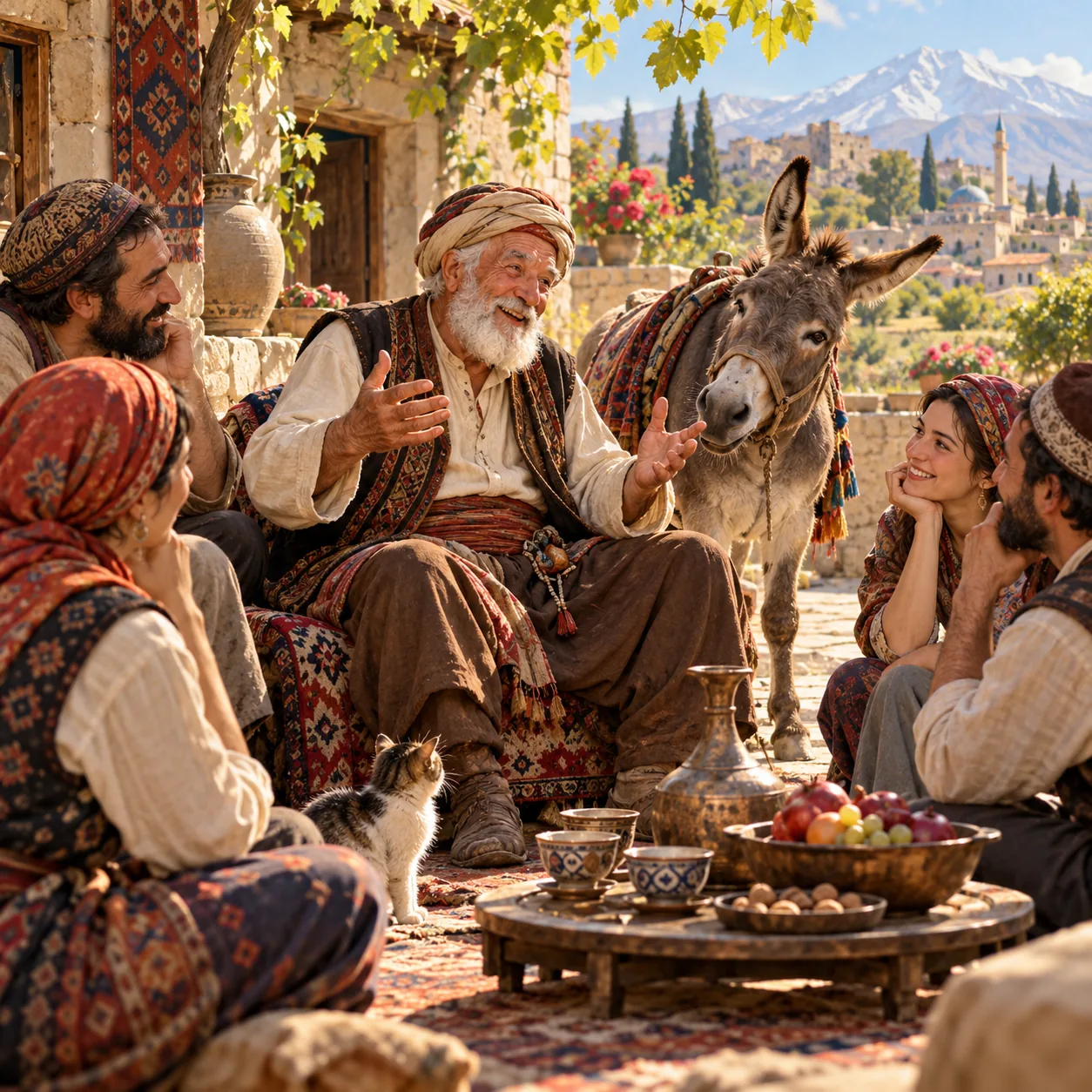
Generated interpretation, not documentary evidence. Imagined storyteller, listeners and donkey in a courtyard; not a historical portrait, authenticated costume or actual festival.
Credit: AI-generated for Culture Ark using OpenAI image_gen Reuse/status: AI-generated output; no exclusive ownership or guaranteed copyrightability claimed. Underlying works, marks and cultural permissions remain separate. Imagined storyteller, listeners and donkey in a courtyard; not a historical portrait, authenticated costume or actual festival. The original 1250 and Turkey label is retained as published, not certified as the precise origin of all these stories. The tradition is shared across borders and no single costume, festival or character portrait represents every version. The generated people, architecture and clothing are fictional; this is not documentation of an Akşehir event.
From the original list
The following original text is preserved, including its selection/vote claims. Preservation is not independent verification of every assertion.
Why: A wise fool whose short stories are told from the Balkans to China.
What to preserve: key stories, the Akşehir festival
Year and origin: 1250 · Turkey
Vote: 7/9 (historian 2 · future kid 2 · curator 3)
Learn more: Nasreddin on Wikipedia
Supplemental context
Nasreddin belongs to a living family of anecdotes rather than a single fixed book. ICH Courier describes related traditions in seven countries, with different names, images and stories but shared uses of humor and wisdom. A short joke can become an argument in everyday conversation, a proverb or a performed lesson about social behavior. Future readers should preserve the storyteller's language, audience and timing alongside any written plot summary. Those details show how a seemingly foolish character can expose the foolishness of others. The illustration imagines a convivial storytelling setting; it does not establish what a historical Nasreddin looked like or what every participating community wears.
Creator/community: Storytelling communities across Anatolia, Central Asia and neighboring regions; many local narrators Place/era: Long-lived oral and written traditions; multinational UNESCO inscription in 2022
Context and limits
The original 1250 and Turkey label is retained as published, not certified as the precise origin of all these stories. The tradition is shared across borders and no single costume, festival or character portrait represents every version. The generated people, architecture and clothing are fictional; this is not documentation of an Akşehir event.
Where to learn more
- https://apiarybee.com/community/reading/biggie-nu-series-008-noahs-ark-set-d-culture-2000
- https://ichcourier.unesco-ichcap.org/board.es?act=view&b_list=12&bid=A102&list_no=672&mid=a10202000000
Apiary library | Original Culture Ark article
Public ID and individual routes: pending publisher allocation. Internal source ID: D-1041
Part of the Culture Ark: 2,000 things people should still be able to see in 2,000 years, picked by AI research teams. This page keeps the original list entry for D-1041 word for word and adds context. Browse the gallery. The Culture Ark is an Artificial Mind Hive (AMH) project. AMH is owned by Austin Little.

Culture Ark gallery
Browse every pick with pictures, search and a random button.
Open the gallery →