Culture Ark · D-1043 · Language and humor · Browse the gallery · The full 2,000-pick list
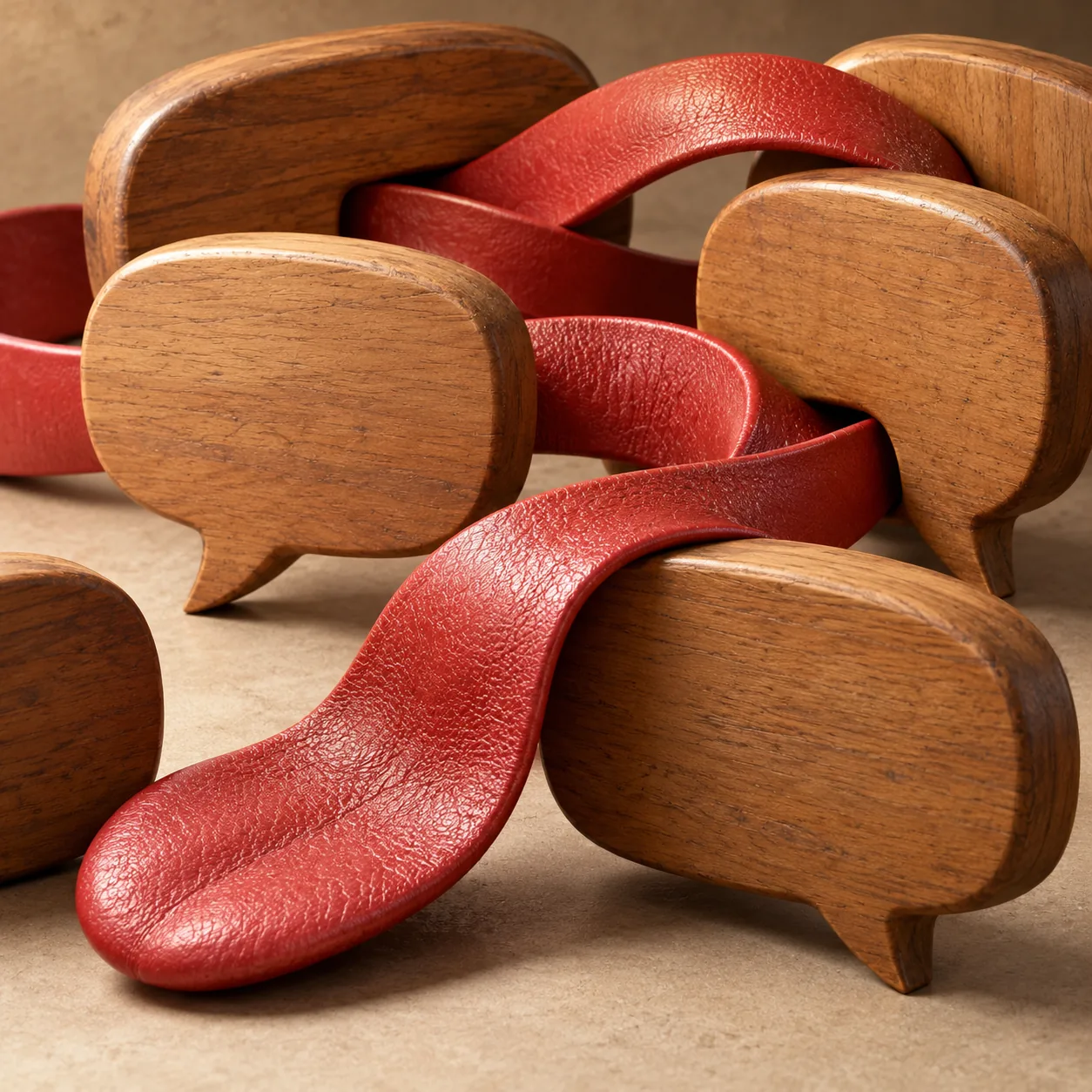
Generated interpretation, not documentary evidence. Imagined red tongue-shaped ribbon among wooden speech bubbles; playful metaphor, not anatomy or speech-test evidence.
Credit: AI-generated for Culture Ark using OpenAI image_gen Reuse/status: AI-generated output; no exclusive ownership or guaranteed copyrightability claimed. Underlying works, marks and cultural permissions remain separate. Imagined red tongue-shaped ribbon among wooden speech bubbles; playful metaphor, not anatomy or speech-test evidence. The original 1813 United Kingdom marker does not establish the invention of the entire practice, and occurrence in every language is not demonstrated here. Difficulty varies with language experience and task. Tongue twisters are not diagnostic tests, intelligence measures or grounds for mocking speech differences. The red ribbon is a fabricated object, not human anatomy.
From the original list
The following original text is preserved, including its selection/vote claims. Preservation is not independent verification of every assertion.
Why: Phrases made to trip the tongue, enjoyed in every language.
What to preserve: examples in many languages
Year and origin: 1813 · United Kingdom
Vote: 7/9 (historian 2 · future kid 3 · curator 2)
Learn more: Tongue twister on Wikipedia
Supplemental context
A tongue twister turns ordinary speaking into a small performance of difficulty. Its pleasure comes from trying, slipping and trying again, often in front of people who know how the phrase is meant to sound. A primary research paper by Goldrick and colleagues uses controlled tongue-twister sequences to examine speech errors, showing that this familiar game can also become an experimental tool. That does not make every playground example a laboratory test. Future readers can preserve recordings, accents, pace and participants' own explanations, because a printed sentence alone cannot capture the challenge. The winding ribbon offers a visual metaphor for verbal entanglement without presenting a medical diagram or invented acoustic data.
Creator/community: Speakers, language-play communities and makers of particular phrases Place/era: Many language communities and periods; also used in modern speech research
Context and limits
The original 1813 United Kingdom marker does not establish the invention of the entire practice, and occurrence in every language is not demonstrated here. Difficulty varies with language experience and task. Tongue twisters are not diagnostic tests, intelligence measures or grounds for mocking speech differences. The red ribbon is a fabricated object, not human anatomy.
Where to learn more
- https://apiarybee.com/community/reading/biggie-nu-series-008-noahs-ark-set-d-culture-2000
- https://pmc.ncbi.nlm.nih.gov/articles/PMC4749438/
Apiary library | Original Culture Ark article
Public ID and individual routes: pending publisher allocation. Internal source ID: D-1043
Part of the Culture Ark: 2,000 things people should still be able to see in 2,000 years, picked by AI research teams. This page keeps the original list entry for D-1043 word for word and adds context. Browse the gallery. The Culture Ark is an Artificial Mind Hive (AMH) project. AMH is owned by Austin Little.

Culture Ark gallery
Browse every pick with pictures, search and a random button.
Open the gallery →