Culture Ark · D-1046 · Language and humor · Browse the gallery · The full 2,000-pick list
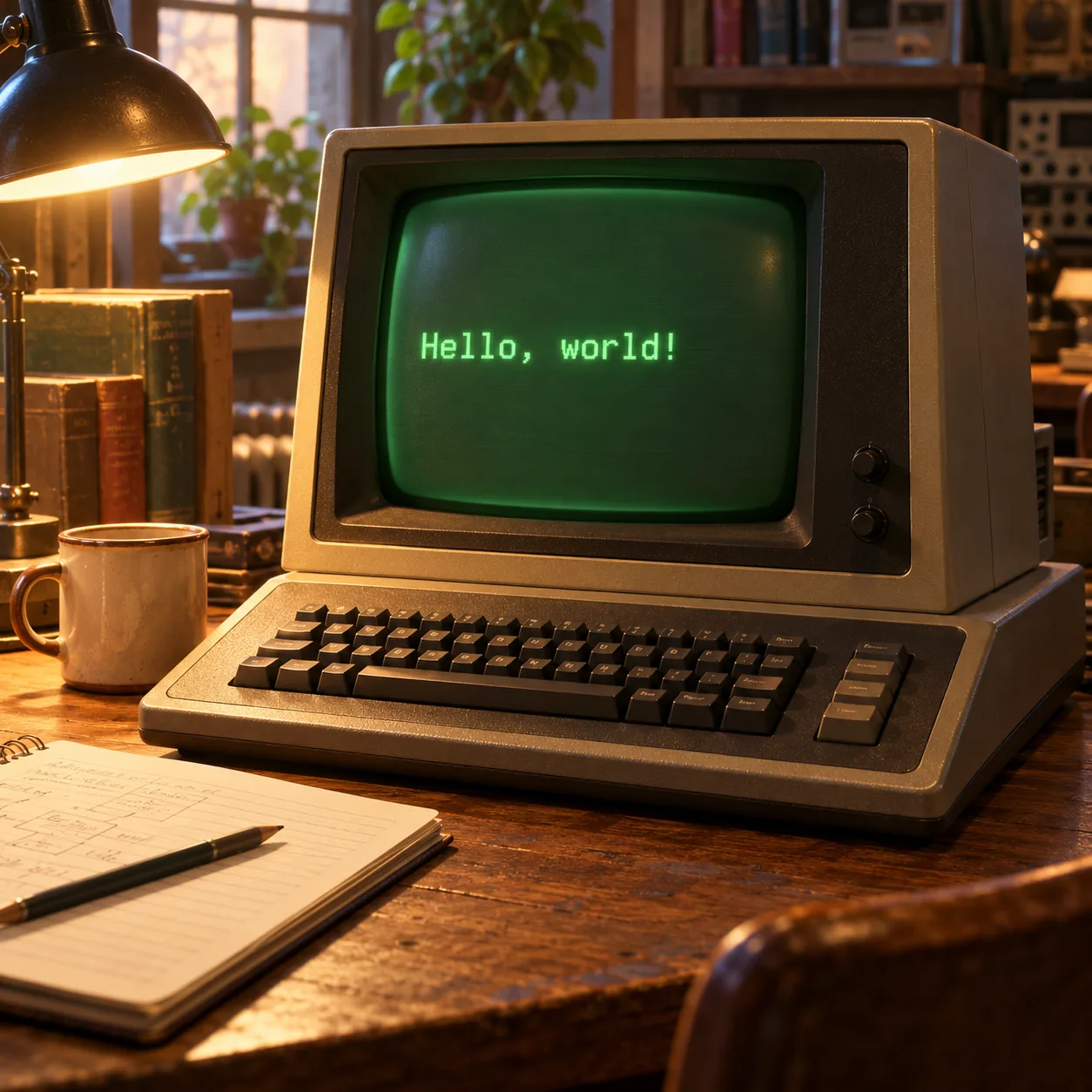
Generated interpretation, not documentary evidence. Imagined vintage-style terminal displaying Hello, world!; not the original Bell Labs hardware or first program output.
Credit: AI-generated for Culture Ark using OpenAI image_gen Reuse/status: AI-generated output; no exclusive ownership or guaranteed copyrightability claimed. Underlying works, marks and cultural permissions remain separate. Imagined vintage-style terminal displaying Hello, world!; not the original Bell Labs hardware or first program output. Not everyone begins programming with this example. Capitalization, punctuation and source code vary by language and edition; the image shows a familiar variant, not a facsimile of Kernighan's original. The interview page supports attribution but this package does not independently settle every early tutorial date. Hardware, keyboard and notebook are imagined; no executable instructions are presented.
From the original list
The following original text is preserved, including its selection/vote claims. Preservation is not independent verification of every assertion.
Why: The first program people write to greet the world.
What to preserve: Kernighan's example
Year and origin: 1972 · United States
Vote: 7/9 (historian 2 · future kid 2 · curator 3)
Learn more: Hello, world on Wikipedia
Supplemental context
Hello, world! is a tiny output with a large social role: it announces that a learner has made a computing environment respond. Microsoft's interview with Brian Kernighan connects the familiar phrase to its author and to the educational setting in which it spread. The program is worth preserving here as an initiation ritual and shared joke, not as a survival manual. Future readers can ask why so many communities repeat an uncomplicated greeting when introducing a new language or tool. The generated terminal evokes the satisfaction of seeing those words appear, but it is deliberately not a reconstruction of the first machine, first listing or exact teaching environment.
Creator/community: Brian Kernighan and generations of programming teachers and learners Place/era: Bell Labs teaching examples in the early 1970 s; later international programming culture
Context and limits
Not everyone begins programming with this example. Capitalization, punctuation and source code vary by language and edition; the image shows a familiar variant, not a facsimile of Kernighan's original. The interview page supports attribution but this package does not independently settle every early tutorial date. Hardware, keyboard and notebook are imagined; no executable instructions are presented.
Where to learn more
- https://apiarybee.com/community/reading/biggie-nu-series-008-noahs-ark-set-d-culture-2000
- https://learn.microsoft.com/en-us/shows/ask-the-expert/ask-the-expert-hello-brian-a-conversation-with-dr-brian-kernighan-creator-of-hello-world
Apiary library | Original Culture Ark article
Public ID and individual routes: pending publisher allocation. Internal source ID: D-1046
Part of the Culture Ark: 2,000 things people should still be able to see in 2,000 years, picked by AI research teams. This page keeps the original list entry for D-1046 word for word and adds context. Browse the gallery. The Culture Ark is an Artificial Mind Hive (AMH) project. AMH is owned by Austin Little.

Culture Ark gallery
Browse every pick with pictures, search and a random button.
Open the gallery →